ToolMage
Sign in

Best 1 Emoji Creation AI tools for Image Generation

Popular Emoji Creation AI tools in Image Generation include AI Emoji, helping you work more efficiently.

AI Emoji
Freemium

AI Emoji

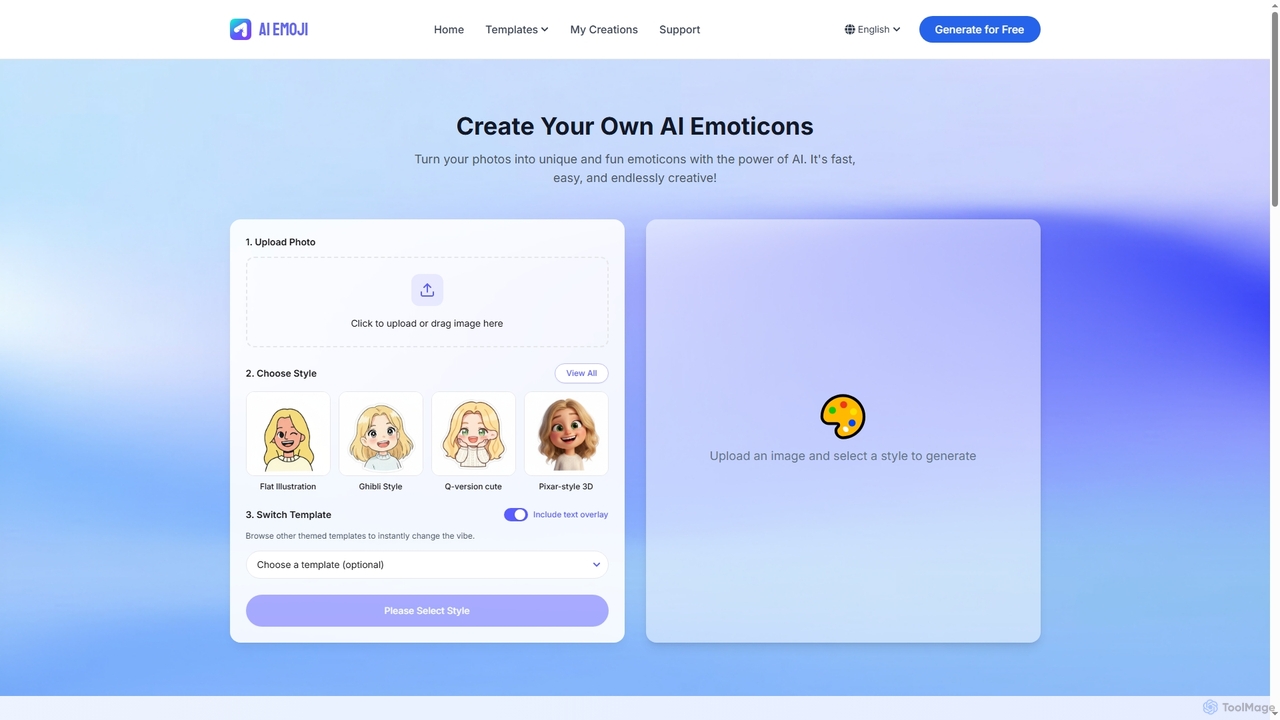
AI Emoji is an innovative online tool that transforms your photos into unique, personalized emoticons using advanced artificial intelligence. It offers a fast, easy, and creative way to generate custom emojis in various artistic styles for enhanced digital communication.

Personalization
Visits 6KFavorites 91Likes 96

About Emoji Creation

Emoji Creation tools are AI-powered platforms designed to generate unique and expressive emojis from text descriptions, image inputs, or even existing emoji styles. These tools leverage advanced generative AI models to transform abstract concepts or specific themes into diverse visual styles, offering a rapid and creative way to personalize digital communication. They enable users to quickly produce custom icons for messaging apps, social media, and branding materials, significantly enhancing visual engagement and brand identity across various digital touchpoints. This sub-category of Image Generation specifically focuses on the compact, symbolic visual language of emojis.

Core Features

  • Text-to-Emoji Generation: Convert written prompts into custom emoji designs, allowing for endless creative possibilities based on simple descriptions.
  • Image-to-Emoji Conversion: Transform photos or illustrations into stylized emoji formats, perfect for creating personalized icons from real-world subjects.
  • Style Customization: Adjust visual elements like color palettes, facial expressions, background elements, and artistic styles to match specific aesthetic requirements.
  • Batch Creation: Generate multiple emoji variations or a series of related emojis simultaneously, ideal for building comprehensive emoji packs or exploring diverse design options efficiently.
  • Vector Export: Export emojis in scalable vector graphics (SVG) formats, ensuring high-quality resolution for versatile use across different platforms and sizes without pixelation.

Applicable Scenarios

These AI-powered tools are invaluable across a spectrum of digital activities. Content creators, for instance, can leverage them to infuse unique visual flair into their blog posts, videos, and social media updates, making their content more engaging and shareable. Marketing professionals find immense value in designing custom brand emojis for targeted campaigns, fostering stronger brand recognition and a playful connection with their audience. Furthermore, individuals can personalize their chat experiences by creating bespoke emojis of their pets, inside jokes, or specific reactions, enriching personal communication. Developers and UI/UX designers also benefit by rapidly prototyping and generating consistent sets of small, expressive icons for mobile applications, websites, and software interfaces, ensuring a cohesive visual language throughout their products. The ability to quickly generate a diverse range of expressive visuals makes these tools a cornerstone for modern digital communication and design.

Key Selection Criteria

When selecting an Emoji Creation tool, several critical factors should guide your decision to ensure it meets your specific needs. Firstly, consider the range of customization options available; a robust tool should allow for fine-tuning of colors, expressions, styles, and background elements. Secondly, evaluate the quality and consistency of the generated output, looking for tools that produce high-resolution, visually appealing emojis that maintain a cohesive aesthetic across different generations. Supported export formats are also crucial; ensure it offers formats like PNG for raster images and SVG for scalable vector graphics, providing flexibility for various applications. Ease of use is paramount, especially for non-designers, so look for intuitive interfaces and straightforward workflows. Additionally, assess the variety of pre-set styles and templates if you need quick starting points. For larger projects, features like batch processing and integration capabilities with other design or communication platforms can significantly enhance efficiency. Finally, consider the pricing model (subscription, one-time purchase, free tier) and the availability of community support or tutorials.

Emoji Creation use cases

1

Creating Custom Brand Emojis for Marketing

Marketing teams can utilize AI emoji creation tools to design unique emojis that reflect their brand's identity, products, or campaign themes. By inputting brand keywords and style guides, they can generate a set of distinctive emojis for social media posts, ad creatives, and internal communications, fostering brand recognition and engagement in a playful, memorable way. This helps differentiate their content from competitors and strengthens brand presence across digital channels.

2

Personalizing Chat and Messaging Experiences

Individual users or small communities can create highly personalized emoji sets for their favorite messaging apps. Whether it's emojis of pets, inside jokes, or specific reactions, these tools allow for quick generation from photos or text prompts. This enhances personal expression and makes conversations more engaging and unique among friends or within private groups, fostering a stronger sense of identity and belonging.

3

Developing Unique Icons for App and UI Design

UI/UX designers can leverage emoji creation AI to rapidly prototype and generate a consistent set of small, expressive icons for mobile applications, websites, or software interfaces. Instead of manually designing each icon, designers can specify themes or emotions, generating multiple variations that maintain a cohesive visual style, significantly speeding up the design iteration process for user interface elements and ensuring brand consistency.

4

Enhancing Educational Content with Visual Cues

Educators and content creators can design custom emojis to represent complex concepts, emotions, or characters in educational materials. For instance, creating a specific emoji for "photosynthesis" or "gravity" can make learning more engaging and help students, especially younger ones, visually associate with abstract ideas. This adds a fun, memorable element to lessons, presentations, and digital worksheets, improving comprehension and retention.

5

Generating Reaction Emojis for Live Streams and Events

Streamers, event organizers, and community managers can use these tools to create unique reaction emojis tailored to their specific content or audience. During live streams or virtual events, custom emojis allow viewers to express nuanced feedback beyond standard options, fostering a stronger sense of community and interaction. This provides a distinct visual language for their platform, making engagement more dynamic and personalized.

6

Crafting Expressive Emojis for Digital Comics and Storytelling

Digital comic artists and storytellers can generate a wide array of expressive emojis to convey character emotions or narrative beats in their work. Instead of drawing each small expression from scratch, they can use AI to quickly produce variations of joy, surprise, anger, or confusion, ensuring consistency and saving significant time in the visual storytelling process, adding depth to character interactions and emotional impact.

Emoji Creation FAQ

What are AI Emoji Creation tools?

AI Emoji Creation tools are specialized platforms that use artificial intelligence, particularly generative adversarial networks (GANs) or diffusion models, to automatically design and generate custom emojis. Users typically provide text prompts, image inputs, or select style parameters, and the AI produces unique, expressive icons. These tools streamline the process of creating personalized visual communication assets for various digital contexts, from social media to messaging apps, offering a quick way to enhance digital expression.

How do AI Emoji Creation tools work?

These tools operate by processing user inputs through sophisticated AI models trained on vast datasets of images and emojis. When a user provides a text description (e.g., "happy cat emoji") or uploads an image, the AI interprets the request and generates a new emoji that matches the specified style, emotion, or subject. Advanced features often include style transfer, color palette adjustments, and resolution scaling to refine the output, ensuring the emoji perfectly matches the user's vision.

What are the key benefits of using AI for emoji creation?

The primary benefits include speed, creativity, and consistency. AI tools can generate emojis in seconds, significantly faster than manual design, allowing for rapid iteration. They can also explore a wider range of creative variations and styles that a human designer might not immediately conceive, fostering innovation. Furthermore, AI helps maintain a consistent visual style across a large set of emojis, which is crucial for branding and user interface design, ensuring a cohesive digital presence.

Can I customize the emojis generated by AI tools?

Yes, most AI Emoji Creation tools offer extensive customization options. Users can typically refine the generated emojis by adjusting parameters such as color schemes, facial expressions, background elements, and artistic styles. Many platforms also allow for iterative generation, where users can provide feedback on initial outputs to guide the AI towards a more desired final design, ensuring the emoji perfectly matches their vision and specific project requirements.

What's the difference between AI Emoji Creation and general AI Image Generation?

While AI Emoji Creation is a subset of general AI Image Generation, its focus is highly specialized. General AI Image Generation can produce a wide array of images, from photorealistic scenes to abstract art, with varying sizes and complexities. Emoji Creation, however, is specifically optimized for generating small, symbolic, and highly expressive icons, often with simplified aesthetics and a focus on conveying emotion or concept efficiently. It prioritizes compactness and immediate recognition over detailed realism, making it distinct within the broader field.