ToolMage
Sign in

Best 1 Cloud Services AI tools for Infrastructure

Popular Cloud Services AI tools in Infrastructure include Not Diamond, helping you work more efficiently.

Not Diamond
Freemium

Not Diamond

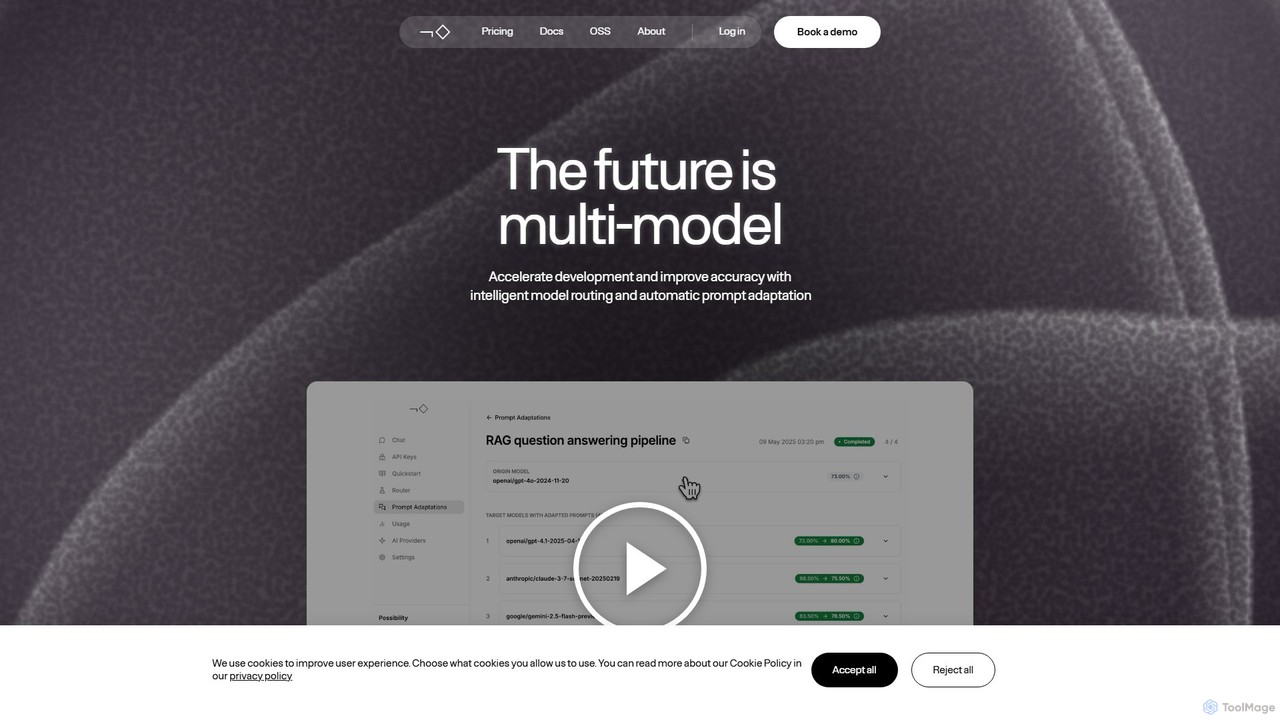
Not Diamond is an intelligent multi-model infrastructure for developers. It uses predictive model routing and automatic prompt adaptation to help teams accelerate development, improve AI accuracy, and optimize costs by dynamically selecting the best large language model (LLM) for any given task.

Llm Orchestration
Visits 71.4KFavorites 129Likes 137

About Cloud Services

AI Cloud Services are platforms that provide on-demand computing power, specialized tools, and infrastructure for developing, training, and deploying artificial intelligence models. These services leverage vast, scalable data centers to offer access to high-performance resources like GPUs and TPUs, which are essential for intensive AI workloads. They enable developers and businesses to build sophisticated AI applications without the massive upfront investment in physical hardware. This approach accelerates innovation by providing managed environments, pre-trained models via APIs, and comprehensive MLOps tools to streamline the entire machine learning lifecycle.

Core Features

  • GPU/TPU Compute Instances: Provides on-demand access to powerful processors optimized for parallel processing, significantly speeding up model training.
  • Managed ML Platforms: Offers integrated environments (e.g., Amazon SageMaker, Google Vertex AI) that cover data preparation, model building, training, and deployment.
  • Pre-trained AI APIs: Delivers ready-to-use models for tasks like image recognition, natural language processing, and speech-to-text, accessible via simple API calls.
  • Scalable Data Storage: Includes object storage and data lake solutions designed to handle petabyte-scale datasets required for training large models.
  • MLOps Tooling: Features tools for version control, automated workflows, model monitoring, and continuous integration/deployment (CI/CD) for machine learning.

Use Cases

AI Cloud Services are crucial for technology startups and research labs that need to train large-scale models without owning a supercomputer. Enterprises across finance, healthcare, and retail use these platforms to deploy fraud detection systems, medical imaging analysis tools, and personalized recommendation engines. Individual developers also leverage these services to integrate advanced AI capabilities, such as voice assistants or content moderation, into their applications with minimal infrastructure management.

How to Choose

When selecting an AI Cloud Service, consider the ecosystem and its integration with your existing tools. Evaluate the breadth and quality of its pre-trained APIs and managed ML platform features. Assess the performance and availability of specific hardware like the latest GPUs. Finally, analyze the pricing model, including costs for compute, storage, data transfer, and API calls, to ensure it aligns with your project's budget and scaling needs.

Cloud Services use cases

1

Training a Custom Large Language Model (LLM)

A research startup aims to build a specialized LLM for the legal industry. Instead of purchasing and maintaining millions of dollars in server hardware, they use an AI Cloud Service. They provision a cluster of hundreds of high-performance GPU instances on demand. Their data scientists upload a curated dataset of legal documents to a scalable cloud storage service. Using a managed ML platform, they configure and run the training job, which lasts for several weeks. The cloud service handles hardware provisioning, monitoring, and fault tolerance, allowing the team to focus solely on model development and experimentation, significantly reducing time-to-market.

2

Deploying a Real-time Fraud Detection System

A financial services company needs to analyze thousands of transactions per second to detect fraudulent activity. They use an AI Cloud Service to deploy their machine learning model. The model is packaged into a container and deployed on a serverless inference service. This service automatically scales the number of compute instances based on the real-time transaction volume, ensuring low latency without over-provisioning resources. The platform also provides built-in monitoring tools to track model performance and detect data drift, allowing the MLOps team to quickly retrain and redeploy the model as fraud patterns evolve, ensuring high accuracy and security.

3

Automating Content Moderation with Pre-trained APIs

A social media platform needs to moderate user-generated content at scale. Instead of building their own complex moderation models, their developers integrate pre-trained AI APIs from a cloud provider. They use a Vision API to detect inappropriate images and videos, and a Natural Language API to flag harmful text and comments. These API calls are integrated directly into their content upload workflow. This serverless approach allows them to process millions of pieces of content daily with high accuracy, without managing any underlying infrastructure. It frees up their engineering team to focus on core platform features rather than specialized AI model development.

4

Building a Scalable Data Processing Pipeline

A data analytics team at a large retail corporation needs to process terabytes of daily sales data to train a demand forecasting model. They use a suite of AI cloud services to build an automated pipeline. Data is first ingested into a cloud data lake. A managed data processing service (like Apache Spark on the cloud) is used to clean, transform, and featurize the data. The processed data is then fed into a managed ML platform to automatically retrain the forecasting model daily. This entire workflow is orchestrated as a serverless pipeline, ensuring efficiency, scalability, and reliability without the need for a dedicated infrastructure team to manage servers.

5

Developing a Voice-Controlled Smart Home Device

An IoT startup is creating a new smart home assistant. To power its conversational abilities, their developers use cloud-based AI APIs. When a user speaks, the device streams the audio to a Speech-to-Text API, which returns a text transcription in milliseconds. This text is then sent to a Natural Language Understanding (NLU) API to determine the user's intent (e.g., 'play music', 'set timer'). Based on the intent, the device performs an action and uses a Text-to-Speech API to generate a natural-sounding voice response. By leveraging these managed cloud services, the startup avoids the complexity of building and hosting its own speech recognition and synthesis models, accelerating product development.

6

Scaling AI Inference for a SaaS Application

A SaaS company offers an AI-powered video editing tool that automatically generates subtitles. During peak hours, tens of thousands of users upload videos simultaneously. To handle this fluctuating demand, they deploy their subtitling model on a cloud-based, auto-scaling inference cluster. They configure rules so that new GPU instances are automatically added when CPU utilization or request queues exceed a certain threshold, and are removed during off-peak hours to save costs. This elastic infrastructure, managed by the cloud provider, ensures their application remains responsive and available for all users, while optimizing operational expenses by only paying for the compute capacity they actually use.

Cloud Services FAQ

What are AI Cloud Services?

AI Cloud Services are specialized cloud computing platforms that provide the infrastructure, tools, and pre-built models needed to create, train, and deploy AI applications. They offer on-demand access to powerful hardware like GPUs and TPUs, which are crucial for machine learning. Key components often include managed ML platforms that streamline the development lifecycle, ready-to-use APIs for common AI tasks (like vision and language), and scalable data storage. Essentially, they allow organizations to leverage advanced AI capabilities without the high cost and complexity of building and maintaining their own physical infrastructure.

How to choose the right AI Cloud Service provider?

Choosing the right provider depends on several factors. Consider the following points:

  • Ecosystem Integration: Select a provider that integrates well with your existing cloud infrastructure and developer tools to ensure a smooth workflow.
  • Service Portfolio: Evaluate the range and maturity of their AI services. Do they offer the specific pre-trained models, hardware (e.g., latest GPUs), or MLOps features your project requires?
  • Performance and Scalability: Assess the provider's ability to scale resources up or down based on your needs, and check performance benchmarks for training and inference tasks relevant to your workload.
  • Pricing and Cost Management: Compare pricing models (pay-as-you-go, reserved instances, spot instances). Analyze the total cost of ownership, including data storage, network transfer, and API call fees.
  • Community and Support: A strong community, extensive documentation, and responsive technical support can be critical, especially when tackling complex problems.
What's the difference between AI Cloud Services and on-premise AI infrastructure?

The primary difference lies in ownership, scalability, and cost structure. On-premise infrastructure requires you to purchase, house, and maintain your own physical servers and GPUs, which involves a significant upfront capital expenditure (CapEx) and ongoing operational costs. AI Cloud Services operate on a pay-as-you-go model (OpEx), eliminating the need for large initial investments. Cloud services offer superior elasticity, allowing you to scale computing resources up or down in minutes to match workload demands. In contrast, scaling on-premise infrastructure is a slow and expensive process. Furthermore, cloud providers manage hardware maintenance, security, and offer a wide range of managed AI tools, allowing your team to focus on development rather than infrastructure management.

What are the main components of an AI Cloud Service platform?

While offerings vary by provider, most comprehensive AI Cloud Service platforms include several core components:

  • Compute Infrastructure: On-demand access to various CPU, GPU, and TPU instances optimized for different AI workloads.
  • Data Storage and Management: Scalable storage solutions like object storage (e.g., S3, Cloud Storage) and data lakes for housing large datasets, along with data preparation and ETL tools.
  • Managed ML Platforms: Integrated development environments (IDEs) like Jupyter notebooks, and end-to-end platforms (e.g., SageMaker, Vertex AI) for building, training, and deploying models.
  • Pre-trained APIs: A collection of APIs that provide access to sophisticated, pre-built models for vision, speech, language, and structured data analysis.
  • MLOps and Governance Tools: Features for model versioning, experiment tracking, automated deployment pipelines (CI/CD), and monitoring model performance in production.
Who are AI Cloud Services for?

AI Cloud Services cater to a wide range of users. Data scientists and machine learning engineers use them to access powerful computing resources and managed platforms to build and train complex models. Software developers leverage pre-trained APIs to easily integrate sophisticated AI features like image recognition or language translation into their applications without needing deep ML expertise. Startups and research institutions rely on them to innovate and compete without the prohibitive cost of on-premise hardware. Finally, large enterprises use these services to scale their AI initiatives, from developing fraud detection systems to creating personalized customer experiences, benefiting from the reliability, security, and scalability of the cloud.