Infrastructure Best in category 1 results Data Storage AI Tool

Popular AI tools in the Data Storage field of Infrastructure include UltiHash, etc., helping you quickly improve efficiency.

UltiHash

UltiHash

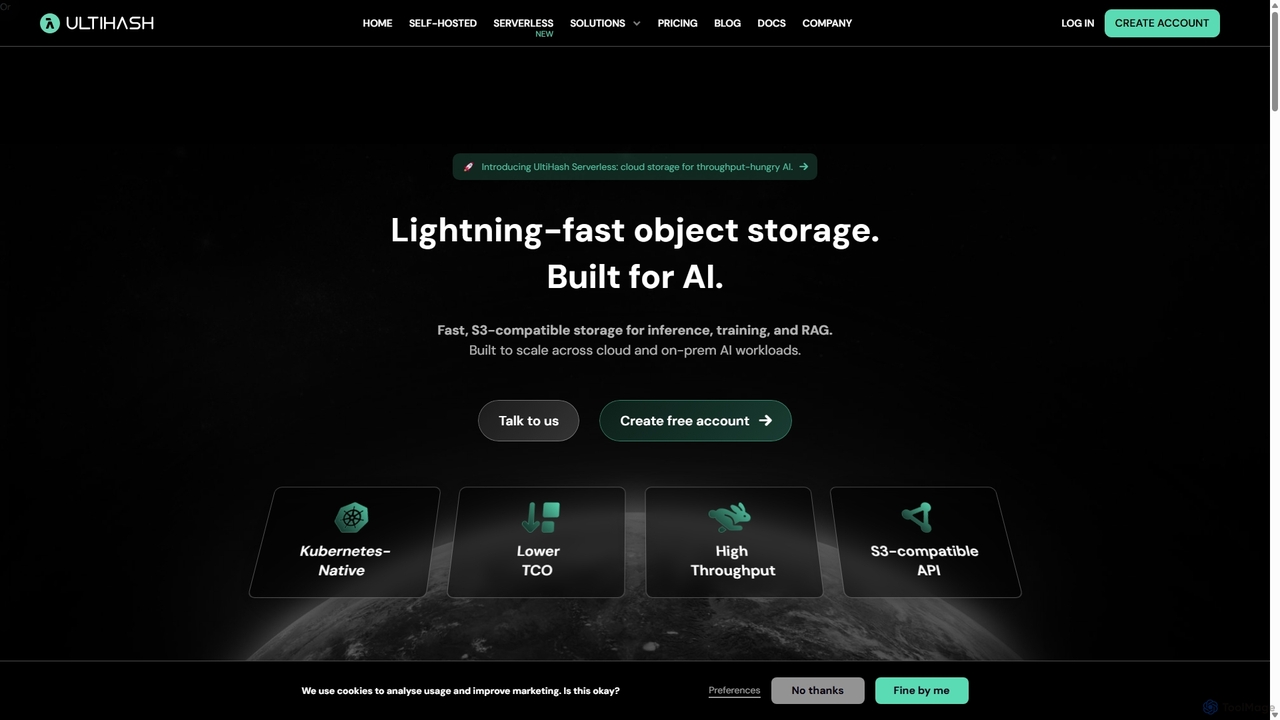
UltiHash is a high-performance, Kubernetes-native object storage platform specifically built for AI and big data workloads. It offers …

3.8K

About Data Storage

AI Data Storage solutions are specialized systems designed to manage the massive, complex datasets required for training and deploying artificial intelligence models. These platforms are engineered for high-throughput, low-latency performance to eliminate data bottlenecks and keep powerful compute resources like GPUs fully utilized. They provide the foundational layer within the AI infrastructure, enabling faster model iteration, improved accuracy, and scalable deployment of AI applications. Their architecture is optimized for handling both unstructured data (images, text, audio) and structured data at petabyte scale.

Core Features

  • High-Performance I/O: Delivers massive parallel throughput and high IOPS (Input/Output Operations Per Second) to feed data-hungry AI training workloads.
  • Massive Scalability: Elastically scales storage capacity and performance independently, from terabytes to exabytes, without disruption.
  • Unstructured Data Optimization: Efficiently stores, manages, and accesses diverse data types common in AI, such as images, videos, and large text corpora.
  • AI Framework Integration: Offers seamless connectivity with popular ML frameworks like TensorFlow and PyTorch, and data platforms like Spark.
  • Data Versioning and Lineage: Tracks dataset versions and metadata, ensuring reproducibility and traceability for model training experiments.

Use Cases

These storage solutions are critical for organizations involved in large-scale AI development. This includes research institutions training foundational models, automotive companies managing autonomous driving data, and healthcare organizations analyzing medical imagery. They are also essential for financial services firms running real-time fraud detection and e-commerce platforms powering recommendation engines.

How to Choose

When selecting an AI Data Storage solution, evaluate its performance benchmarks (e.g., throughput for your specific workload). Consider its ability to handle your primary data types and its integration with your existing MLOps toolchain. Assess the scalability model to ensure it can grow with your data needs. Finally, compare the total cost of ownership, including data transfer, API requests, and support, against your budget.

Data StorageUse Cases

1

Training Large Language Models (LLMs)

An AI research lab is developing a new foundational model. They need to store and process a 50-terabyte dataset of curated text and code. An AI-optimized data storage solution provides the high parallel throughput required to feed hundreds of GPUs simultaneously, preventing them from sitting idle. This accelerates the training process from months to weeks, allowing for more rapid experimentation and model refinement. Data versioning features are also used to track which dataset snapshot was used for each training run, ensuring reproducibility.

2

Managing Autonomous Vehicle Sensor Data

An automotive company collects petabytes of data from its fleet of test vehicles, including high-resolution video, LiDAR, and radar data. A scalable AI data storage platform acts as a central data lake. It allows engineers to efficiently ingest, catalog, and query this massive dataset to find specific scenarios (e.g., 'nighttime rain on a highway'). This curated data is then fed into training pipelines for perception and control models, directly improving the safety and reliability of their autonomous driving system.

3

Powering Real-Time Recommendation Engines

A large e-commerce platform uses an AI model to provide personalized product recommendations. A high-performance data storage system, often a feature store, is used to hold user behavior data and product feature vectors. When a user browses the site, the recommendation engine queries this store to retrieve relevant features with sub-millisecond latency. This enables the platform to generate and display fresh, relevant recommendations in real-time, significantly increasing user engagement and conversion rates.

4

Analyzing Medical Imaging for Diagnostics

A healthcare technology company is developing an AI to detect diseases from MRI scans. They require a secure and compliant data storage solution to house millions of high-resolution DICOM image files. The storage system must provide fast read access for training convolutional neural networks (CNNs) and also integrate with data annotation platforms. Efficient data handling allows researchers to quickly iterate on model architectures and improve the diagnostic accuracy of their AI, ultimately leading to better patient outcomes.

5

Building a Data Lake for Genomic Research

A bioinformatics institute processes vast amounts of genomic sequencing data. They use an AI data storage solution to create a centralized data lake. This system is optimized to handle a mix of very large files (sequence reads) and millions of smaller files (analysis results). Its high-performance file system allows dozens of researchers to run complex data processing and machine learning pipelines in parallel without performance degradation. This accelerates the pace of discovery in areas like personalized medicine and drug development.

6

Archiving and Accessing Media Production Assets

A visual effects (VFX) studio works with 4K and 8K video files, which are extremely large. They use a high-capacity AI data storage system as an active archive. This allows artists to quickly search and retrieve specific clips or assets from past projects using AI-powered metadata tagging and search. The storage provides sufficient performance for artists to directly work off the archive for tasks like color grading or adding effects, eliminating the slow process of restoring data from traditional tape-based archives.

Data StorageFrequently Asked Questions