Infrastructure Best in category 1 results Cloud AI Tool

Popular AI tools in the Cloud field of Infrastructure include Permit.io, etc., helping you quickly improve efficiency.

Permit.io

Permit.io

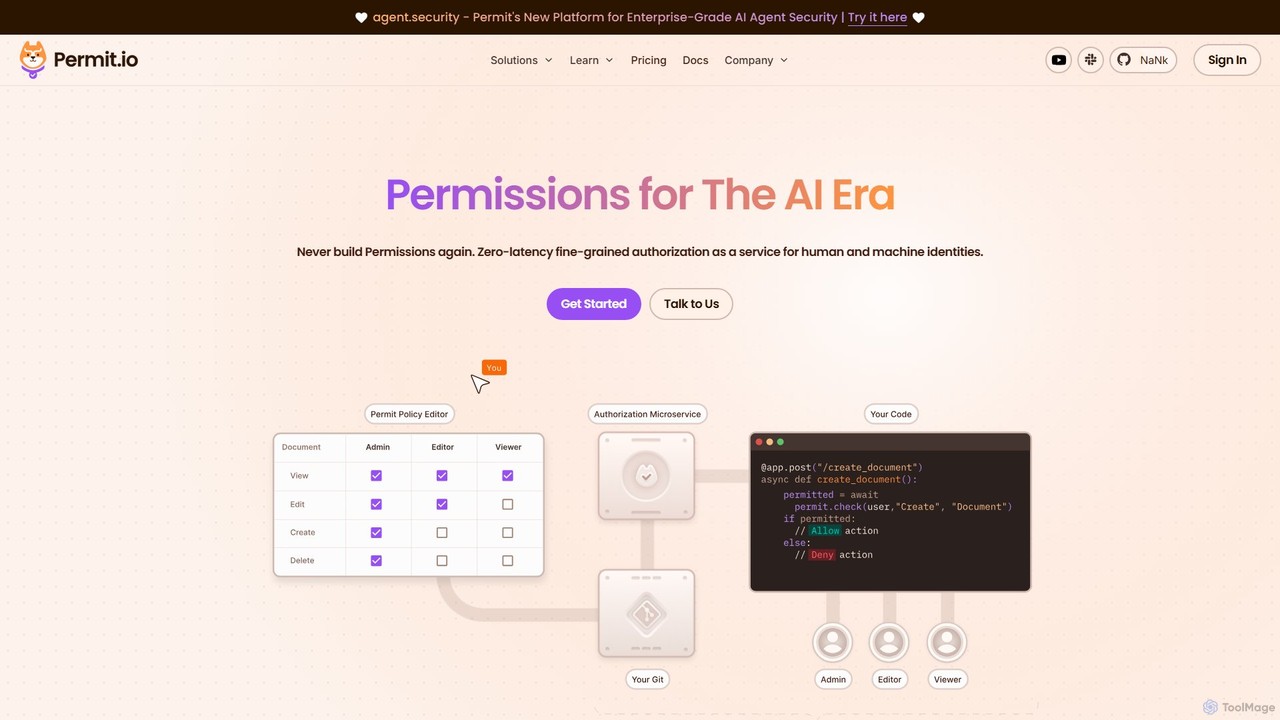
Permit.io is a full-stack authorization platform designed for the AI era. It simplifies the implementation of complex access …

52.9K

About Cloud

Cloud in the context of AI tools refers to cloud computing platforms and services specifically designed to host, develop, train, and deploy artificial intelligence and machine learning models. These platforms provide scalable, on-demand access to computing resources, specialized hardware like GPUs/TPUs, and pre-built AI services. They enable developers and businesses to build and run sophisticated AI applications without managing physical infrastructure, offering unparalleled flexibility and efficiency for AI workloads. This approach significantly accelerates AI innovation and deployment.

Core Features

  • Scalable Compute Resources: On-demand access to powerful CPUs, GPUs, and TPUs for intensive model training and inference.
  • Managed AI/ML Services: Pre-configured platforms and APIs for common AI tasks like NLP, computer vision, and predictive analytics.
  • Data Storage & Management: Secure, scalable storage solutions (e.g., object storage, data lakes) optimized for large AI datasets.
  • MLOps & Deployment Tools: Integrated tools for model versioning, monitoring, and seamless deployment into production environments.
  • Global Infrastructure: Distributed data centers for low-latency access and high availability of AI applications worldwide.

Applicable Scenarios

AI/ML developers leverage cloud platforms for training complex deep learning models on massive datasets, utilizing elastic compute resources to accelerate development cycles. Data scientists use cloud-based data lakes and analytics services to prepare and process data for AI. Enterprises deploy AI-powered applications, such as intelligent chatbots or recommendation engines, on cloud infrastructure to ensure high availability and scalability for their users.

How to Choose

When choosing a cloud platform for AI, consider the availability of specialized hardware (GPUs/TPUs) and managed AI/ML services that align with your project needs. Evaluate data storage and processing capabilities, ensuring they can handle your dataset size and type. Assess MLOps features for streamlined development-to-deployment workflows. Finally, compare pricing models, global reach, and ecosystem integrations to find a solution that balances cost, performance, and flexibility.

CloudUse Cases

1

Large-Scale AI Model Training

Data scientists utilize cloud platforms to train complex deep learning models, such as large language models or advanced computer vision models, on massive datasets. By leveraging elastic cloud GPUs and TPUs, they can significantly accelerate training times, conduct distributed training, and iterate on model architectures much faster than with on-premise infrastructure. This enables rapid experimentation and the development of cutting-edge AI capabilities.

2

Deploying AI-Powered Web Applications

Developers host AI-powered web applications, such as intelligent chatbots, personalized recommendation engines, or real-time image recognition services, on cloud infrastructure. Cloud platforms provide the necessary scalability, reliability, and global reach to serve a large user base with low latency. This ensures that AI applications remain performant and available, adapting dynamically to fluctuating user demand without manual intervention.

3

Building Data Lakes and AI Data Pipelines

Data engineers utilize cloud storage services (e.g., object storage) to build scalable data lakes, ingesting and storing vast amounts of raw data from various sources for AI model training. Cloud-based data processing services then transform and prepare this data, creating robust AI data pipelines. This ensures that AI models have access to clean, well-structured, and up-to-date data, which is crucial for their performance and accuracy.

4

Developing and Deploying MaaS (Model as a Service)

AI startups and enterprises offer their trained AI models as APIs (Application Programming Interfaces) via cloud platforms, enabling other businesses to integrate sophisticated AI capabilities into their own applications without building models from scratch. Cloud infrastructure provides the robust, scalable, and secure environment necessary for hosting these MaaS offerings, handling authentication, billing, and ensuring high availability for API consumers globally.

5

Edge AI Inference and Management

Companies deploy lightweight AI models on edge devices (e.g., IoT sensors, smart cameras) for real-time inference, with cloud platforms managing model updates, monitoring device health, and aggregating data from these distributed devices. This hybrid approach allows for immediate local decision-making at the edge while centralizing model lifecycle management and data analysis in the cloud, optimizing both performance and operational efficiency for AI at scale.

6

AI Research and Experimentation Environments

Researchers and developers create isolated, on-demand cloud environments to experiment with different AI algorithms, frameworks, and hyperparameter tuning. Cloud platforms allow for rapid provisioning and de-provisioning of resources, enabling quick setup of specialized compute instances (e.g., with specific GPU configurations) for short-term projects. This flexibility fosters innovation by reducing the overhead of infrastructure management and facilitating parallel experimentation.

CloudFrequently Asked Questions