
DigitalOcean
DigitalOcean is a developer-focused cloud infrastructure platform that simplifies building, deploying, and scaling applications. It offers a comprehensive …
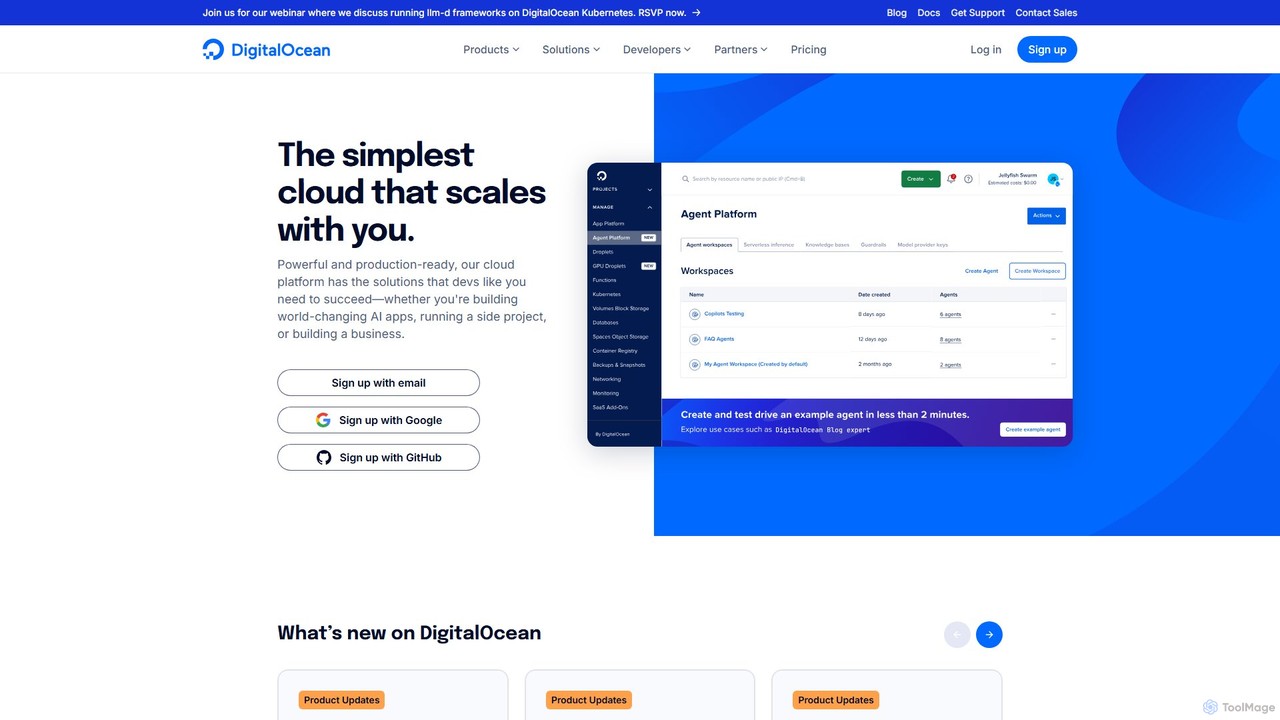
DigitalOcean is a developer-focused cloud infrastructure platform that simplifies building, deploying, and scaling applications. It offers a comprehensive suite of products, including virtual machines (Droplets), managed Kubernetes, and the GradientAI platform, providing powerful GPU resources and tools for creating and hosting world-changing AI applications, from side projects to large-scale businesses.
About Database
AI Databases are specialized data storage and retrieval systems designed to handle the complex data types and query patterns required by artificial intelligence applications. These systems often incorporate vector search capabilities to find semantically similar data, efficiently managing unstructured information like text, images, and audio. They are crucial for building applications such as recommendation engines, semantic search, and generative AI systems that rely on understanding data context. Unlike traditional databases, AI databases are optimized for high-dimensional data and low-latency queries essential for real-time machine learning tasks.
Core Features
- Vector Search: Enables finding data based on conceptual similarity rather than exact keyword matches by querying high-dimensional vector embeddings.
- Unstructured Data Management: Natively stores and indexes complex data types, including text, images, audio, and their corresponding vector representations.
- Scalability and Performance: Designed for horizontal scaling to handle massive datasets and high-throughput, low-latency queries for real-time applications.
- Metadata Filtering: Allows combining similarity search with traditional attribute-based filtering for more precise and context-aware query results.
- ML Framework Integration: Provides seamless integrations with popular machine learning frameworks and libraries like TensorFlow, PyTorch, and LangChain.
Use Cases
AI Databases are primarily used by Machine Learning Engineers, Data Scientists, and AI Application Developers. They are fundamental in industries like e-commerce for building product recommendation systems, in SaaS for creating intelligent in-app search, and in finance for sophisticated fraud detection. They also form the backbone of Retrieval-Augmented Generation (RAG) systems for large language models.
How to Choose
When selecting an AI Database, consider the specific vector indexing algorithms offered and their impact on search speed and accuracy. Evaluate its scalability to ensure it can grow with your data volume and query load. Assess the ease of integration with your existing data pipelines and machine learning models. Finally, compare deployment options (cloud-managed, self-hosted, serverless) and pricing models to align with your operational needs and budget.
DatabaseUse Cases
Powering Semantic Search in a Knowledge Base
A SaaS company's support team needs to provide customers with fast and accurate answers through their online help center. They use an AI database to store vector embeddings of all their support articles. When a user types a question like 'how do I reset my billing info?', the system converts the query into a vector and uses the AI database to find articles with the most similar meaning, not just those containing the exact keywords. This results in more relevant search results and a significant reduction in support ticket volume.
Building an E-commerce Visual Product Recommendation Engine
An online fashion retailer wants to suggest visually similar items to shoppers. For every product image, they generate a vector embedding that captures its visual features (color, pattern, style) and store it in an AI database. When a customer views a specific dress, the website queries the database to find other items with the closest vectors. This allows them to display a 'You might also like' section with products that have a similar aesthetic, improving user engagement and increasing cross-sell opportunities.
Implementing Retrieval-Augmented Generation (RAG) for Chatbots
A developer is building an AI chatbot that needs to answer questions based on a large, private collection of documents. To avoid hallucinations and provide factual answers, they implement a RAG pipeline. All documents are chunked, converted into vector embeddings, and stored in an AI database. When a user asks a question, the system first queries the database to retrieve the most relevant document chunks. These chunks are then passed to a Large Language Model (LLM) along with the original question, enabling the LLM to generate an accurate, context-aware, and verifiable answer.
Real-time Anomaly and Fraud Detection
A financial technology company processes thousands of transactions per second and needs to detect fraudulent activity instantly. Each transaction is converted into a vector representing its various attributes (amount, location, time, merchant). This vector is then compared against clusters of 'normal' transaction vectors stored in a high-performance AI database. If a new transaction vector falls far outside any normal cluster, it is flagged as an anomaly for immediate review. The low-latency query capability of the AI database is critical for making these decisions in real-time.
Automated Content Moderation for Social Platforms
A social media platform needs to quickly identify and remove harmful content like hate speech or graphic images. They maintain an AI database containing vector embeddings of known violating content. When a user uploads a new image or text post, it is immediately converted into a vector. The platform then performs a similarity search against the database. If the new content's vector is highly similar to a known piece of harmful content, it is automatically flagged or removed, enabling moderation at a scale that would be impossible for human reviewers alone.
Accelerating Drug Discovery with Molecular Similarity Search
In bioinformatics, researchers analyze vast databases of chemical compounds to find potential new drugs. Each molecule can be represented as a unique vector fingerprint. A pharmaceutical research team uses an AI database to store these fingerprints for millions of compounds. When searching for candidates to target a specific disease, they can query the database with the fingerprint of a known effective compound. The database rapidly returns a list of structurally similar molecules, drastically narrowing down the search space and accelerating the initial stages of drug discovery.