Developer Tools Best in category 2 results Hosting AI Tool

Popular AI tools in the Hosting field of Developer Tools include DigitalOcean、Dollie, etc., helping you quickly improve efficiency.

Dollie

Dollie

Dollie is an all-in-one platform for WordPress agencies and freelancers, offering white-label hosting, centralized site management, automated site …

4.6K
DigitalOcean

DigitalOcean

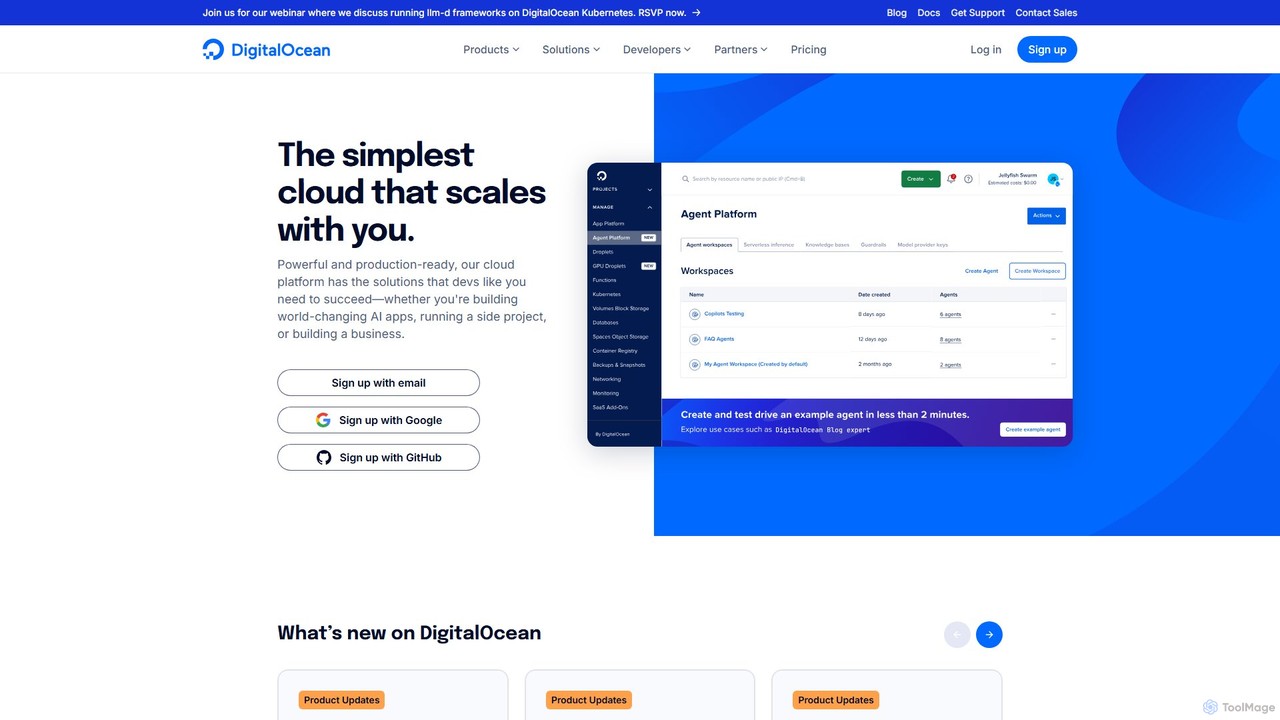
DigitalOcean is a developer-focused cloud infrastructure platform that simplifies building, deploying, and scaling applications. It offers a comprehensive …

4.7M

About Hosting

AI Hosting services provide specialized cloud infrastructure designed to deploy, manage, and scale machine learning models and AI applications. These platforms are optimized for the computational demands of AI, offering access to powerful hardware like GPUs and TPUs. They simplify the MLOps lifecycle by providing tools for model versioning, API endpoint creation, and performance monitoring. This enables developers to efficiently move models from development to production and deliver low-latency AI-powered features to users.

Core Features

  • Optimized Infrastructure: Provides access to scalable GPU and TPU resources for high-performance model inference.
  • One-Click Deployment: Simplifies the process of turning trained models into live, scalable API endpoints.
  • Performance Monitoring: Offers dashboards to track model latency, throughput, and resource utilization.
  • Model Versioning: Allows for managing multiple versions of a model, facilitating A/B testing and rollbacks.
  • Security & Scalability: Ensures secure API access and automatic scaling to handle fluctuating traffic loads.

Use Cases

AI Hosting is crucial for tech companies, startups, and individual developers building AI-driven products. It's used to power recommendation engines on e-commerce sites, serve natural language processing models for chatbots and translation services, and deploy computer vision models for image analysis or autonomous systems. Any application requiring real-time AI inference benefits from a dedicated hosting solution.

How to Choose

When selecting an AI Hosting service, evaluate its support for your specific machine learning framework (e.g., TensorFlow, PyTorch). Consider the availability and pricing of GPU resources, as this heavily impacts cost and performance. Assess the platform's ease of use, integration with your existing CI/CD pipeline, and its auto-scaling capabilities. Finally, review security features and data privacy compliance to ensure your application and user data are protected.

HostingUse Cases

1

Deploying a Customer Service Chatbot API

A startup developing an AI-powered customer service chatbot needs to make their model available 24/7 with low latency. Using an AI Hosting platform, their developers can upload the trained NLP model and, with a few clicks, generate a secure REST API endpoint. The platform automatically handles server provisioning, software dependencies, and scaling. This allows the chatbot on their website and mobile app to respond to user queries in real-time, handling thousands of concurrent conversations without the need for a dedicated infrastructure team.

2

Serving a Real-Time Image Recognition Model

A mobile application developer wants to add a feature that identifies objects in photos taken by the user. This requires a powerful computer vision model that can process images quickly. Instead of running the model on the user's device, which would drain battery and require a large app size, they use an AI Hosting service. They deploy their trained model to the service, which provides a GPU-accelerated API. The app sends the image to the API and receives the object labels back in milliseconds, providing a seamless user experience without impacting device performance.

3

Powering a Recommendation Engine for E-commerce

An online retailer wants to provide personalized product recommendations to its customers. Their data science team builds a collaborative filtering model, but serving recommendations in real-time to millions of users is a challenge. They use an AI Hosting platform to deploy the model as a scalable microservice. The platform's auto-scaling feature ensures that enough resources are allocated during peak shopping hours and scaled down during off-peak times to save costs. The retailer's website can then query this service to fetch personalized recommendations for each user, improving engagement and sales.

4

A/B Testing Different Machine Learning Models

A data science team has developed two different versions of a fraud detection model and wants to determine which one performs better in a live environment. Using an AI Hosting service that supports model versioning, they can deploy both models simultaneously. The platform allows them to route a percentage of live traffic to each model version (e.g., 50% to Model A, 50% to Model B). By monitoring the performance metrics like accuracy and latency for each version through the platform's dashboard, the team can make a data-driven decision on which model to fully deploy to production.

5

Creating a Backend for a Generative AI Application

A developer is building a web application that generates images from text prompts using a large generative model like Stable Diffusion. These models require significant GPU memory and processing power. By using an AI Hosting platform, the developer can host the model on powerful, pay-as-you-go GPU instances. The platform provides a simple API for the front-end application to call. This architecture allows the developer to offer a powerful generative AI feature to a wide audience without needing to purchase or maintain expensive hardware, ensuring the service is both scalable and cost-effective.

6

Hosting a Private Model for Internal Enterprise Use

A large corporation has trained a proprietary language model on its internal documents to assist employees with knowledge retrieval. For security and compliance reasons, this model cannot be hosted on a public cloud. They opt for an AI Hosting solution that offers on-premise or virtual private cloud (VPC) deployment. This allows them to host the model within their own secure network infrastructure. Employees can access the model's capabilities through an internal web portal, while the company maintains full control over its data and intellectual property, ensuring compliance with strict data governance policies.

HostingFrequently Asked Questions