Grafbase
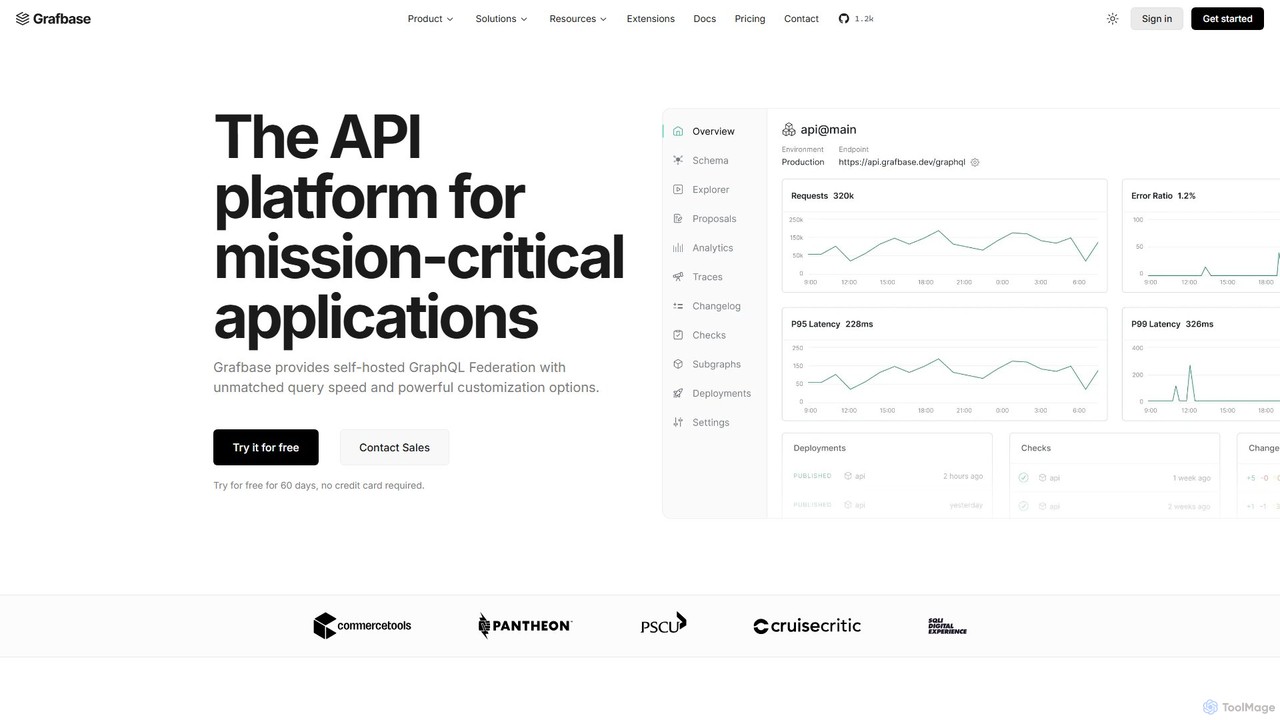
Grafbase is an enterprise-grade API platform for scaling GraphQL Federation. It provides a high-performance, self-hosted gateway built with …
Grafbase is an enterprise-grade API platform for scaling GraphQL Federation. It provides a high-performance, self-hosted gateway built with Rust, offering unmatched speed and security. A key feature is its native support for the Model Context Protocol (MCP), enabling AI agents to query your APIs using natural language, making it a future-proof solution for building AI-powered applications.
About Backend
AI Backend tools are platforms designed to build, deploy, and scale the server-side infrastructure for artificial intelligence applications. These tools provide pre-built components and managed environments, abstracting away the complexities of model hosting, API creation, and resource scaling. They enable developers to quickly turn trained models into production-ready services that can be integrated into any application. This significantly accelerates the development lifecycle and reduces the need for specialized DevOps expertise.
Core Features
- Model Deployment: Upload and host various machine learning models (e.g., LLMs, computer vision) as scalable endpoints.
- Automatic API Generation: Instantly create secure REST or GraphQL APIs for your models, making them accessible to front-end applications.
- Scalable Inference: Automatically manage and scale computational resources to handle fluctuating API request loads efficiently.
- Vector Database Integration: Natively connect with or include vector databases to build powerful Retrieval-Augmented Generation (RAG) applications.
- Environment Management: Provide pre-configured, optimized environments for running AI models, handling dependencies and hardware requirements.
Use Cases
These tools are primarily used by developers and organizations building AI-native products or integrating AI features into existing software. Common scenarios include creating backend services for chatbots, powering recommendation engines, deploying computer vision APIs for image analysis, and building the foundation for complex generative AI SaaS platforms.
How to Choose
When selecting an AI Backend tool, consider the supported model frameworks (e.g., PyTorch, TensorFlow), the scalability model (serverless vs. dedicated instances), ease of integration with your existing data sources and vector databases, and the level of control offered (low-code vs. code-first). Also, evaluate the pricing structure based on compute usage, API calls, and included features.

BackendUse Cases
Deploying a Custom Chatbot API
A startup developer needs to launch a web application featuring a specialized customer service chatbot. Instead of building server infrastructure from scratch, they use an AI Backend tool. They upload their fine-tuned language model, and the platform automatically wraps it in a secure, scalable REST API endpoint. This allows their front-end application to start making calls to the chatbot immediately, reducing the time-to-market from weeks to just a few hours and eliminating the need for a dedicated DevOps engineer.
Building a RAG-based Q&A System
A legal tech company wants to create a tool that answers questions based on a large corpus of legal documents. Their data science team uses an AI Backend platform that has native vector database integration. They process and store their documents in the vector database, then deploy a large language model on the same platform. The backend tool manages the entire Retrieval-Augmented Generation (RAG) pipeline, retrieving relevant document chunks and feeding them to the LLM to generate accurate, context-aware answers through a single API call.
Scaling an Image Recognition Service
An e-commerce platform uses an AI model to automatically tag new product images. During holiday seasons, image uploads spike from thousands to millions per day. They use a serverless AI Backend tool to host their computer vision model. The platform automatically provisions and scales the required GPU resources in real-time to handle the surge in traffic, ensuring fast processing times without any manual intervention. After the peak, it scales back down, so the company only pays for the compute resources they actually use, optimizing costs significantly.
Prototyping an AI-Powered SaaS MVP
A solo founder has an idea for a SaaS tool that generates personalized workout plans. To validate the idea quickly, they use a low-code AI Backend platform. This allows them to deploy a generative model for workout creation, set up user authentication, and manage API keys all within a single interface. By leveraging pre-built components, they can build a functional Minimum Viable Product (MVP) and launch it to early users in a matter of days, focusing their limited resources on user feedback and product features rather than backend infrastructure.
Integrating Generative AI into an Existing App
An established project management software company decides to add an 'AI Assistant' feature to help users draft project plans. Their existing infrastructure is not optimized for hosting LLMs. They use a managed AI Backend service to handle all interactions with a third-party model like GPT-4. The backend service manages API key security, formats prompts, and processes the responses before sending them back to their application. This approach allows them to integrate a powerful AI feature securely and reliably without having to re-architect their core product.
Creating a Multi-Model Content Generation Service
A marketing agency builds an internal tool to streamline content creation. They need different models for generating blog post outlines, social media captions, and email subject lines. Using a code-first AI Backend platform, their developers deploy three separate, specialized models. The platform allows them to manage these models as independent microservices, each with its own API endpoint. This modular approach simplifies updates and maintenance, as they can improve one model (e.g., the social media caption generator) without affecting the others, ensuring a robust and flexible backend system.