Ai Infrastructure Best in category 2 results Machine Learning Operations AI Tool

Popular AI tools in the Machine Learning Operations field of Ai Infrastructure include Labellerr、UltiHash, etc., helping you quickly improve efficiency.

UltiHash

UltiHash

UltiHash is a high-performance, Kubernetes-native object storage platform specifically built for AI and big data workloads. It offers …

3.0K
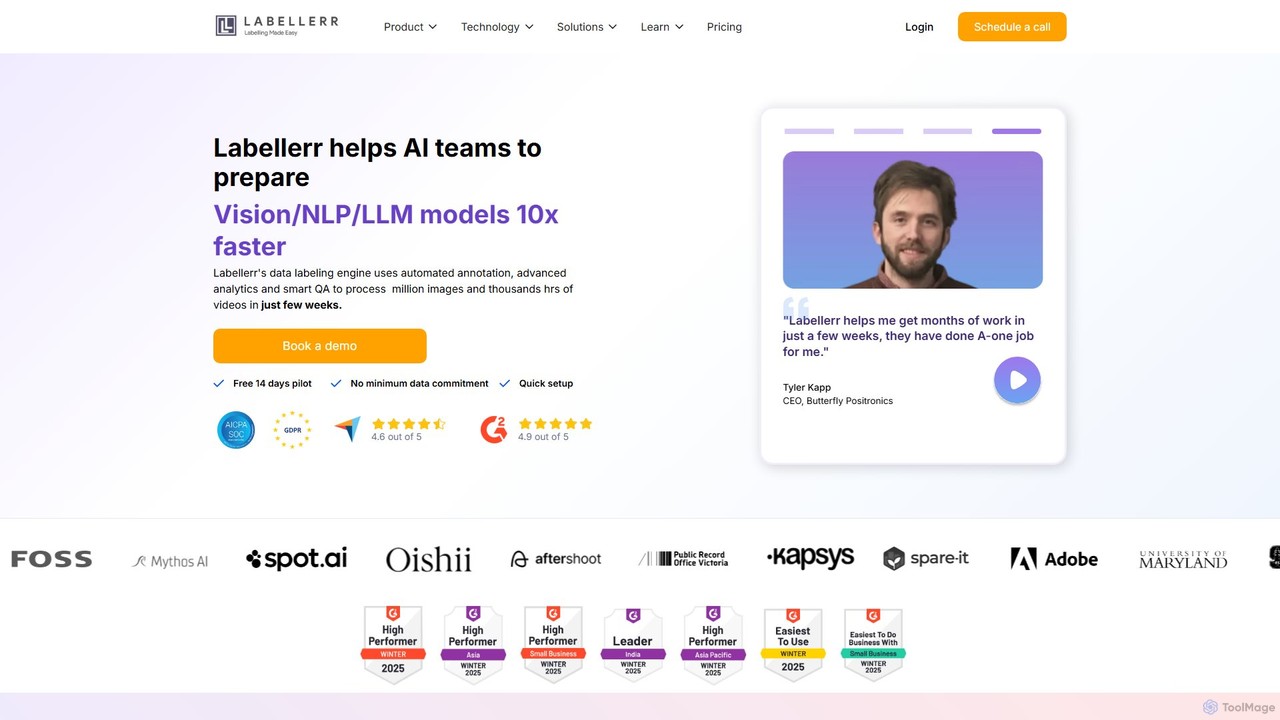
Labellerr

Labellerr

Labellerr is an AI-powered data labeling and annotation platform designed to accelerate the development of Vision, NLP, and …

124.4K

About Machine Learning Operations

Machine Learning Operations (MLOps) tools are platforms designed to standardize and streamline the lifecycle of machine learning models. These tools apply DevOps principles to ML workflows, automating processes from data preparation and model training to deployment and monitoring. Their primary value lies in making machine learning systems reproducible, scalable, and reliable in production environments. As a key component of AI Infrastructure, MLOps focuses specifically on the operational management of the model lifecycle itself.

Core Features

  • Automated Pipelines: Build and manage CI/CD pipelines for data validation, model training, and testing.
  • Model Registry: A central repository to version, store, and manage trained machine learning models.
  • Experiment Tracking: Log, compare, and visualize metrics, parameters, and artifacts from different training runs.
  • Model Deployment & Serving: Tools to package and deploy models as scalable and secure APIs for real-time or batch inference.
  • Performance Monitoring: Track production model performance, detect data and concept drift, and trigger alerts or retraining.

Use Cases

MLOps tools are essential for organizations deploying machine learning at scale. They are primarily used by Machine Learning Engineers, Data Scientists, and DevOps teams in sectors like finance for fraud detection, e-commerce for recommendation engines, and manufacturing for quality control. Any workflow requiring frequent model retraining and robust monitoring benefits from an MLOps platform.

How to Choose

When selecting an MLOps tool, consider its integration capabilities with your existing data stack and cloud provider (e.g., AWS, GCP, Azure). Evaluate whether you need an end-to-end platform or modular tools for specific tasks. Also, assess the level of automation required, support for various ML frameworks (like TensorFlow or PyTorch), and the technical expertise needed to operate the platform effectively.


Machine Learning OperationsUse Cases

1

Automating the Lifecycle of a Fraud Detection Model

A financial services company needs to keep its credit card fraud detection model constantly updated to combat new fraudulent schemes. Using an MLOps platform, their ML engineers build an automated pipeline. This pipeline automatically triggers a retraining process whenever model performance drops below a certain threshold or when significant data drift is detected. The newly validated model is then automatically deployed into production with zero downtime, ensuring the company maintains a high level of protection against fraud without manual intervention.

2

Managing E-commerce Recommendation Engines

An online retailer uses multiple recommendation algorithms across its website. A data science team uses an MLOps tool's experiment tracking feature to log and compare the performance of different models (e.g., collaborative filtering vs. content-based). The model registry stores the best-performing version for each product category. The deployment feature allows them to run A/B tests easily, serving different model versions to segments of users and monitoring metrics like click-through rate and conversion to determine the most effective recommendation strategy.

3

Scaling Computer Vision for Quality Control

A manufacturing company deploys computer vision models on its assembly line to detect product defects. An MLOps platform is used to manage the deployment of these models to hundreds of edge devices. The platform's monitoring capabilities track inference latency and accuracy in real-time. When a new type of defect appears, images are collected, and the retraining pipeline is triggered. The MLOps tool then orchestrates the rollout of the updated model to all devices, ensuring consistent and up-to-date quality control across the entire production line.

4

Ensuring Reproducibility in Scientific Research

A university research lab works on complex climate simulation models. To ensure their findings are verifiable and reproducible, they use an MLOps tool. Every experiment, including the specific dataset version, code commit, hyperparameters, and resulting model, is logged automatically. This creates a complete audit trail. When publishing their paper, they can share a link to the tracked experiment, allowing other researchers to replicate their results precisely and build upon their work with confidence.

5

CI/CD for Natural Language Processing (NLP) Models

A tech company maintains an NLP model for sentiment analysis on customer reviews. Their DevOps team integrates an MLOps platform into their existing CI/CD workflow. Now, whenever a data scientist pushes new training code to the repository, a pipeline is triggered. It automatically runs data validation checks, trains the model, evaluates it against a baseline, and, if successful, registers the new model version. This 'CI/CD for ML' approach significantly speeds up the iteration cycle and reduces the risk of deploying faulty models.

6

Governing and Auditing AI Models in Healthcare

A healthcare provider uses AI models for tasks like medical image analysis. To comply with regulations like HIPAA, they must maintain strict governance. An MLOps platform provides a central model registry that serves as a single source of truth. It tracks model lineage—who trained the model, with what data, and its performance metrics. This allows them to easily generate audit reports, explain model predictions when required, and ensure that only validated and approved models are used in clinical settings, enhancing patient safety and regulatory compliance.

Machine Learning OperationsFrequently Asked Questions