Webbotify
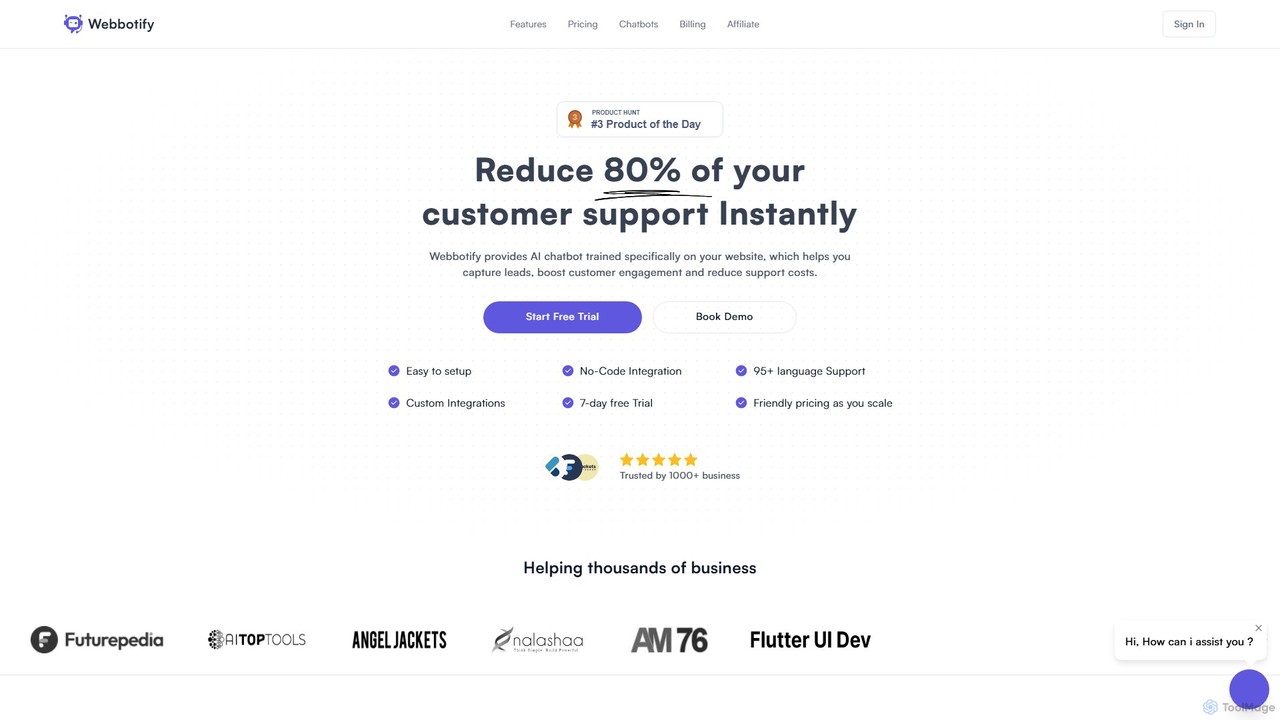
Webbotify is an AI chatbot platform that trains on your website data to automate customer support, capture leads, …
Webbotify is an AI chatbot platform that trains on your website data to automate customer support, capture leads, and boost engagement. It offers a no-code setup, supports over 95 languages, and integrates with popular platforms, aiming to reduce support costs by up to 80% while providing 24/7 assistance.
About Marketing
AI Marketing tools are a specialized category of software that uses artificial intelligence to automate, analyze, and optimize marketing campaigns. As a key component of Lead Generation, these tools focus specifically on attracting and engaging potential customers through data-driven strategies. They leverage machine learning algorithms to understand customer behavior, personalize content at scale, and predict campaign outcomes. This enables marketers to create more effective, targeted, and efficient marketing funnels that convert prospects into qualified leads.
Core Features
- Predictive Analytics: Forecasts market trends, customer lifetime value, and churn rates to inform strategy.
- Content Personalization: Dynamically adapts website content, emails, and ads for individual users based on their behavior.
- Ad Campaign Optimization: Automates bidding, targeting, and creative testing for digital advertising to maximize ROI.
- Marketing Automation: Manages and automates repetitive tasks like email sequences, social media posting, and lead nurturing workflows.
- Customer Segmentation: Uses AI to automatically group customers into micro-segments based on complex behavioral patterns.
Applicable Scenarios
These tools are widely used by digital marketing teams, e-commerce managers, and content strategists. Common applications include running multi-channel advertising campaigns, implementing personalized email nurturing sequences to guide prospects through the sales funnel, and using AI-driven insights to develop a data-backed content strategy that resonates with the target audience.
Selection Criteria
When choosing an AI Marketing tool, consider its integration capabilities with your existing CRM, ad platforms, and analytics software. Evaluate the depth of its data analytics and reporting features. Assess the complexity of its automation builder to ensure it matches your team's technical skills. Finally, consider its scalability and pricing model to ensure it aligns with your business growth and budget.

MarketingUse Cases
Automated Social Media Campaign Management
A social media manager for a direct-to-consumer brand uses an AI Marketing tool to streamline their content calendar. The tool analyzes past performance data to suggest optimal posting times for platforms like Instagram and TikTok. It also helps generate caption variations and relevant hashtags to increase reach. By automating post scheduling and performance tracking, the manager saves over 10 hours per week and sees a 15% increase in engagement by targeting audiences when they are most active.
Personalized Email Nurturing Sequences
An email marketer for a SaaS company sets up an AI-driven nurturing workflow. The system tracks how new leads interact with the website and initial emails. Based on this data, it automatically sends personalized follow-up content. For instance, a lead who read a blog post about 'API integration' receives a case study on that topic, while another who watched a 'reporting features' webinar gets an invitation to a live demo. This personalization increases the lead-to-opportunity conversion rate by 25% compared to generic email blasts.
AI-Powered SEO Content Strategy
A content strategist at a digital agency uses an AI marketing platform to identify content opportunities for a client. The tool analyzes top-ranking articles for a target keyword, identifies semantic subtopics, and suggests a comprehensive content outline. It also scores existing content for SEO and readability, providing specific recommendations for improvement, such as adding LSI keywords or improving sentence structure. This data-driven approach helps the agency create content that ranks higher and faster, leading to a 40% increase in organic traffic for the client within three months.
Optimizing Digital Advertising Spend
A performance marketer at an e-commerce company uses an AI tool to manage their Google Ads and Facebook Ads campaigns. The AI automatically allocates the daily budget to the best-performing ad sets and audiences in real-time. It also conducts continuous A/B testing on ad copy and images, identifying winning combinations faster than manual testing. This process leads to a 20% reduction in cost-per-acquisition (CPA) and allows the marketer to focus on high-level strategy instead of manual bid adjustments.
Predictive Lead Scoring for Sales Prioritization
A marketing operations team integrates an AI tool with their CRM. The tool analyzes hundreds of data points for each new lead, including firmographics, website behavior, and email engagement. It then assigns a predictive score from 1 to 100, indicating the likelihood of conversion. This score is synced to the CRM, allowing the sales team to instantly identify and prioritize 'hot leads'. This process ensures that sales reps focus their efforts on the most promising opportunities, increasing sales efficiency and shortening the sales cycle.
Market Trend and Competitor Analysis
A market analyst for a technology firm uses an AI marketing intelligence tool to monitor the digital landscape. The tool scrapes and analyzes data from news sites, social media, and competitor blogs. It identifies emerging industry trends, tracks shifts in consumer sentiment around key topics, and alerts the analyst to new marketing campaigns launched by competitors. This provides the firm with real-time strategic insights, enabling them to adapt their marketing messages and product positioning proactively.