AI.Law
AI.Law is a patent-pending AI platform designed for litigation teams to draft court-ready legal documents in minutes. It …
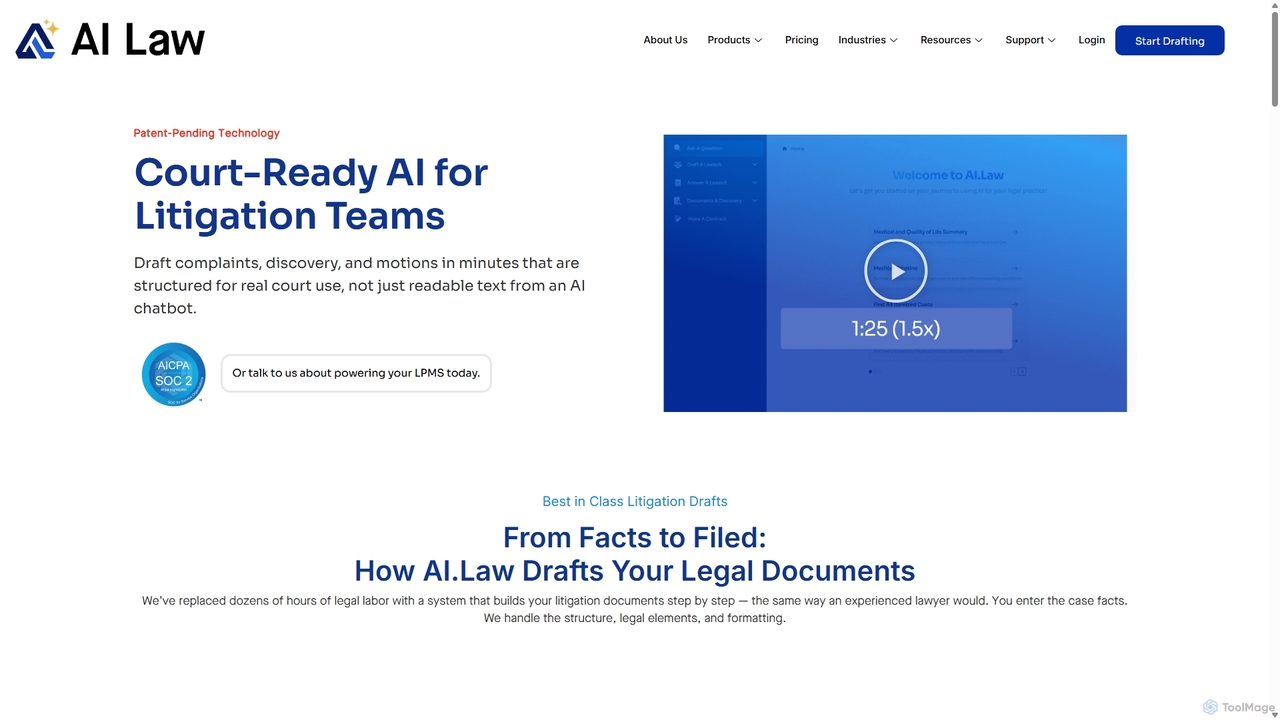
AI.Law is a patent-pending AI platform designed for litigation teams to draft court-ready legal documents in minutes. It automates the creation of complaints, answers, discovery, and motions, using layered legal logic and jurisdiction-specific rules. Built by experienced lawyers, it streamlines workflows, reduces drafting time by thousands of percent, and enhances case strategy for law firms, in-house counsel, and government legal units.
About Litigation Management
Litigation Management AI tools are specialized software solutions that leverage artificial intelligence to streamline and enhance various aspects of the legal dispute resolution process. These tools utilize machine learning, natural language processing, and predictive analytics to automate tasks, analyze vast datasets, and provide data-driven insights for legal professionals. Their primary value lies in improving efficiency, reducing costs, and enhancing strategic decision-making throughout the litigation lifecycle, from e-discovery to case strategy and settlement.
Core Features
- Automated Document Review: Rapidly analyzes and categorizes large volumes of legal documents, identifying relevance and key information.
- Predictive Analytics for Case Outcomes: Uses historical data to forecast potential case outcomes, risks, and settlement ranges.
- E-Discovery Automation: Streamlines the identification, preservation, collection, processing, review, and production of electronically stored information.
- Legal Research & Precedent Analysis: Integrates with legal databases to quickly find relevant statutes, case law, and precedents.
- Case Strategy & Workflow Management: Provides tools for organizing case information, tracking deadlines, and managing legal team workflows.
Use Cases
Law firms, corporate legal departments, and government agencies utilize these tools to manage complex legal disputes more effectively. They are crucial for handling large-scale e-discovery in class action lawsuits, predicting the likelihood of success in commercial litigation, and optimizing resource allocation for legal teams. These tools enable a more proactive and data-informed approach to managing legal challenges.
How to Choose
When selecting Litigation Management AI tools, consider the accuracy and reliability of the AI models, the tool's integration capabilities with existing legal tech stacks, and its compliance with data security and privacy regulations (e.g., GDPR, CCPA). Evaluate the user interface for ease of use, the scope of features offered (e.g., e-discovery, predictive analytics, document automation), and the vendor's support and training resources to ensure seamless adoption and maximum benefit.
Litigation ManagementUse Cases
Automating E-Discovery Document Review
Legal teams facing extensive e-discovery demands can use AI litigation management tools to automate the review of millions of documents. By leveraging natural language processing (NLP) and machine learning, the AI can quickly identify relevant documents, redact sensitive information, and categorize content, drastically reducing the manual effort and time required. This leads to a significant reduction in discovery costs and accelerates the litigation timeline, allowing legal professionals to focus on strategic analysis rather than tedious review.
Predicting Case Outcomes and Informing Strategy
Attorneys can utilize AI predictive analytics within litigation management platforms to assess the potential outcomes of a case. By analyzing vast datasets of historical case law, judicial decisions, and settlement data, the AI provides insights into the likelihood of success, potential damages, and optimal settlement ranges. This data-driven approach empowers legal teams to make more informed strategic decisions, negotiate more effectively, and better advise clients on risks and opportunities, ultimately improving overall case management.
Streamlining Legal Research and Precedent Analysis
Legal researchers and litigators can employ AI tools to conduct more efficient and comprehensive legal research. These platforms can quickly scan and synthesize information from legal databases, identifying relevant statutes, regulations, and case precedents that might be overlooked by manual methods. The AI can highlight key arguments, dissenting opinions, and judicial trends, providing a deeper understanding of the legal landscape and strengthening legal arguments for ongoing litigation.
Managing Complex Multi-Party Litigation
For large law firms or corporate legal departments handling complex multi-party litigation, AI management tools offer centralized platforms to organize vast amounts of information. These tools can track communications, manage document versions, monitor deadlines, and assign tasks across multiple teams and jurisdictions. This ensures consistent information flow, reduces the risk of errors, and maintains a cohesive strategy across all facets of the complex case, enhancing overall coordination and control.
Ensuring Regulatory Compliance in Litigation
Corporate legal departments can leverage AI litigation management tools to ensure strict adherence to regulatory compliance requirements throughout the litigation process. The AI can monitor documents and communications for compliance with industry-specific regulations, data privacy laws (e.g., GDPR, HIPAA), and internal policies. This proactive compliance monitoring minimizes the risk of penalties, reputational damage, and ensures that all legal proceedings are conducted within established legal and ethical frameworks.
Optimizing Settlement Negotiations with Data Insights
Legal professionals can use AI-driven insights to optimize settlement negotiations. By analyzing historical settlement data, jury verdicts, and specific case parameters, AI tools can provide data-backed recommendations for negotiation strategies and acceptable settlement ranges. This allows attorneys to approach negotiations with greater confidence, presenting compelling data to opposing counsel and clients, leading to more favorable and efficient resolutions for all parties involved in the litigation.