LawBotica
LawBotica is an AI-powered legal assistant designed for litigation teams. It streamlines document-heavy workflows by automating the review, …
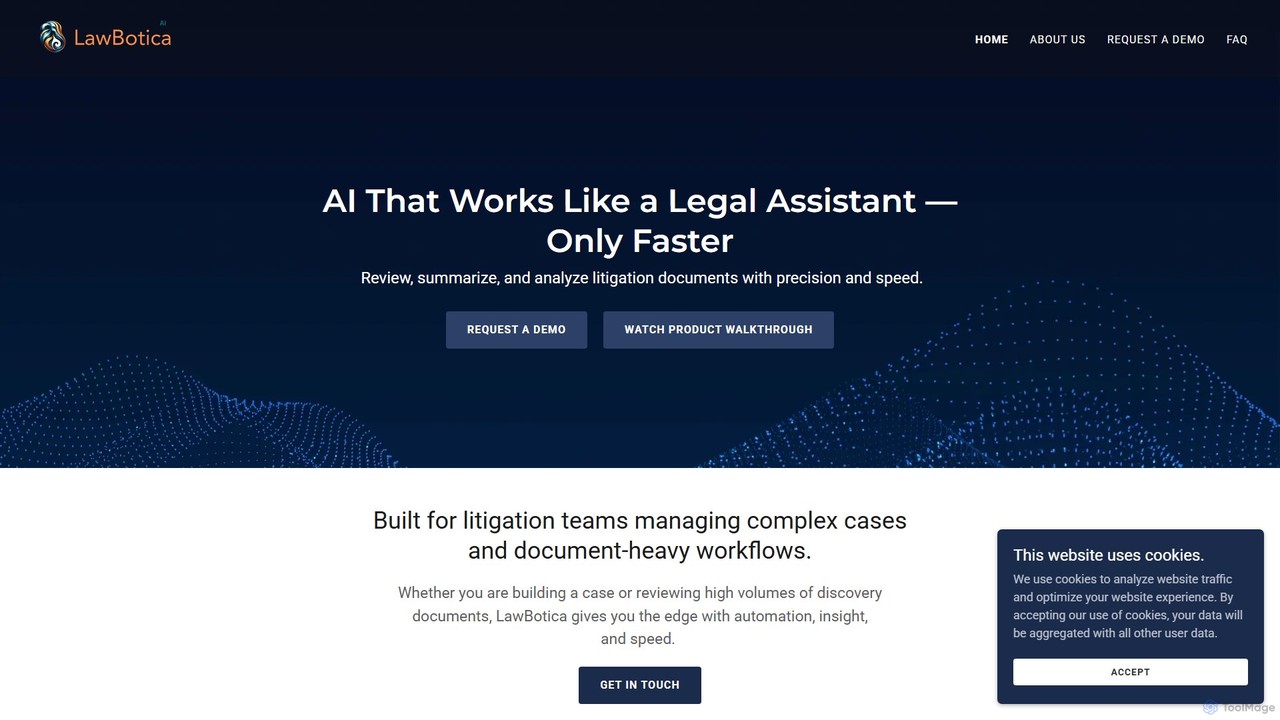
LawBotica is an AI-powered legal assistant designed for litigation teams. It streamlines document-heavy workflows by automating the review, summarization, and analysis of legal documents like depositions, complaints, and medical records. It offers features like smart document review, automatic timeline generation, explainable AI summaries, and multi-document chat to enhance precision, speed, and collaboration in complex case management.
About Litigation Support
Litigation Support AI tools are specialized artificial intelligence applications designed to streamline and enhance various stages of the legal litigation process. These tools leverage advanced machine learning, natural language processing (NLP), and data analytics to automate tasks, analyze vast amounts of legal data, and provide actionable insights. Their primary value lies in significantly reducing the time and cost associated with e-discovery, document review, and case preparation, ultimately empowering legal professionals to build stronger cases more efficiently.
Core Features
- E-Discovery & Document Review: Automates the identification, collection, processing, and review of electronically stored information (ESI) for relevance, privilege, and responsiveness.
- Predictive Coding: Uses AI to learn from human review decisions, then applies that learning to categorize and prioritize large document sets, accelerating review.
- Legal Research & Analysis: Quickly sifts through legal precedents, statutes, and case law to identify relevant information and patterns, aiding in strategic decision-making.
- Evidence Analysis: Analyzes diverse forms of evidence, including text, audio, and video, to identify key facts, inconsistencies, and potential liabilities.
- Case Strategy & Prediction: Provides data-driven insights into potential case outcomes, settlement probabilities, and optimal litigation strategies based on historical data.
Applicable Scenarios
Law firms utilize these tools to manage complex e-discovery processes for large corporate litigation, ensuring compliance and reducing manual labor. Corporate legal departments deploy them for internal investigations and regulatory responses, rapidly identifying critical documents. Government agencies leverage AI for public records requests and large-scale data analysis in investigations.
How to Choose
When selecting Litigation Support AI tools, prioritize data security and compliance with legal standards (e.g., GDPR, HIPAA). Evaluate the accuracy and explainability of the AI models, ensuring transparency in decision-making. Consider integration capabilities with existing legal tech stacks (e.g., practice management software) and the scalability of the solution to handle varying case sizes. Finally, assess the user interface and support for ease of adoption by legal teams.

Litigation SupportUse Cases
Automating E-Discovery for Complex Litigation
A large law firm representing a multinational corporation in a class-action lawsuit faces millions of documents. Litigation Support AI tools are used to automatically identify, collect, process, and review electronically stored information (ESI), flagging relevant documents, privileged communications, and potential liabilities, drastically reducing the manual review burden and accelerating the discovery phase.
Expediting Contract Review for Due Diligence
During a merger and acquisition (M&A) due diligence process, a legal team needs to review thousands of contracts for specific clauses, risks, and obligations. AI-powered litigation support platforms can rapidly extract key terms, identify anomalies, and highlight potential compliance issues, enabling faster risk assessment and negotiation.
Predictive Coding for Efficient Document Prioritization
A corporate legal department is responding to a regulatory inquiry involving hundreds of thousands of internal emails. Instead of manual review, they train a predictive coding AI model on a small sample of relevant documents. The AI then prioritizes the remaining documents, surfacing the most pertinent ones first, leading to a 70% reduction in overall review time.
Enhancing Legal Research and Precedent Analysis
A litigator preparing for a novel intellectual property case needs to find obscure precedents and legal arguments. AI legal research tools can quickly scan vast databases of case law, statutes, and academic articles, identifying highly relevant cases, dissenting opinions, and judicial trends that might be missed by traditional keyword searches, strengthening their legal arguments.
Analyzing Deposition Transcripts for Key Insights
During trial preparation, a legal team has dozens of deposition transcripts to analyze for inconsistencies, key admissions, or potential impeachment material. Litigation Support AI can process these transcripts, identify recurring themes, sentiment shifts, and specific statements from witnesses, providing a comprehensive overview and highlighting critical areas for cross-examination.
Developing Data-Driven Case Strategy
A legal team wants to assess the likelihood of success for a new commercial dispute. By feeding historical case data, judge profiles, and relevant legal arguments into a Litigation Support AI tool, they can receive predictive analytics on potential outcomes, settlement ranges, and optimal strategic approaches, informing their negotiation and trial tactics.