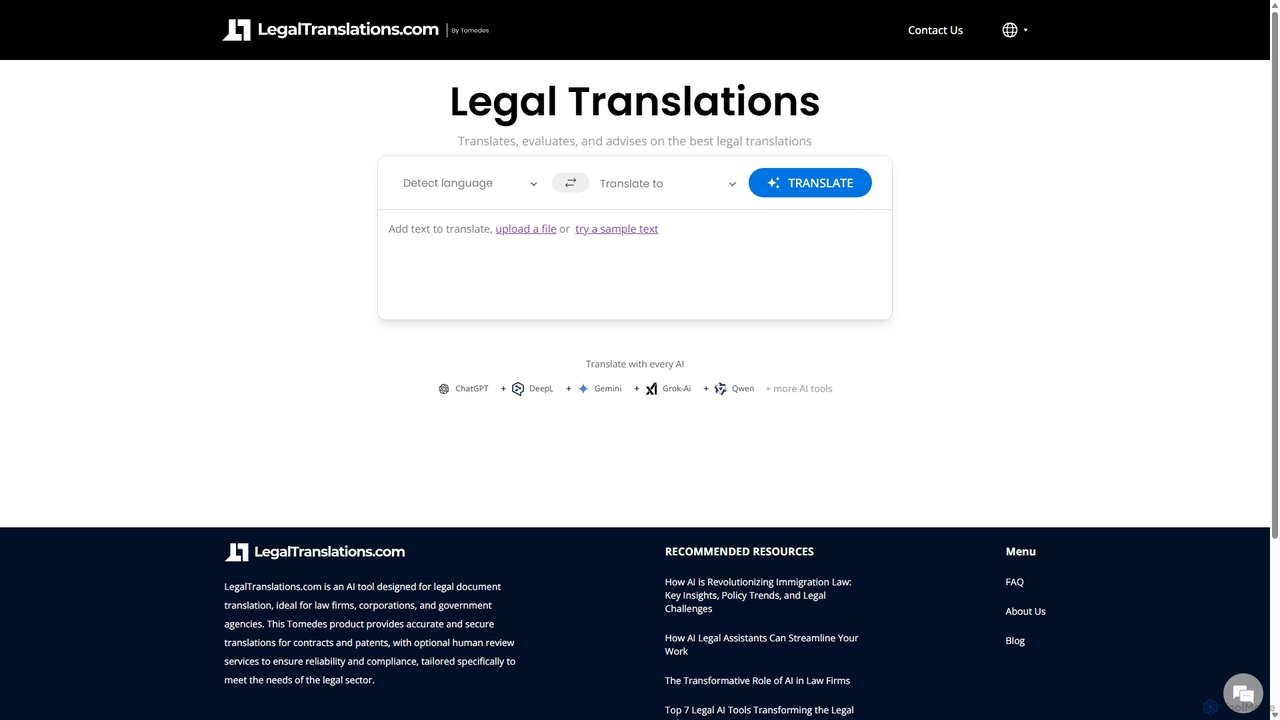
AI Legal Translation tools are specialized platforms designed for the high-stakes translation of legal documents. They leverage neural machine translation (NMT) models trained on extensive legal corpora, including contracts, case law, and statutes, to ensure terminological accuracy. This enables law firms, corporate legal departments, and courts to process cross-border litigation documents, international agreements, and compliance materials with greater speed and consistency. Unlike general-purpose translators, these tools prioritize confidentiality, data security, and the preservation of original document formatting.
Core Features
- Legal Terminology Management: Utilizes pre-trained models and customizable glossaries for specific legal domains like patent, contract, or criminal law.
- Enhanced Data Security: Offers features such as on-premise deployment, end-to-end encryption, and compliance with data protection regulations (e.g., GDPR).
- Document Format Preservation: Retains the complex formatting of legal documents, including tables, footnotes, and paragraph numbering, after translation.
- Bilingual Review Interface: Provides a side-by-side view of the source and translated text, facilitating efficient review and editing by legal professionals.
Use Cases
These tools are essential for international law firms handling cross-border discovery, multinational corporations conducting due diligence for mergers and acquisitions, and intellectual property attorneys filing patents in multiple jurisdictions. They are also used in compliance departments to translate foreign regulations and policies.
How to Choose
When selecting an AI Legal Translation tool, prioritize data security protocols and compliance certifications (like ISO 27001). Evaluate the tool's accuracy on your specific document types and its support for relevant legal jurisdictions. Also consider its integration capabilities with e-discovery and case management systems, and whether the pricing model aligns with your project volume.