Manufacturing Best in category 1 results Quoting AI Tool

Popular AI tools in the Quoting field of Manufacturing include Afterquote, etc., helping you quickly improve efficiency.

Afterquote

Afterquote

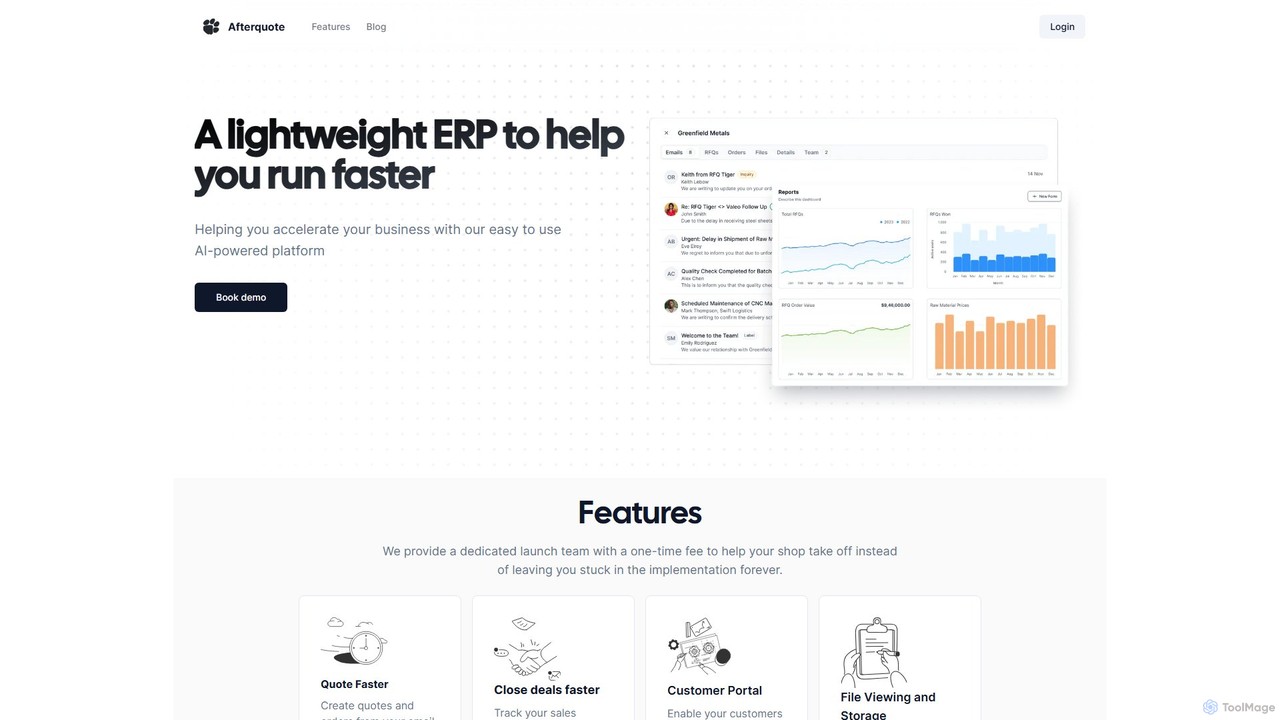
Afterquote is a lightweight, AI-powered ERP platform designed for manufacturing businesses, particularly in metal fabrication. It streamlines operations …

2.4K

About Quoting

AI Quoting tools are a specialized class of software that automates the generation of price estimates and sales quotes, primarily within the manufacturing sector. These platforms leverage artificial intelligence to analyze 2D/3D CAD files, interpret geometric complexity, and calculate production costs based on materials, machine time, and labor. This results in highly accurate and consistent quotes delivered in minutes, rather than hours or days. They are a critical component for modern manufacturers seeking to accelerate their sales cycle and improve quoting accuracy.

Core Features

  • Automated CAD Analysis: Instantly processes 3D models (like STEP, STL) to extract geometric data for cost estimation.
  • Cost Simulation Engine: Calculates manufacturing costs based on material selection, machine processes, labor rates, and overhead.
  • Design for Manufacturability (DFM) Feedback: Provides automated suggestions to optimize a part's design for easier and cheaper production.
  • Supplier & Material Database: Integrates with material cost databases and supplier pricing to ensure estimates are based on current market rates.
  • Quote Management Dashboard: Centralizes all quote requests, generated quotes, and customer communication in one place.

Use Cases

These tools are essential for contract manufacturers, job shops, and service bureaus in sectors like CNC machining, sheet metal fabrication, injection molding, and 3D printing. Sales engineers, estimators, and business owners use them to respond to RFQs (Requests for Quotation) with speed and precision, freeing up engineering resources from manual estimation tasks.

How to Choose

When selecting an AI Quoting tool, consider the specific manufacturing processes it supports (e.g., milling, turning, laser cutting). Evaluate its integration capabilities with your existing ERP or CRM systems. Assess the accuracy and customizability of its cost models to ensure they reflect your shop's unique operations. Finally, consider the user interface's ease of use for non-technical sales staff.

QuotingUse Cases

1

Instant Quoting for CNC Machining Shops

A CNC machine shop owner receives dozens of RFQs daily, each with a unique 3D CAD model. Manually quoting each part is time-consuming and prone to inconsistency. By using an AI Quoting tool, they can upload the customer's STEP or IGES file directly to the platform. The AI instantly analyzes the part's geometry, identifies features like holes and pockets, calculates the required machine time for milling or turning, and estimates material costs. Within minutes, a professional, detailed quote is generated and sent to the customer, reducing quote turnaround time from hours to under five minutes and increasing the win rate.

2

Automated Quoting for Sheet Metal Fabrication

A sheet metal fabricator needs to quote a complex assembly involving multiple bent and cut parts. Traditionally, this requires an estimator to manually unfold the 3D models, calculate material usage, and estimate bending and cutting times. An AI Quoting tool automates this entire process. It can analyze an assembly file, automatically flatten each part to determine the blank size, account for bend deductions, and calculate the path length for laser or waterjet cutting. The system generates a comprehensive quote for the entire assembly, including material, machine time, and secondary operations like welding or finishing, ensuring both speed and accuracy.

3

Dynamic Pricing for 3D Printing Services

A 3D printing service bureau handles a high volume of orders for various materials (e.g., PLA, ABS, Resin) and technologies (FDM, SLA). Pricing depends on material volume, print time, and machine usage. An AI Quoting tool provides an instant, interactive quoting portal for their website. Customers can upload their STL files, select material and print resolution, and immediately see the price. The AI calculates the part's volume, estimates the print duration based on slicing parameters, and applies the correct material cost, providing a transparent and immediate quote that enhances customer experience and streamlines order intake.

4

Estimating Injection Molding Tooling and Part Costs

For an injection molding company, quoting involves two major components: the one-time cost of the mold (tooling) and the per-part price. An AI Quoting tool can analyze a 3D model and provide an initial estimate for both. It assesses part complexity, undercuts, surface area, and material to predict the cost of creating the steel or aluminum mold. Simultaneously, it calculates the cycle time and material consumption to determine the price for each molded part at different volume breaks. This allows sales teams to provide comprehensive quotes for high-volume production runs quickly and with greater confidence.

5

Validating Supplier Quotes for Procurement Teams

A procurement manager in a large manufacturing enterprise is responsible for sourcing hundreds of custom parts. They often receive quotes from multiple suppliers with significant price variations. Instead of relying solely on supplier data, the manager uses an internal AI Quoting tool as a benchmark. By uploading the part's CAD file, they can generate an independent, data-driven cost estimate. This 'should-cost' analysis helps them identify overpriced quotes, negotiate more effectively with suppliers, and make more informed purchasing decisions, leading to significant cost savings across the supply chain.

6

Providing DFM Feedback to Accelerate Product Development

A product design engineer is developing a new component and needs to ensure it's cost-effective to manufacture. Before sending the design to a machine shop, they upload the CAD model to an AI Quoting tool that includes Design for Manufacturability (DFM) analysis. The tool automatically flags potential issues, such as internal corners that are too sharp for a standard end mill, walls that are too thin, or holes that are difficult to drill. By addressing these DFM issues early in the design phase, the engineer can reduce production costs, avoid potential manufacturing delays, and shorten the overall product development lifecycle.

QuotingFrequently Asked Questions