SwitchOn
SwitchOn is an AI-powered quality inspection platform for manufacturers, leveraging advanced computer vision to ensure zero-defect production. It …
SwitchOn is an AI-powered quality inspection platform for manufacturers, leveraging advanced computer vision to ensure zero-defect production. It rapidly detects visual defects across various industries like automotive, pharma, consumer goods, and electronics, significantly reducing costs and boosting accuracy to over 99.95% at high speeds of 1000+ parts per minute.
Overview.ai
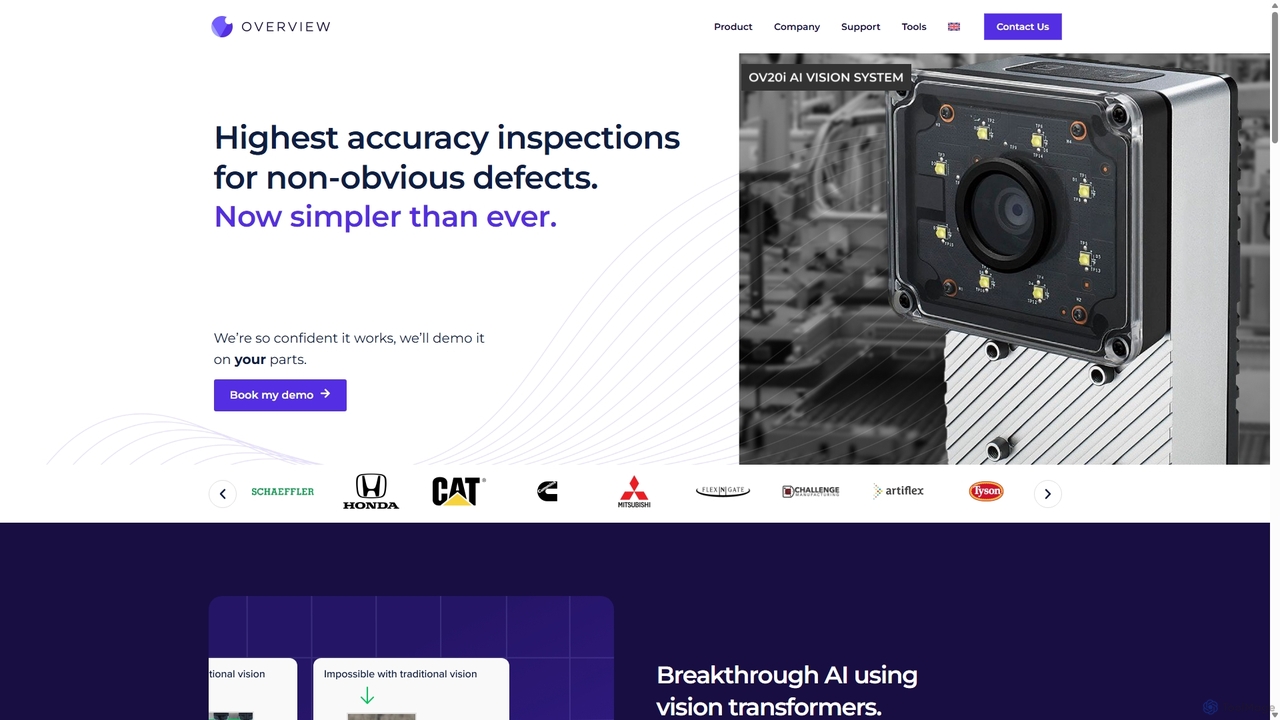
Overview.ai provides a next-generation AI industrial vision system, the OV20i, designed for high-accuracy defect detection in manufacturing. Leveraging …
Overview.ai provides a next-generation AI industrial vision system, the OV20i, designed for high-accuracy defect detection in manufacturing. Leveraging vision transformers and deep learning, it identifies non-obvious flaws that traditional systems and human inspectors miss. The system is incredibly easy to use, requires no programming, and deploys in hours, dramatically accelerating time-to-value for manufacturers in automotive, medical, and other industries.
Nanotronics
Nanotronics is an industrial AI company providing an advanced platform for autonomous manufacturing. It combines AI, computer vision, …
Nanotronics is an industrial AI company providing an advanced platform for autonomous manufacturing. It combines AI, computer vision, and robotics in its nSpec (Automated Optical Inspection) and nControl (AI Process Control) systems to help manufacturers in sectors like semiconductors and automotive increase yields, reduce waste, and optimize production through real-time data analysis and predictive control.
Averroes
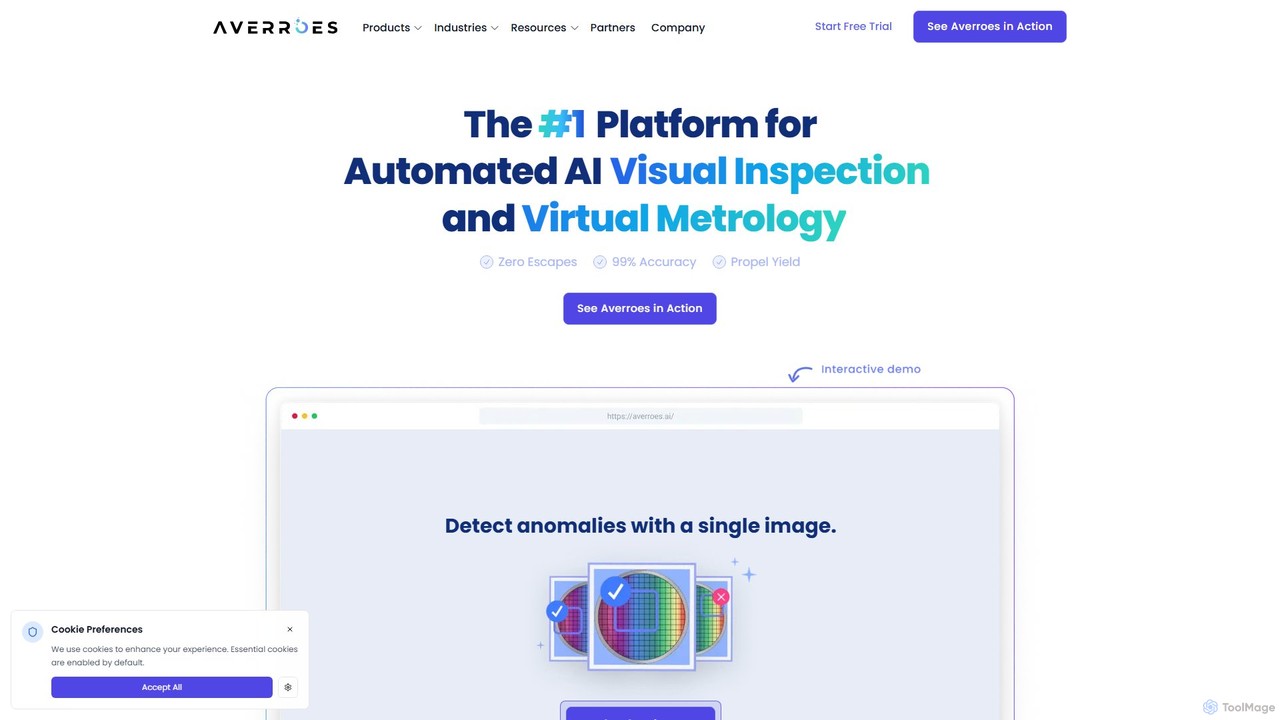
Averroes is a no-code AI platform for automated visual inspection and virtual metrology in manufacturing. It delivers over …
Averroes is a no-code AI platform for automated visual inspection and virtual metrology in manufacturing. It delivers over 99% accuracy in defect detection, integrates seamlessly with existing hardware, and requires minimal data to train. Designed for industries like semiconductors, electronics, and solar, it boosts productivity and yield by automating quality control processes.
Intelgic
Intelgic provides comprehensive AI-powered machine vision solutions for industrial automation. Specializing in high-speed, high-precision defect detection, their system …
Intelgic provides comprehensive AI-powered machine vision solutions for industrial automation. Specializing in high-speed, high-precision defect detection, their system integrates custom hardware (cameras, lighting, robotics) with proprietary "Live Vision AI" software to ensure quality control in manufacturing environments like automotive, electronics, and material processing.
About Quality Control
AI Quality Control tools are a class of software that uses artificial intelligence, primarily computer vision and machine learning, to automate the inspection and analysis of products within the manufacturing process. These tools analyze visual data from cameras or sensor data from equipment to identify defects, anomalies, or deviations from quality standards with high precision and speed. Their primary value lies in increasing detection accuracy, reducing human error, and enabling real-time process adjustments to prevent widespread quality issues. This technology surpasses traditional manual inspection by offering consistent, scalable, and data-driven quality assurance.
Core Features
- Automated Visual Inspection: Utilizes computer vision to automatically detect surface defects, assembly errors, and cosmetic imperfections on production lines.
- Predictive Quality Analytics: Analyzes production data to forecast potential quality issues before they occur, enabling proactive maintenance and process optimization.
- Real-time Anomaly Detection: Monitors sensor data and production metrics in real-time to instantly flag deviations from normal operating parameters.
- Root Cause Analysis: Employs machine learning algorithms to identify the underlying causes of recurring defects, helping to resolve systemic problems.
- Automated Reporting & Classification: Automatically categorizes defect types and generates detailed quality reports for compliance and process improvement.
Use Cases
These tools are critical in high-precision manufacturing sectors such as electronics, automotive, pharmaceuticals, and aerospace. They are used by quality assurance engineers and production managers to monitor assembly lines, inspect components like PCBs or engine parts, and ensure packaging integrity. For example, an automotive plant might use AI to inspect weld seams, while a pharmaceutical company uses it to verify tablet uniformity.
How to Choose
When selecting an AI Quality Control tool, consider the following: Detection Accuracy & Speed for your specific defect types. Integration Capability with your existing Manufacturing Execution Systems (MES) and cameras. Model Training & Management requirements—evaluate if you need a no-code platform or have a data science team. Finally, assess the system's Scalability to handle increasing production volumes and product variations.
Quality ControlUse Cases
Automated Defect Detection on Electronics Assembly Lines
An electronics manufacturer needs to inspect thousands of Printed Circuit Boards (PCBs) daily for microscopic defects like faulty soldering, missing components, or hairline cracks. A quality control engineer uses an AI visual inspection tool integrated with high-resolution cameras on the assembly line. The AI model, trained on thousands of images of good and defective boards, scans each PCB in milliseconds. It automatically flags any board with anomalies, routing it for manual review or rejection. This process increases throughput by over 300% compared to manual inspection and improves defect detection accuracy to over 99.5%, significantly reducing field failures.
Ensuring Packaging Integrity in the Food Industry
A food and beverage company uses an AI quality control system to ensure packaging consistency on a high-speed bottling line. The system's cameras capture images of every bottle, and the AI analyzes them for multiple quality checks simultaneously: verifying the label is correctly applied and not skewed, checking that the cap is sealed properly, and ensuring the fill level is within tolerance. Any product that fails these checks is automatically ejected from the line. This automated process prevents costly recalls due to mislabeling or spoilage and maintains brand reputation by ensuring every product reaching the customer meets quality standards.
Predictive Quality Analytics in Automotive Manufacturing
An automotive parts supplier uses an AI tool to analyze sensor data from its CNC machines. The tool monitors variables like temperature, vibration, and spindle speed in real-time. By correlating subtle changes in these patterns with historical defect data, the AI model predicts when a machine is likely to start producing out-of-spec parts. It alerts the maintenance team to perform proactive adjustments or replace a wearing tool before any defects occur. This predictive approach shifts quality control from reactive detection to proactive prevention, minimizing scrap rates and avoiding costly production line stoppages.
Pharmaceutical Tablet and Capsule Inspection
In pharmaceutical manufacturing, ensuring every tablet is perfect is a regulatory requirement. A pharmaceutical company deploys an AI vision system to inspect tablets for defects like cracks, chips, incorrect color, or foreign contaminants. The system processes thousands of tablets per minute, far exceeding human capability. It provides a complete audit trail for each batch, documenting every inspection and rejection. This not only ensures patient safety and product efficacy but also helps the company maintain compliance with strict industry regulations like GMP (Good Manufacturing Practice).
Identifying Flaws in Textile Manufacturing
A textile mill producing high-end fabrics needs to ensure its products are free from weaving defects, stains, or color inconsistencies. An AI quality control system with line-scan cameras is installed over the fabric rolls as they are produced. The AI analyzes the continuous image feed, instantly identifying and classifying flaws like slubs, holes, or color streaks. The system maps the exact location of each defect on the roll, allowing operators to either cut out the flawed section with minimal waste or grade the roll accordingly. This automation improves quality consistency and reduces material waste compared to relying solely on human inspectors who can experience fatigue.
Weld Seam Analysis in Heavy Industry
In industries like shipbuilding or automotive frame construction, the integrity of weld seams is critical for structural safety. A quality engineer uses an AI-powered system that analyzes X-ray or ultrasonic images of welds. The AI can detect internal defects such as porosity, cracks, or incomplete fusion that are invisible to the naked eye. It provides an objective, repeatable analysis, removing the subjectivity of manual interpretation. The system generates a detailed report for each weld, flagging any that fall below safety standards, ensuring that only structurally sound components are used in the final product.