Side Space
Side Space is a powerful AI assistant that integrates seamlessly into your desktop workflow. It operates from a …
Side Space is a powerful AI assistant that integrates seamlessly into your desktop workflow. It operates from a convenient sidebar, providing instant access to AI-powered tools for writing, coding, and general productivity without ever leaving your current application. Enhance your efficiency with contextual actions on selected text and customizable commands.
Omnipilot
Omnipilot is a system-wide AI copilot for macOS, designed to integrate seamlessly into any application. It provides contextual …
Omnipilot is a system-wide AI copilot for macOS, designed to integrate seamlessly into any application. It provides contextual assistance, allowing you to generate text, write code, and automate tasks in any text field, boosting productivity by eliminating the need to switch between apps. Note: Omnipilot has been acquired by and merged into Highlight AI.
HP IQ
HP IQ is an advanced AI ecosystem, born from the acquisition of Humane, featuring the Ai Pin wearable …
HP IQ is an advanced AI ecosystem, born from the acquisition of Humane, featuring the Ai Pin wearable and the intelligent CosmOS. It offers a screen-free, context-aware computing experience through voice, gestures, and a laser-projected display. Designed for both personal and enterprise use, it aims to enhance productivity and integrate AI seamlessly into daily life, prioritizing intuitive interaction and user privacy.
GPTBox
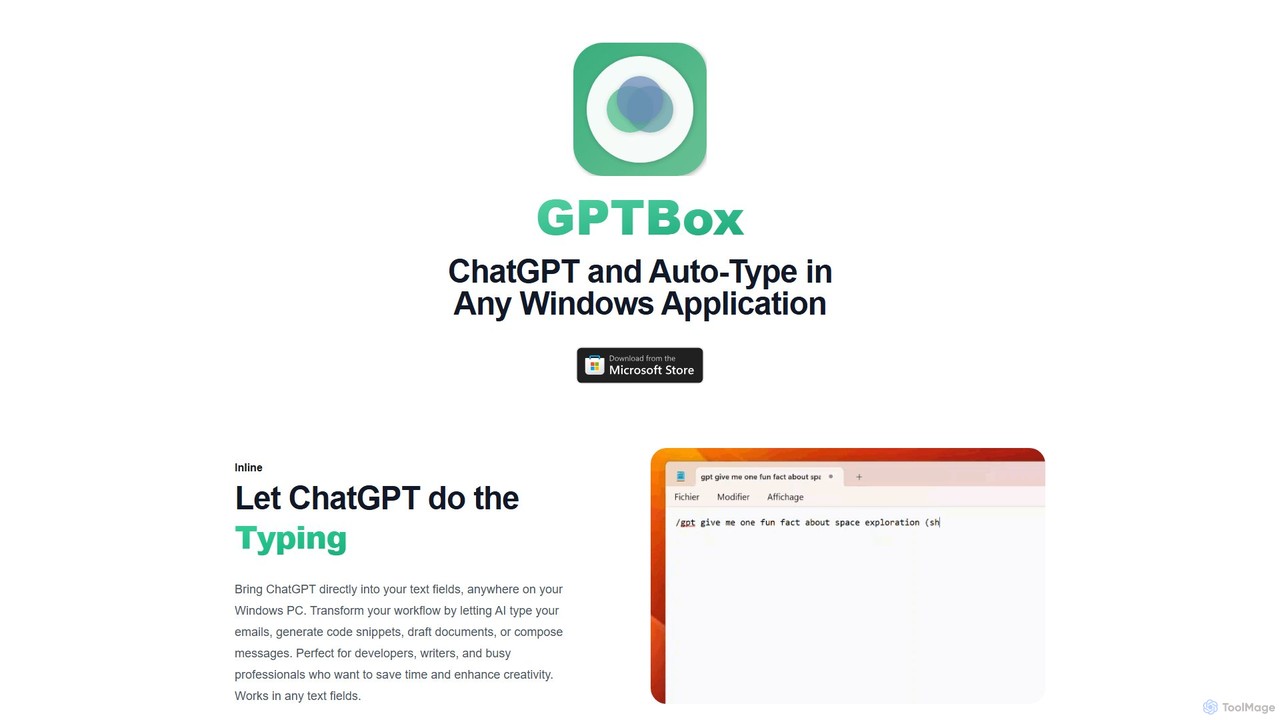
GPTBox is a native Windows application that seamlessly integrates ChatGPT and DeepSeek into your taskbar. It allows you …
GPTBox is a native Windows application that seamlessly integrates ChatGPT and DeepSeek into your taskbar. It allows you to access AI assistance from anywhere on your PC with a simple keyboard shortcut and use an inline auto-type feature to draft emails, write code, and generate content directly in any text field. Designed for developers, writers, and professionals, it boosts productivity by embedding AI into your daily workflow.
About Os
AI Operating Systems are AI-powered tools that fundamentally redefine how computing resources are managed, optimized, and interacted with. These innovative systems leverage advanced machine learning, natural language processing, and predictive analytics to create highly adaptive, autonomous, and personalized computing environments. They extend beyond traditional operating system functions by intelligently automating complex tasks, predicting user needs, and dynamically allocating resources for unparalleled efficiency, security, and user experience across diverse platforms and devices.
Core Features
- Intelligent Resource Management: Dynamically allocates CPU, memory, and network resources based on real-time demand, workload patterns, and predictive models to optimize performance and cost efficiency.
- Automated Task Orchestration: Automates complex workflows, schedules tasks, and manages dependencies across various applications, services, and even distributed systems without extensive manual intervention.
- Adaptive User Interfaces: Personalizes the user experience by continuously learning individual preferences, proactively suggesting actions, and dynamically adjusting interface elements for optimal interaction and accessibility.
- Predictive System Maintenance: Monitors system health in real-time, predicts potential hardware or software failures, and initiates preventative measures or self-healing processes to ensure continuous operation and minimize downtime.
- Enhanced Security & Anomaly Detection: Utilizes AI and machine learning to detect unusual patterns, identify potential threats, and respond autonomously to security breaches, bolstering overall system integrity and data protection.
Applicable Scenarios
AI Operating Systems are poised to transform various sectors, from optimizing large-scale cloud infrastructures for global enterprises to creating highly personalized and proactive digital assistants for individual users. They are becoming indispensable in environments demanding high levels of automation, dynamic resource allocation, and adaptive user interaction, such as smart cities, advanced industrial IoT deployments, and cutting-edge research and development platforms where traditional OS limitations are a bottleneck.
How to Choose
When selecting an AI Operating System, it is crucial to consider its integration capabilities with your existing hardware, software ecosystems, and cloud services to ensure seamless deployment. Evaluate its scalability and performance under varying and growing workloads, along with the robustness of its security features, including data encryption and threat detection. Furthermore, assess its customization and adaptability to specific organizational needs, the clarity of its data privacy policies, and the availability of comprehensive developer tools for future extensions and integrations.

OsUse Cases
Enterprise Cloud Resource Optimization
Large enterprises utilize AI Operating Systems to intelligently manage their vast cloud infrastructure. The AI OS continuously monitors workload patterns, predicts future demands, and dynamically scales computing resources (VMs, containers, storage) up or down, ensuring optimal performance while significantly reducing cloud spending by preventing over-provisioning.
Personalized Digital Workspaces
For individual professionals or creative teams, an AI OS creates a highly adaptive digital environment. It learns user habits, prioritizes notifications, automatically organizes files, and proactively launches necessary applications or suggests relevant information, streamlining daily workflows and boosting personal productivity.
Autonomous IoT Device Management
In smart cities or large industrial complexes, an AI OS oversees thousands of interconnected IoT devices. It performs predictive maintenance on sensors and machinery, detects anomalies in real-time (e.g., equipment malfunction, unusual environmental readings), and automates firmware updates, ensuring operational continuity and security across the network.
Adaptive Gaming & Entertainment Platforms
Gaming companies deploy AI Operating Systems to enhance player experience. The AI OS dynamically adjusts game difficulty, generates personalized content (e.g., quests, character interactions), and optimizes game performance based on individual player skill, engagement levels, and hardware capabilities, creating a more immersive and responsive environment.
AI-driven Cybersecurity Command Center
Organizations implement an AI OS as a central cybersecurity hub. This system continuously analyzes network traffic, user behavior, and system logs for suspicious activities. Upon detecting a potential threat, the AI OS can autonomously isolate affected systems, deploy countermeasures, and alert security teams, providing proactive and rapid incident response.
Advanced Scientific Research & Simulation
Research institutions leverage AI Operating Systems to manage complex computational experiments and simulations. The AI OS automates the setup and execution of simulations, optimizes resource allocation for high-performance computing clusters, and even suggests modifications to experimental parameters based on intermediate results, accelerating scientific discovery.