Other Best in category 1 results Defense Tech AI Tool

Popular AI tools in the Defense Tech field of Other include Onebrief, etc., helping you quickly improve efficiency.

Onebrief

Onebrief

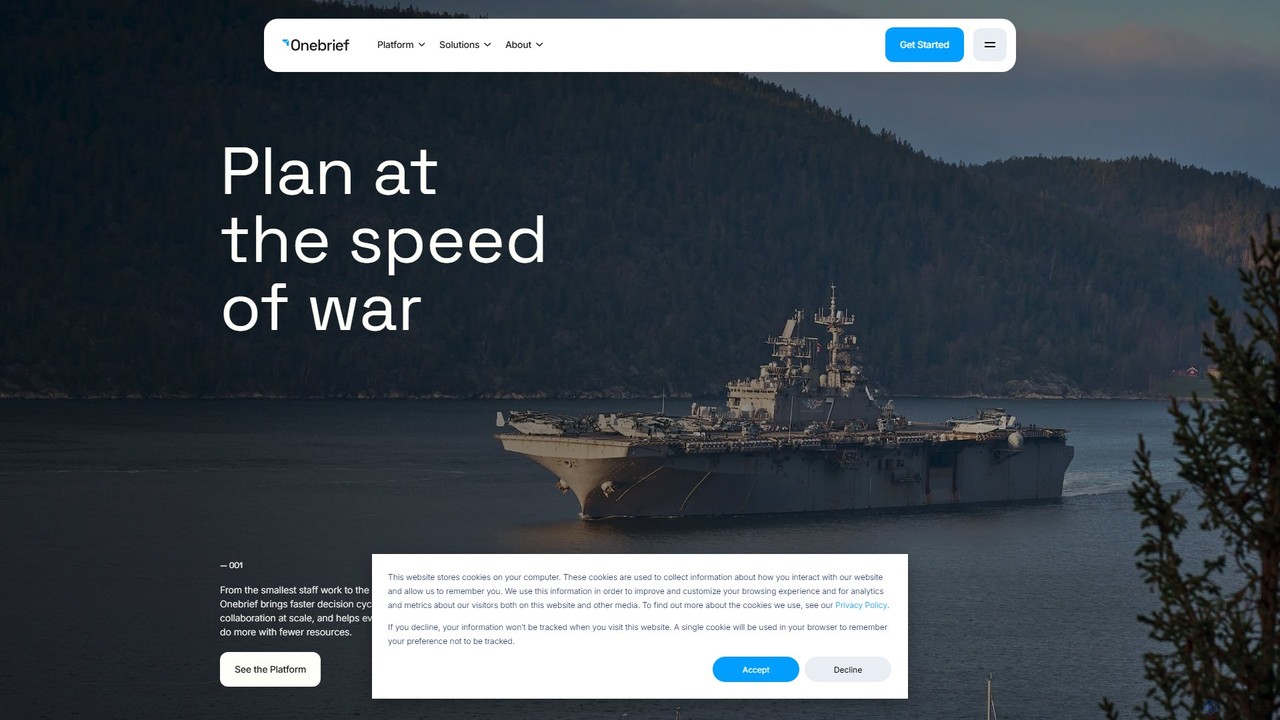
Onebrief is an AI-powered collaborative planning platform designed for military and defense organizations. It streamlines complex operational planning, …

25.1K

About Defense Tech

Defense Tech AI tools are specialized systems that apply artificial intelligence to enhance national security and military operations. These tools leverage machine learning, computer vision, and predictive analytics to process vast amounts of data from sensors, satellites, and intelligence sources. Their primary value lies in accelerating decision-making, improving situational awareness, and optimizing the allocation of resources in complex, high-stakes environments. They provide critical support for intelligence analysis, autonomous systems, and logistical planning.

Core Features

  • ISR Data Analysis: Automates the processing and interpretation of Intelligence, Surveillance, and Reconnaissance data from imagery, signals, and other sensors.
  • Predictive Maintenance: Uses sensor data to forecast equipment failures in vehicles, aircraft, and systems, enabling proactive repairs.
  • Autonomous Navigation: Provides AI algorithms for guiding unmanned aerial (UAVs), ground (UGVs), and maritime vehicles without continuous human control.
  • Cyber Threat Detection: Employs machine learning to identify and neutralize sophisticated cyberattacks on critical defense networks in real-time.
  • Logistics Optimization: AI-driven planning tools that optimize supply chains, troop movements, and resource management for maximum efficiency and safety.

Applicable Scenarios

These tools are primarily used by government defense agencies, military branches, and intelligence communities. Roles such as intelligence analysts, mission commanders, cybersecurity officers, and logistics planners rely on Defense Tech AI to analyze complex data, simulate strategic scenarios, and manage assets effectively on and off the battlefield.

Selection Criteria

When selecting a Defense Tech AI tool, key factors include its adherence to stringent government security and compliance standards (e.g., FedRAMP, CMMC). Other critical considerations are its interoperability with existing legacy systems, the proven accuracy and reliability of its AI models in operational conditions, and its ability to scale and process massive, real-time data streams.

Defense TechUse Cases

1

Automated Target Recognition in Satellite Imagery

An intelligence analyst is tasked with monitoring a vast, remote area for specific military assets. Manually scanning thousands of square kilometers of high-resolution satellite imagery is time-consuming and prone to human error. By using a Defense Tech AI tool with automated target recognition (ATR), the analyst can upload the imagery stream. The AI model, trained on millions of similar images, automatically detects, classifies, and flags potential targets like vehicles, aircraft, or structures in minutes. This reduces manual review time by over 90%, allowing the analyst to focus on verifying high-priority targets and conducting deeper analysis.

2

Predictive Maintenance for a Naval Fleet

A naval maintenance officer is responsible for ensuring the operational readiness of a fleet of ships. Unplanned equipment failures at sea can be catastrophic and costly. The officer uses an AI-powered predictive maintenance system that continuously analyzes data from thousands of sensors on engines, generators, and navigation systems. The AI identifies subtle patterns and anomalies that precede failures. It then generates alerts predicting that a specific component on a specific ship has a high probability of failing within the next 30 days, allowing maintenance crews to schedule repairs during the next port call, preventing at-sea breakdowns and improving fleet availability.

3

Cyber Threat Hunting in a Defense Network

A cybersecurity specialist in a military command center must protect critical networks from advanced persistent threats (APTs). Traditional signature-based antivirus and firewalls are often ineffective against novel attacks. The specialist deploys an AI-driven threat hunting platform that monitors all network traffic and endpoint behavior in real-time. Instead of looking for known threats, the AI establishes a baseline of normal activity and flags any deviation. It can detect stealthy reconnaissance activities or unusual data exfiltration patterns, providing early warnings of a potential breach and allowing the security team to isolate and neutralize the threat before significant damage occurs.

4

Optimizing Military Supply Chain Logistics

A logistics planner for a large-scale military exercise needs to coordinate the delivery of fuel, ammunition, and medical supplies to multiple units spread across a wide geographical area. Factors like weather, road conditions, and potential security threats make manual planning extremely complex. The planner uses an AI-powered logistics optimization tool. They input the supply requirements, unit locations, and available transport assets. The AI runs thousands of simulations to identify the most efficient and secure routes, calculates optimal inventory levels for each location, and can even re-route convoys in real-time in response to new intelligence, ensuring critical supplies reach their destination on time.

5

AI-Assisted Mission Planning and Simulation

A mission commander is planning a complex operation in an urban environment. There are countless variables to consider, from enemy positions to civilian traffic patterns. The commander uses an AI simulation tool to model the operational area. The AI can generate thousands of potential scenarios, simulating different strategies against a range of possible enemy responses based on doctrine and past behavior. This allows the planning team to identify weaknesses in their initial plans, discover unexpected vulnerabilities, and develop more robust and adaptable strategies. The process, which would take weeks manually, is completed in hours, significantly improving the quality and resilience of the final mission plan.

6

Real-time Language Translation for Field Operations

A special forces team is operating in a region where they do not speak the local dialect. Clear communication with the local population is critical for gathering intelligence and ensuring safety. Each team member is equipped with a rugged, portable AI translation device. When speaking with a local, the device captures their speech, translates it into English in near real-time (displayed as text or audio), and translates the team member's English response back into the local dialect. This technology breaks down language barriers, reduces the reliance on human translators who may be unavailable or pose a security risk, and fosters better rapport and understanding in critical situations.

Defense TechFrequently Asked Questions