ToolMage
Sign in

Best 46 Privacy AI tools for Security

Popular Privacy AI tools in Security include DuckDuckGo, Brave, Opera, Kaspersky, Lenso.ai, Neeva, Multilogin, AnythingLLM, DoNotPay, and Fellow, helping you work more efficiently.

Simpliterms
Paid

Simpliterms

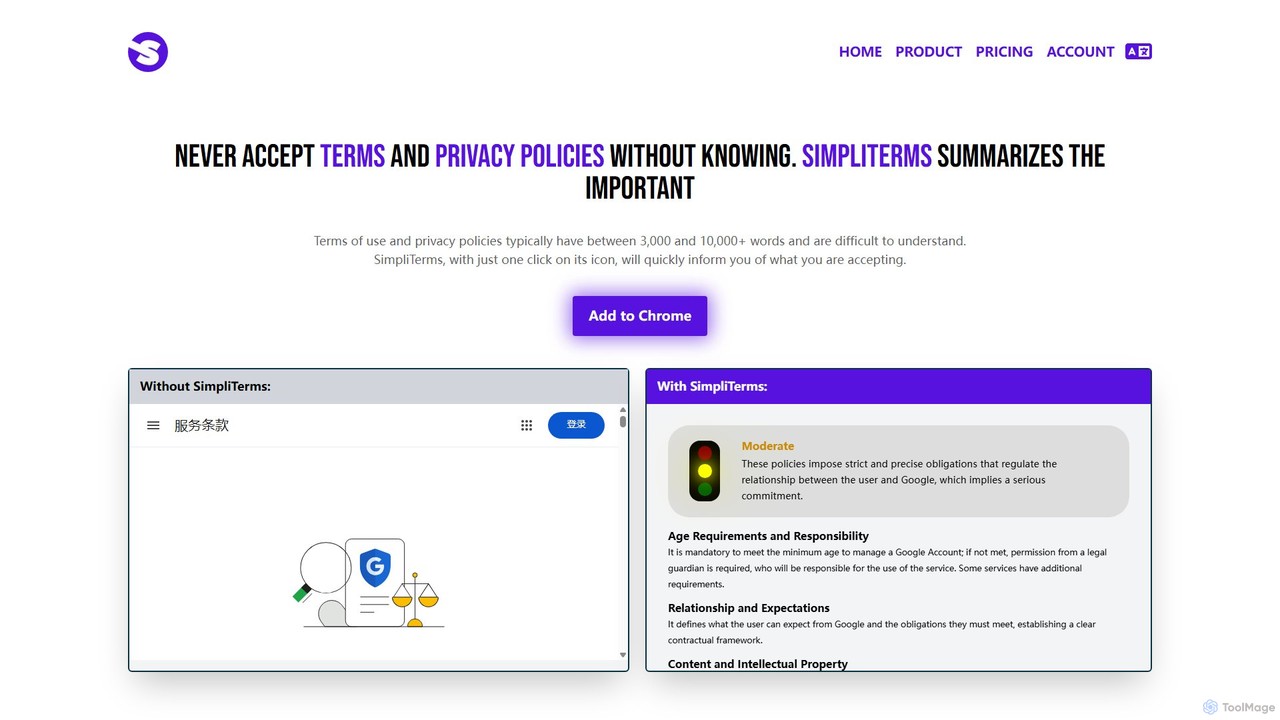
Simpliterms is an AI-powered Chrome extension that instantly summarizes complex terms of service and privacy policies. It helps you understand what you're agreeing to online, saving you time, protecting your privacy, and preventing potential legal issues with just one click.

Chrome Extensions
Visits 5.5KFavorites 101Likes 91
WiseOptIn
Freemium

WiseOptIn

WiseOptIn is an AI-powered Chrome extension that analyzes and simplifies complex privacy policies and terms of service. It scores legal documents, provides easy-to-understand summaries, and features a chatbot to answer your specific questions, empowering you to understand what you're agreeing to online.

Chrome Extensions
Visits 5.4KFavorites 125Likes 123
NICH: GPT Anonymizer
Freemium

NICH: GPT Anonymizer

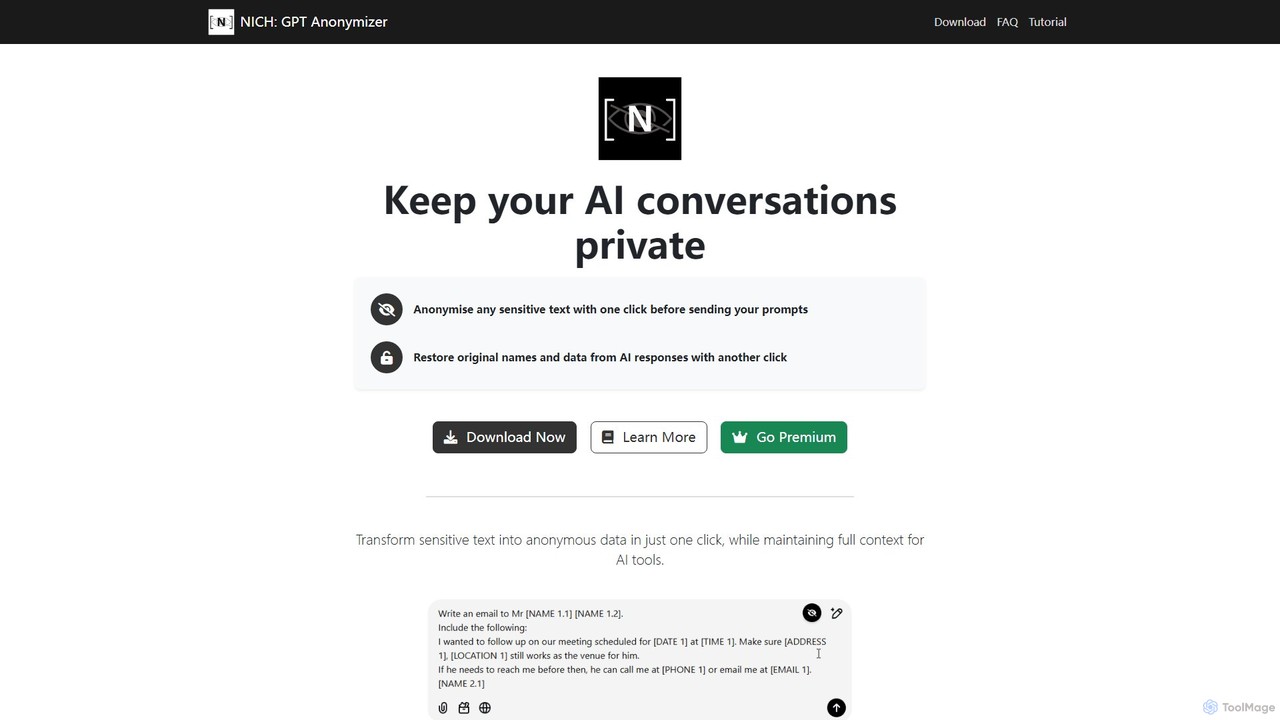
NICH: GPT Anonymizer is a privacy-focused browser extension that secures your AI interactions. It anonymizes sensitive data in your prompts with one click before sending them to services like ChatGPT, and restores the original information from AI responses. All processing is done 100% on your device, ensuring your confidential data never leaves your computer.

Chrome
Visits 5.4KFavorites 138Likes 129

About Privacy

AI Privacy tools are a specialized class of solutions that use artificial intelligence to protect personal and sensitive data. These tools employ advanced techniques like differential privacy, federated learning, and synthetic data generation to anonymize information or train models without exposing raw data. Their primary value lies in enabling organizations to innovate with data while adhering to strict privacy regulations like GDPR and CCPA, thereby building user trust. As a key component of a modern security strategy, they focus proactively on data protection rather than just reactive threat defense.

Core Features

  • Data Anonymization & Pseudonymization: Uses AI to automatically identify and remove or replace personally identifiable information (PII) from datasets.
  • Synthetic Data Generation: Creates statistically representative artificial datasets that mimic real data, allowing for analysis and model training without using sensitive information.
  • Privacy-Preserving Machine Learning (PPML): Implements techniques like federated learning, allowing models to be trained on decentralized data without centralizing it.
  • Automated Compliance Monitoring: Scans data stores and applications to detect potential privacy risks and ensure adherence to legal and regulatory standards.

Use Cases

These tools are crucial in data-sensitive industries such as healthcare, finance, and technology. Data scientists use them to train models on patient or customer data securely. Compliance officers leverage them to automate audits and risk assessments. Developers integrate them to build privacy-by-design applications, ensuring user data is protected from the ground up.

How to Choose

When selecting an AI Privacy tool, consider the specific privacy-enhancing technology (PET) it uses, such as synthetic data or differential privacy, and match it to your use case. Evaluate its support for relevant regulations (e.g., GDPR, HIPAA). Assess its integration capabilities with your existing data pipelines and ML frameworks. Finally, analyze the trade-off between the level of privacy protection and the utility or accuracy of the resulting data.

Featured tool rankings

Privacy use cases

1

Secure Medical Research with Synthetic Data

A healthcare research institute needs to collaborate with other organizations on a study of a rare disease, but cannot share real patient data due to HIPAA regulations. Researchers use an AI Privacy tool to generate a high-fidelity synthetic dataset. This dataset mirrors the statistical properties and correlations of the original patient data, including demographics and clinical outcomes, without containing any real personally identifiable information. As a result, partner institutions can freely analyze the data and develop predictive models, accelerating research breakthroughs while ensuring 100% patient confidentiality.

2

GDPR-Compliant Customer Analytics

An e-commerce company wants to personalize marketing campaigns by analyzing customer purchase history and browsing behavior. To comply with GDPR, the data analytics team uses an AI-powered anonymization tool before loading data into their analytics platform. The tool automatically identifies and redacts PII like names, addresses, and contact details, while preserving data structures and relationships. This allows marketers to uncover valuable trends and segment audiences effectively without accessing sensitive personal data, mitigating the risk of data breaches and ensuring full compliance with privacy laws.

3

Collaborative Fraud Detection with Federated Learning

A consortium of banks wants to build a more robust fraud detection model by pooling their data, but they are legally prohibited from sharing customer transaction information. They adopt a federated learning platform. Each bank trains a local model on its own private data. The platform then aggregates the learnings (model weights) from each bank to create a global, more accurate model, without any raw data ever leaving the banks' secure servers. This collaborative approach significantly improves the detection of complex fraud patterns while maintaining strict data privacy and security for all participating institutions.

4

Automating PII Detection in Code Repositories

A software company is preparing for a security audit and needs to ensure no personally identifiable information (PII) has been accidentally hardcoded into its source code or configuration files. A DevOps engineer uses an AI Privacy tool to scan the company's entire GitHub repository. The tool uses natural language processing to identify potential PII such as API keys, passwords, and email addresses across thousands of files. It flags all instances and generates a report, allowing developers to quickly remediate the issues. This automated process saves hundreds of hours of manual review and helps the company pass its audit.

5

Publishing Public Datasets with Differential Privacy

A government statistics agency wants to release a dataset about public health trends to researchers and the public. To prevent the re-identification of individuals, the agency applies differential privacy techniques using an AI tool. The tool adds a carefully calibrated amount of statistical noise to the dataset before publication. This noise is small enough to preserve the overall accuracy of statistical queries and analyses but large enough to make it mathematically impossible to determine whether any specific individual's data is included. This allows the agency to share valuable data for the public good while providing a formal, provable privacy guarantee.

6

Real-time Redaction of Sensitive Data in Chatbots

A customer service department uses an AI chatbot to handle user inquiries. To prevent accidental collection of sensitive information like credit card numbers or social security numbers, they integrate an AI Privacy API. As users interact with the chatbot, the API analyzes the conversation in real-time. If it detects any PII, it automatically redacts the information before it is stored in the chat logs or passed to a human agent. This proactive measure ensures the company remains compliant with PCI DSS and other regulations, protecting both the customer and the business from data exposure risks.

Privacy FAQ

What are AI Privacy tools?

AI Privacy tools are software solutions that use artificial intelligence to protect sensitive data and ensure regulatory compliance. Unlike general security tools that focus on external threats, these tools focus on the data itself. They employ techniques like data anonymization, synthetic data generation, and federated learning to allow data to be used for analysis and machine learning without compromising individual privacy. Common applications include securing medical research data and enabling GDPR-compliant marketing analytics.

How do I choose the right AI Privacy tool?

Choosing the right tool depends on your specific needs. Consider the following factors:

  • Use Case: Do you need to anonymize data for analytics, generate synthetic data for testing, or train models collaboratively with federated learning?
  • Regulatory Needs: Ensure the tool helps you comply with specific regulations relevant to your industry, such as HIPAA for healthcare or GDPR for European customer data.
  • Data Type: Check if the tool supports your data formats, whether it's structured (like in a database) or unstructured (like text or images).
  • Integration: Evaluate how easily it integrates with your existing technology stack, including databases, data warehouses, and machine learning platforms.
What's the difference between AI Privacy and traditional Security tools?

The primary difference lies in their focus. Traditional security tools, like firewalls or antivirus software, are primarily concerned with protecting systems from external threats such as malware and unauthorized access. They act as a perimeter defense. AI Privacy tools, on the other hand, focus on protecting the data itself, often from internal or analytical use. They work to minimize the risk of data exposure even when data is being actively used, ensuring that insights can be drawn without revealing sensitive individual information. They are a proactive data-centric safeguard, whereas traditional security is often a reactive system-centric defense.

Can AI Privacy tools guarantee 100% data privacy?

While no single solution can offer an absolute 100% guarantee against all possible future threats, AI Privacy tools provide a very high, often mathematically provable, level of protection. Techniques like differential privacy offer a formal guarantee that the inclusion of any single individual's data in a dataset has a statistically insignificant effect on the outcome. Similarly, synthetic data completely decouples the analysis from real individuals. These tools significantly reduce the risk of re-identification and data linkage attacks compared to older, simpler anonymization methods, representing the current state-of-the-art in data protection.

Who should use AI Privacy tools?

AI Privacy tools are valuable for any organization that handles sensitive personal data. Key users include:

  • Data Scientists and Analysts: To build models and perform analytics on sensitive datasets without compromising privacy.
  • Compliance and Legal Teams: To automate monitoring, enforce privacy policies, and ensure adherence to regulations like GDPR, CCPA, and HIPAA.
  • Software Developers and DevOps Engineers: To build privacy-by-design applications and prevent sensitive data leaks in code and infrastructure.
  • Healthcare and Financial Institutions: To protect patient and customer data while still enabling innovation and research.