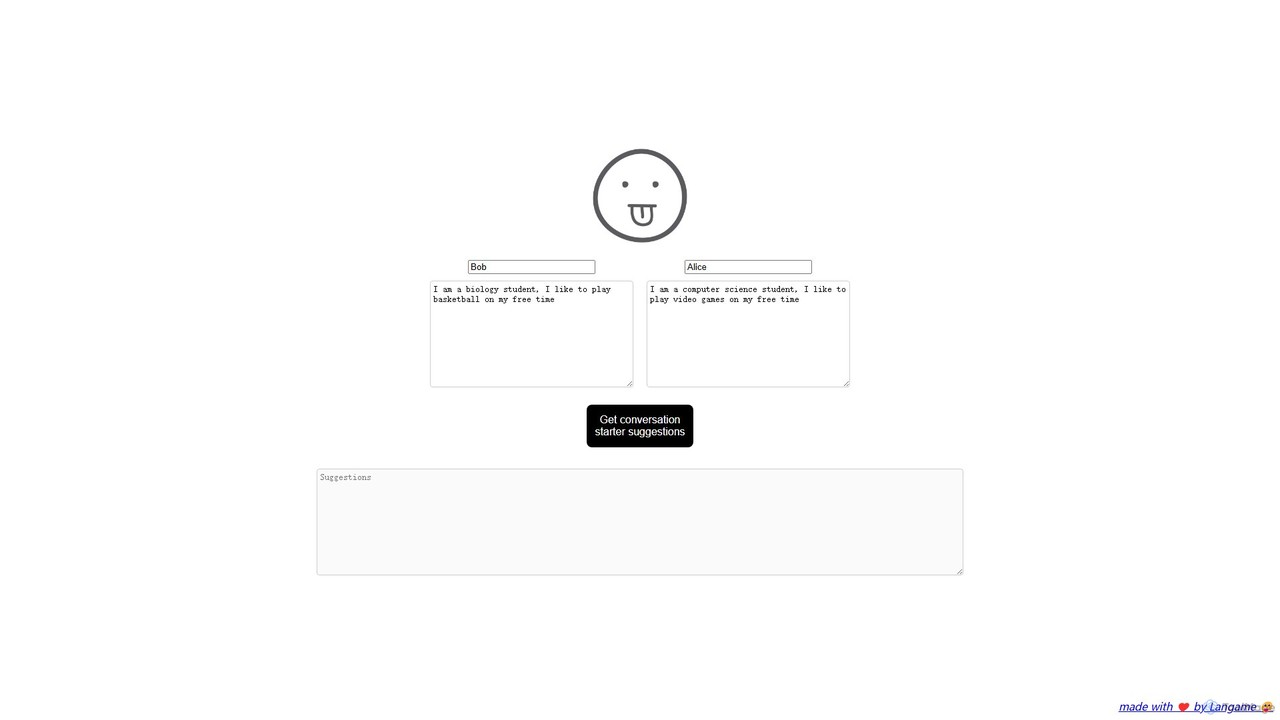
Icebreaker AI tools are a category of artificial intelligence applications designed to facilitate initial interactions and foster connections between individuals or groups, particularly in social or professional settings. These tools leverage natural language processing, sentiment analysis, and behavioral psychology principles to generate personalized conversation starters, engaging prompts, or interactive activities. Their primary value lies in reducing social friction, overcoming awkward silences, and accelerating the formation of rapport, making networking events, team introductions, or online communities more dynamic and inclusive.
Core Features
- Personalized Prompts: Generates tailored questions or topics based on user profiles, shared interests, or event context.
- Conversation Starters: Provides engaging opening lines or discussion points to initiate dialogue effortlessly.
- Interactive Activities: Suggests quick games, polls, or challenges to encourage group participation and interaction.
- Sentiment Analysis: Analyzes communication patterns to suggest appropriate follow-up questions or topics.
Use Cases
Icebreaker AI tools are invaluable in various social and professional contexts. They are frequently used in virtual and in-person networking events to help attendees connect more easily, in corporate team-building sessions to foster camaraderie among new or existing teams, and in educational settings to encourage student participation and group discussions. These tools streamline the process of breaking down initial barriers and creating a more open communication environment.
How to Choose
When selecting an Icebreaker AI tool, consider its customization capabilities for different event types and audiences, the variety and quality of its generated prompts, and its integration options with existing communication platforms like Zoom or Slack. Evaluate its ease of use for both organizers and participants, and assess its ability to scale for various group sizes. Look for tools that offer analytics to measure engagement and feedback mechanisms for continuous improvement.