ToolMage
Sign in

Best 1 Matchmaking AI tools for Social

Popular Matchmaking AI tools in Social include Tuned Together, helping you work more efficiently.

Tuned Together
Freemium

Tuned Together

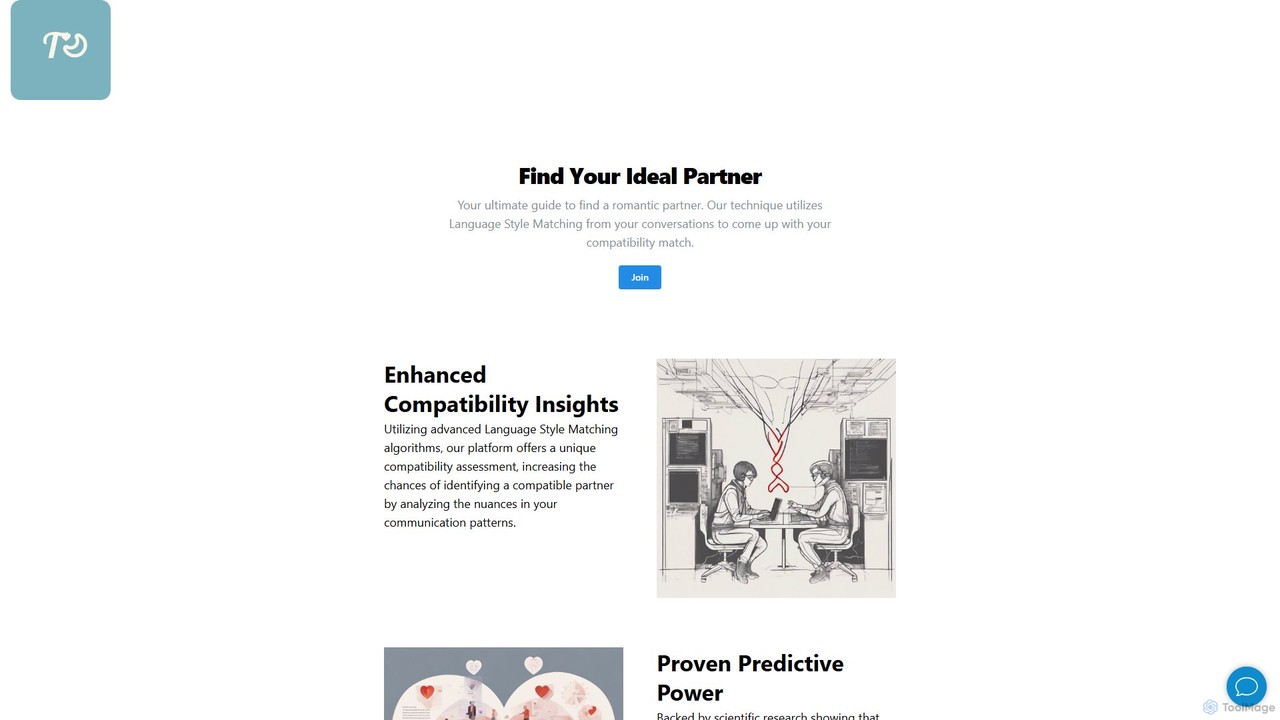
Tuned Together is an AI-powered dating platform that uses Language Style Matching (LSM) to assess compatibility. By analyzing your communication patterns through a chatbot, it connects you with partners who have a similar language style, increasing the likelihood of mutual romantic interest and long-term relationship stability.

Dating
Visits 4.7KFavorites 120Likes 107

About Matchmaking

AI Matchmaking tools are a specialized category of social applications that use artificial intelligence to connect individuals based on deep compatibility. These platforms go beyond simple keyword filters, employing machine learning algorithms to analyze user profiles, behavioral data, and stated preferences. The primary value of AI Matchmaking lies in its ability to identify nuanced connections and predict the potential for successful relationships, whether for personal, professional, or social purposes. This data-driven approach results in more relevant, high-quality suggestions, saving users significant time and effort in their search for the right connections.

Core Features

  • Compatibility Scoring: Utilizes complex algorithms to calculate and display a compatibility score between users based on dozens of data points.
  • Behavioral Analysis: Learns from user interactions, such as who they view, message, and ignore, to continuously refine match recommendations.
  • Personalized Recommendations: Delivers highly tailored suggestions that evolve with the user's preferences and on-platform activity.
  • Semantic Profile Analysis: Employs Natural Language Processing (NLP) to understand the context and sentiment within profile descriptions and communications.
  • Predictive Analytics: Forecasts the likelihood of a successful interaction or long-term relationship based on historical data patterns.

Use Cases

AI Matchmaking tools are widely used in online dating platforms to foster more meaningful connections. They are also increasingly applied in professional networking for pairing mentors with mentees, connecting event attendees with similar interests, and helping recruiters find candidates with the right cultural fit. Other applications include finding co-founders, building project teams, and connecting individuals for shared hobbies.

How to Choose

When selecting an AI Matchmaking tool, consider the specificity of its algorithm and the niche it serves (e.g., romantic, professional, creative). Evaluate its data privacy and security policies to understand how your information is used. The size and activity level of the user base are crucial for a good pool of potential matches. Finally, assess the user interface and the transparency of its matching process to ensure it aligns with your expectations.

Matchmaking use cases

1

Facilitating High-Compatibility Romantic Connections

For individuals using online dating platforms, AI Matchmaking tools serve as a sophisticated personal connector. Instead of manually sifting through thousands of profiles based on basic filters like age and location, the user provides data on their personality, values, communication style, and life goals. The AI analyzes this information, along with on-site behavior, to generate a curated list of highly compatible potential partners. This significantly increases the probability of finding a meaningful relationship by focusing on deep-seated compatibility rather than superficial attributes, saving users emotional energy and time.

2

Intelligent Networking at Professional Events

Event organizers and attendees use AI Matchmaking to maximize networking value at conferences, trade shows, and corporate events. Before the event, attendees complete a profile outlining their professional goals, expertise, and what they seek in new connections. The AI engine then processes this data to suggest meetings with other attendees, speakers, or exhibitors who have complementary interests or business needs. This transforms chaotic networking into a structured, goal-oriented experience, ensuring participants connect with the most relevant people to foster valuable business relationships.

3

Pairing Mentors and Mentees in Organizations

Corporations and educational institutions leverage AI Matchmaking to create effective mentorship programs. The system analyzes detailed profiles of both potential mentors and mentees, considering factors like skills, career aspirations, industry experience, leadership style, and even personality traits. By identifying the best possible pairings based on this holistic data, the AI helps foster developmental relationships that are more likely to succeed. This automated, data-driven process removes manual bias and dramatically improves the quality and scalability of the mentorship program.

4

Assembling High-Performance Project Teams

For project managers and HR departments, AI Matchmaking tools can be instrumental in building effective teams. The software evaluates employees' technical skills, past project performance, collaboration styles, and problem-solving approaches. It then recommends team compositions that balance technical capabilities with interpersonal dynamics. This ensures that the assembled team not only has the required expertise but also possesses a high potential for synergy and efficient collaboration, leading to better project outcomes and a more positive work environment.

5

Connecting Co-founders for New Ventures

Entrepreneurs seeking a business partner can use specialized AI Matchmaking platforms to find a suitable co-founder. These tools go beyond matching industry experience and skills. They assess critical entrepreneurial traits such as risk tolerance, work ethic, long-term vision, and leadership style. By analyzing these deeper compatibility factors, the AI helps connect founders who are truly aligned in their mission and approach, forming a strong foundation for a successful startup and mitigating the risk of future founder conflicts.

6

Discovering Friends with Shared Hobbies

Beyond romance and business, AI Matchmaking helps individuals find platonic friends or activity partners. Users input their hobbies, interests, availability, and social preferences (e.g., preference for small groups vs. large events). The AI then connects them with like-minded people in their local area. This is particularly useful for people who have recently moved to a new city or are looking to expand their social circle, providing a targeted way to find companions for activities like hiking, book clubs, or learning a new skill.

Matchmaking FAQ

What are AI Matchmaking tools?

AI Matchmaking tools are software applications that use artificial intelligence, particularly machine learning algorithms, to connect people based on deep compatibility. Unlike simple search filters, they analyze a wide range of data—including personality traits, behaviors, interests, and communication styles—to predict the success of a potential connection. They are used for romantic dating, professional networking, mentorship, and social discovery.

How is AI Matchmaking different from a standard social media platform?

The primary difference lies in their core purpose. Standard social media platforms focus on building broad networks of existing and new connections (quantity), often based on shared history or casual interests. AI Matchmaking tools focus on creating a limited number of high-quality, highly compatible connections for a specific goal (quality). Matchmaking AI actively analyzes and scores compatibility to make targeted recommendations, whereas social media relies more on user-initiated discovery.

How do AI algorithms determine compatibility?

AI algorithms determine compatibility by processing and weighting numerous data points. This typically includes:

  • Explicit Data: Information users provide directly, such as interests, values, and relationship goals.
  • Implicit Data: Behavioral patterns observed on the platform, like profile views, messaging habits, and response times.
  • Semantic Data: Analysis of the language used in profiles and messages using Natural Language Processing (NLP).
The algorithm then builds a predictive model to calculate a compatibility score for each potential pair.

What are the key benefits of using AI for matchmaking?

The main benefits include increased efficiency, higher quality matches, and the discovery of non-obvious connections. AI automates the time-consuming process of searching for compatible individuals. By analyzing deep data, it often produces more successful and meaningful matches than manual searching. It can also identify potential connections that users might have overlooked based on their own conscious or unconscious biases, leading to more diverse and serendipitous pairings.

How should I choose an AI Matchmaking tool?

When choosing a tool, consider these four factors:

  • Niche and Purpose: Select a platform designed for your specific goal (e.g., dating, business networking, finding a co-founder).
  • Algorithm Transparency: Understand, to the extent possible, what factors the algorithm prioritizes.
  • Data Privacy: Review the platform's privacy policy to ensure your personal data is handled securely and ethically.
  • User Base: A larger, more active user base provides a better pool of potential matches. Check reviews for insights into community quality.