ToolMage
Sign in

Best 1 Customer Relationship Management AI tools for Social Media

Popular Customer Relationship Management AI tools in Social Media include Geniechat, helping you work more efficiently.

Geniechat
Freemium

Geniechat

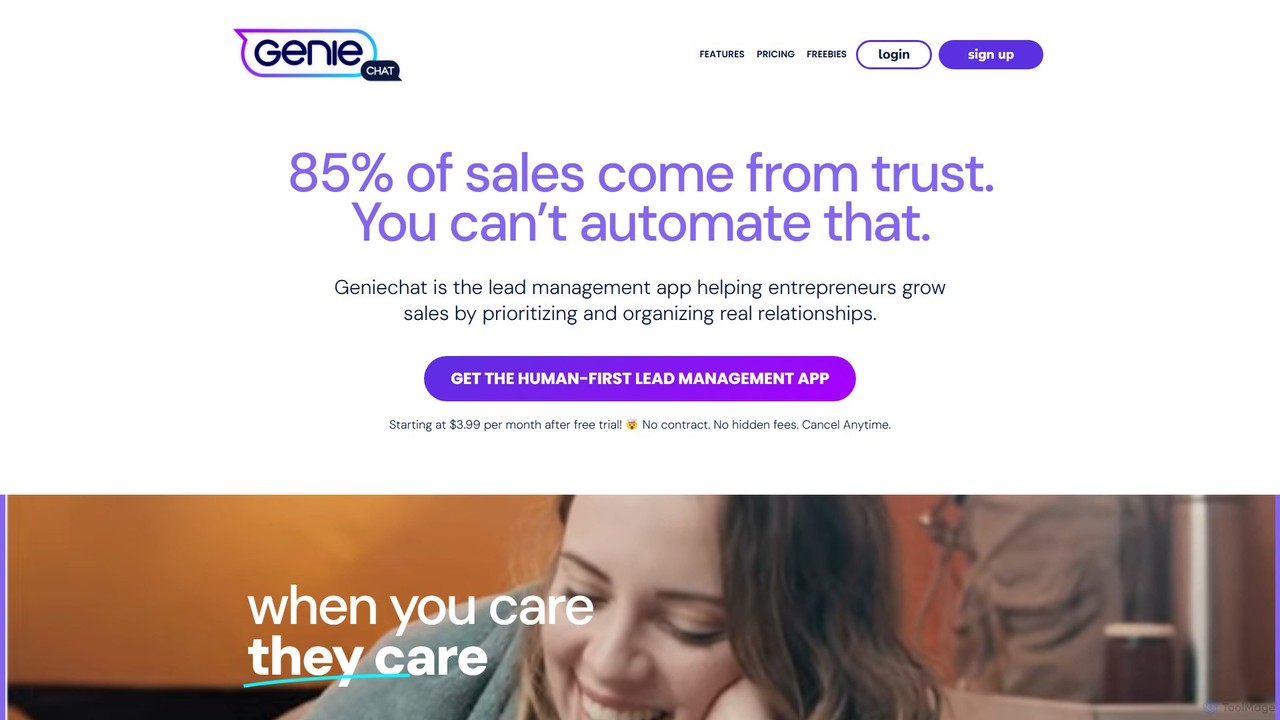
Geniechat is a human-first lead management app and mini-CRM designed for entrepreneurs. It helps you grow sales by organizing social media leads, nurturing relationships, and managing content. It combines a task manager, content hub, and an AI message generator to ensure you never miss a follow-up or a chance to connect personally.

Task Management
Visits 8.2KFavorites 131Likes 120

About Customer Relationship Management

AI Customer Relationship Management (CRM) tools are specialized platforms that use artificial intelligence to manage and analyze customer interactions, primarily on social media channels. These tools leverage technologies like Natural Language Processing (NLP) and sentiment analysis to interpret comments, messages, and mentions in real time. They enable businesses to automate responses, route inquiries intelligently, and gain deep insights from unstructured social conversations. By integrating with social media, these CRMs transform public engagement into structured data for support, marketing, and sales.

Core Features

  • AI-Powered Sentiment Analysis: Automatically detects the emotional tone (positive, negative, neutral) of social media comments and messages.
  • Automated Ticket Routing: Intelligently assigns social media inquiries to the appropriate team or agent based on content, urgency, or user history.
  • Social Media Chatbots: Deploys conversational AI on platforms like Facebook Messenger and Instagram DMs for instant support and lead qualification.
  • Unified Social Inbox: Consolidates all interactions from various social platforms into a single, AI-organized dashboard.
  • Predictive Lead Scoring: Analyzes user engagement on social media to identify and prioritize potential sales leads.

Use Cases

These tools are essential for social media managers, customer support teams, and digital marketers in sectors like e-commerce, retail, and SaaS. They are used to manage high volumes of customer inquiries during campaigns, proactively address negative feedback across platforms, and identify sales opportunities from public conversations, turning social media into a core revenue and support channel.

How to Choose

When selecting an AI CRM for social media, evaluate its platform integrations (does it support your key channels like Instagram, TikTok, X?). Assess the depth of its AI capabilities, such as the accuracy of its sentiment analysis and the flexibility of its chatbot builder. Consider its scalability to handle your interaction volume and its ability to integrate with your existing CRM or helpdesk software for a unified customer view.

Customer Relationship Management use cases

1

Automate Social Media Customer Support

An e-commerce brand's support team uses an AI CRM to manage the high volume of inquiries on Instagram and Facebook during a sales event. The tool's AI automatically categorizes incoming DMs into tags like 'order status', 'shipping query', or 'return request'. A chatbot provides instant answers to common questions, resolving over 60% of inquiries without human intervention. Complex issues are automatically routed to specialized agents, reducing average response time from hours to minutes and improving customer satisfaction.

2

Proactively Manage Brand Reputation

A SaaS company's marketing team uses an AI CRM to monitor brand mentions across X (formerly Twitter) and Reddit. The tool's sentiment analysis engine flags negative comments in real-time, even those that don't directly tag the company's official account. This allows the community management team to quickly engage with unhappy users, address their concerns publicly, and turn a potential PR crisis into a positive customer service interaction, protecting the brand's online reputation.

3

Identify Sales Leads from Social Conversations

A B2B tech company's sales team leverages their AI CRM to find leads on LinkedIn. The tool analyzes comments on industry-related posts and identifies users asking questions that indicate a buying intent (e.g., 'Which solution integrates with Salesforce?'). The AI automatically creates a lead profile with the user's public information and conversation history. This allows the sales team to initiate a relevant, informed conversation, significantly increasing the quality of social selling leads compared to cold outreach.

4

Personalize Community Engagement at Scale

A video game developer's community manager uses an AI CRM to interact with thousands of players on Discord and Reddit. The AI analyzes discussions to identify trending topics, common feature requests, and bug reports. It groups similar feedback together, allowing the manager to craft a single, well-informed response that addresses hundreds of players at once. The tool also identifies influential community members, enabling personalized outreach and fostering stronger relationships with key advocates.

5

Measure Social Media Campaign Impact

A marketing agency runs a multi-platform campaign for a fashion client. They use an AI CRM to track the entire customer journey, from a user clicking an ad on TikTok to making a purchase. The tool connects social media profiles to customer accounts, attributing sales directly to specific campaigns, posts, or influencers. This provides the agency with clear, quantifiable data on ROI, allowing them to optimize future ad spend and prove the value of their social media strategy to the client.

6

Streamline Influencer Collaboration Management

A beauty brand's marketing team manages relationships with hundreds of influencers. They use an AI CRM as a central hub for all communications. The tool automatically logs DMs and email exchanges with each influencer, tracks contract statuses, and monitors the performance of their sponsored posts using sentiment analysis. This unified view prevents miscommunication and allows the team to easily identify their top-performing partners for future campaigns, making their influencer marketing program more efficient and data-driven.

Customer Relationship Management FAQ

What is AI-powered Customer Relationship Management (CRM) for social media?

AI-powered CRM for social media is software that uses artificial intelligence to manage, analyze, and automate customer interactions across social platforms. Unlike traditional CRMs that focus on email and calls, these tools are built to handle the high volume and unstructured nature of social media conversations. Key AI features include sentiment analysis to understand customer tone, chatbots for instant responses, and automated routing of inquiries to the right support agent.

How does an AI CRM differ from a standard social media management tool?

Standard social media management tools focus on content scheduling, publishing, and basic analytics (likes, shares). An AI CRM goes deeper by focusing on the customer relationship. It uses AI to analyze the content of conversations, not just the engagement metrics. Key differences include:

  • Sentiment Analysis: AI CRMs understand if a comment is positive or negative; standard tools just count it.
  • Automated Ticketing: AI CRMs can turn a tweet into a support ticket and route it automatically.
  • Lead Identification: AI CRMs can identify buying signals in conversations to create sales leads.
In short, management tools help you talk *at* your audience, while AI CRMs help you talk *with* them and understand them at scale.

What are the key features to look for in a Social Media CRM tool?

When choosing a Social Media CRM, prioritize features that align with your goals. Key features include:

  • Platform Integrations: Ensure it supports all the social media channels where your audience is active (e.g., Instagram, TikTok, Facebook, X, LinkedIn).
  • Unified Inbox: A single stream for all messages, comments, and mentions to ensure no interaction is missed.
  • AI and Automation Quality: Evaluate the accuracy of its sentiment analysis and the flexibility of its automation rules and chatbot builder.
  • Analytics and Reporting: Look for robust dashboards that track response times, team performance, sentiment trends, and conversation topics.
  • Integration with Other Systems: Check if it can connect to your main CRM (like Salesforce) or helpdesk software to create a complete customer profile.

Which businesses benefit most from using an AI Social Media CRM?

Businesses with a high volume of customer interactions on social media see the most significant benefits. This typically includes:

  • B2C Brands and E-commerce: Companies that handle numerous customer service questions, order inquiries, and product feedback on platforms like Instagram and Facebook.
  • SaaS and Technology Companies: Firms that use social media for lead generation, community building, and providing technical support.
  • Hospitality and Travel: Businesses like hotels and airlines that manage bookings, reviews, and real-time customer issues via social channels.
Essentially, any organization that views social media as a critical channel for customer acquisition, support, and retention can gain a competitive advantage with an AI CRM.

How does AI improve customer response times on social media?

AI dramatically reduces response times in several ways. First, AI-powered chatbots can provide instant, 24/7 answers to frequently asked questions, resolving many queries without needing a human agent. Second, for more complex issues, AI automatically analyzes and categorizes incoming messages, routing them to the correct department or agent immediately. This eliminates the manual sorting process, which is often a major bottleneck. By handling simple queries instantly and routing complex ones efficiently, AI ensures customers get the right help faster.