
ToolMage
Sign in

Best 1 Response Generation AI tools for Social Media

Popular Response Generation AI tools in Social Media include ResponsifyAI, helping you work more efficiently.

ResponsifyAI
Freemium

ResponsifyAI

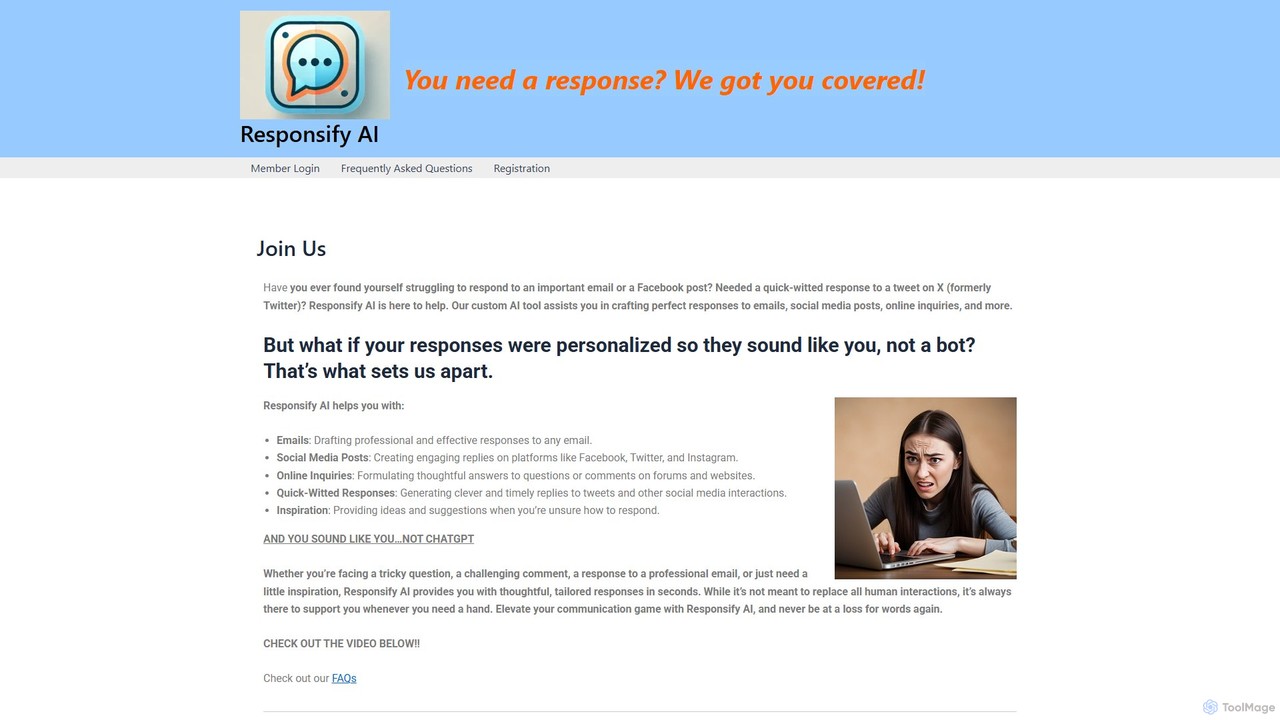
ResponsifyAI is an AI-powered assistant designed to help you craft perfect, personalized responses for emails, social media, and online inquiries. It focuses on generating replies that sound like you, not a bot, saving you time and enhancing your digital communication with clever, engaging, and professional content.

Email Assistant
Visits 5.7KFavorites 112Likes 122

About Response Generation

Response Generation tools are AI-powered solutions designed to automatically craft contextually relevant and engaging text replies. Leveraging advanced Natural Language Processing (NLP) and Natural Language Generation (NLG), these tools analyze incoming messages, understand user intent, and produce human-like responses. They are invaluable for maintaining consistent brand communication, scaling customer interactions, and significantly reducing manual effort across various digital platforms, especially within social media environments.

Core Features

  • Contextual Understanding: Analyzes previous interactions and conversation history to generate highly relevant replies.
  • Tone & Style Customization: Adapts response tone (e.g., formal, friendly, empathetic) to match brand voice and specific situations.
  • Multi-platform Integration: Seamlessly connects with popular social media platforms, messaging apps, and CRM systems.
  • Automated Drafting & Suggestion: Provides full response drafts or intelligent suggestions for human agents to review and send.
  • Sentiment Analysis: Detects the emotional tone of incoming messages to ensure appropriate and sensitive replies.

Applicable Scenarios

Social media managers use these tools to handle high volumes of comments and direct messages efficiently. Customer support teams deploy them for instant, consistent answers to common inquiries, freeing up agents for complex issues. Marketing professionals leverage response generation for personalized engagement in campaigns, ensuring timely and relevant interactions with their audience.

How to Choose

When selecting a Response Generation tool, prioritize its accuracy in understanding context and generating relevant replies. Evaluate customization options for tone and brand voice, as well as integration capabilities with your existing social media and CRM platforms. Consider scalability to handle growing message volumes and the quality of its multilingual support for diverse audiences. Finally, assess the ease of use and the level of human oversight required for optimal performance.

Response Generation use cases

1

Automating Social Media Customer Support

For brands receiving hundreds of daily inquiries on platforms like Twitter or Facebook, AI response generation tools can automatically answer frequently asked questions, provide order updates, or direct users to relevant resources. This ensures 24/7 support, reduces response times, and allows human agents to focus on complex issues, significantly improving customer satisfaction and operational efficiency.

2

Engaging with User Comments on Posts

Content creators and marketing teams can use these tools to generate unique, personalized replies to comments on their social media posts (e.g., Instagram, YouTube). Instead of generic "thank you" messages, the AI can craft responses that acknowledge specific points in the comment, fostering deeper community engagement and making followers feel heard and valued, even at scale.

3

Personalizing Direct Message (DM) Campaigns

Businesses running personalized outreach campaigns via DMs on platforms like LinkedIn or Instagram can leverage response generation to tailor follow-up messages. Based on initial user replies or profile information, the AI can suggest or draft subsequent messages that are highly relevant to the individual, increasing conversion rates and building stronger relationships.

4

Managing Online Reviews and Feedback

Hospitality businesses or e-commerce stores often receive numerous reviews on Google, Yelp, or product pages. Response generation tools can help draft polite, professional, and varied replies to both positive and negative feedback. This ensures consistent brand image, addresses customer concerns promptly, and demonstrates active engagement with the customer base.

5

Facilitating Interactive Q&A Sessions

During live Q&A sessions or webinars on social media, AI response generators can assist moderators by quickly drafting answers to common or pre-defined questions. This allows for a smoother, more dynamic interaction, ensuring that a wider range of audience questions are addressed promptly without overwhelming the human host, enhancing the overall event experience.

6

Drafting Crisis Communication Responses

In situations requiring rapid and sensitive communication, such as a public relations crisis on social media, these tools can help draft initial holding statements or empathetic responses. While human oversight is crucial, the AI can quickly generate multiple drafts that adhere to brand guidelines and convey the right tone, enabling faster and more consistent crisis management.

Response Generation FAQ

What are AI Response Generation tools?

AI Response Generation tools are advanced software applications that use artificial intelligence, specifically Natural Language Processing (NLP) and Natural Language Generation (NLG), to automatically create text replies. Within the social media context, they analyze incoming messages, comments, or queries and generate relevant, context-aware, and often personalized responses, aiming to automate communication and enhance engagement.

How do AI Response Generation tools work?

These tools typically work by first ingesting and analyzing incoming text using NLP to understand its meaning, sentiment, and user intent. They then use NLG models, often trained on vast datasets of conversations and brand-specific content, to construct a suitable reply. The AI considers context, desired tone, and predefined rules or knowledge bases to generate a coherent and relevant response, which can then be automatically sent or presented for human review.

What are the main benefits of using Response Generation for social media?

The primary benefits include significantly improved efficiency and scalability in handling high volumes of social media interactions, ensuring consistent brand voice and messaging across all replies, and reducing response times. They free up human agents to focus on more complex or sensitive issues, enhance customer satisfaction through prompt and relevant communication, and can operate 24/7, extending support availability.

How should I choose an AI Response Generation tool for my business?

When selecting a tool, consider its accuracy in understanding diverse user inputs and generating appropriate responses. Evaluate its customization capabilities for adapting to your specific brand voice, tone, and industry-specific terminology. Look for robust integration with your existing social media platforms and CRM systems, assess its scalability to grow with your needs, and compare pricing models. Finally, consider the level of control and human oversight it offers.

What's the difference between Response Generation and general AI writing assistants?

While both generate text, Response Generation tools are specifically designed for *interactive, dialogue-based replies* to existing inputs, often in real-time. They excel at understanding conversational context and generating short, direct, and relevant answers or follow-ups. General AI writing assistants, on the other hand, are typically used for generating longer-form content like articles, marketing copy, or creative writing, with less emphasis on immediate, contextual interaction.