
ToolMage
Sign in

Best 1 Networking AI tools for Social

Popular Networking AI tools in Social include cards, helping you work more efficiently.

cards
Paid

cards

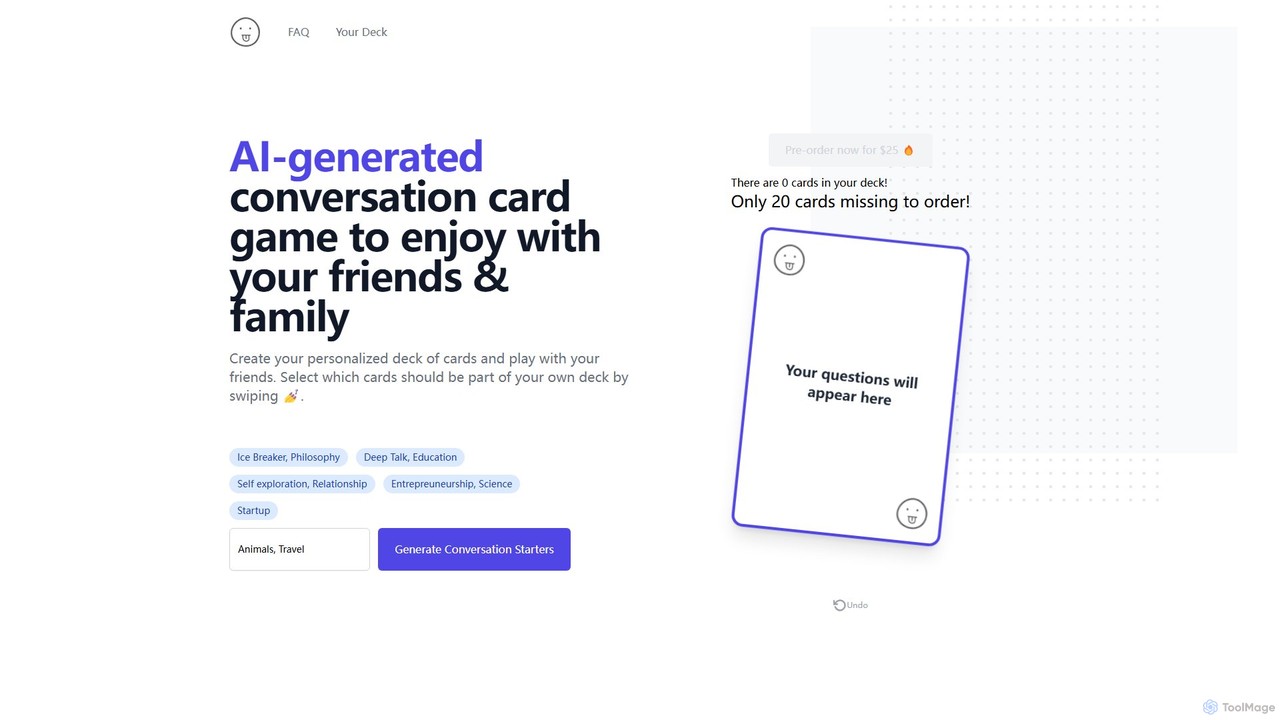
cards is an AI-powered platform for creating personalized conversation starter card games. Select from diverse categories like Ice Breaker, Philosophy, and Relationships, then swipe through AI-generated questions to build your unique deck. Perfect for friends, family, or team-building events, you can pre-order your custom physical card game to spark engaging and meaningful discussions in any social setting.

Conversation Starters
Visits 6.6KFavorites 147Likes 145

About Networking

AI Networking tools are specialized platforms that leverage artificial intelligence to help users discover, build, and manage professional relationships. They analyze data from various sources like social profiles and professional databases to suggest relevant connections and personalize outreach. These tools streamline the process of expanding one's professional circle, making it easier for sales teams, entrepreneurs, and job seekers to connect with the right people at the right time. Unlike general social media management tools, they focus specifically on facilitating meaningful one-on-one interactions.

Core Features

  • Intelligent Contact Discovery: Identifies potential contacts based on industry, role, company, and shared interests.
  • AI-Powered Outreach: Generates personalized icebreakers and follow-up messages to increase response rates.
  • Relationship Mapping: Visualizes your network to uncover hidden connections and pathways to key individuals.
  • Event Networking Assistance: Suggests relevant people to meet at conferences and events based on your goals.
  • Automated Follow-ups: Schedules and sends reminders to nurture new and existing connections consistently.

Use Cases

These tools are widely used by sales development representatives for lead generation, founders seeking investors, and professionals looking to expand their industry influence. For instance, a user can set criteria for their ideal client, and the tool will generate a list of prospects with suggested conversation starters to initiate contact.

How to Choose

When selecting an AI Networking tool, consider its data sources and accuracy for contact discovery. Evaluate the quality of its AI-generated messaging and the level of personalization it allows. Also, check for integrations with your existing CRM or email platforms and consider the pricing model, whether it's per-user or based on the number of contacts.

Networking use cases

1

Automating Lead Generation for Sales Teams

Sales development representatives (SDRs) often spend hours manually searching for prospects on platforms like LinkedIn. An AI Networking tool automates this by identifying ideal customer profiles based on firmographics and buying signals. The AI can then generate personalized outreach sequences, including initial connection requests and follow-up emails, tailored to each prospect's role and industry. This significantly reduces manual research time and increases the number of qualified meetings booked per month.

2

Accelerating Job Search and Career Growth

For job seekers, connecting with the right recruiters and hiring managers is critical. AI Networking tools help identify key decision-makers at target companies who might not be actively posting jobs. The platform can suggest personalized messages that highlight the user's relevant skills and experience, increasing the chances of getting a response. It also helps track conversations and schedule follow-ups, ensuring no opportunity is missed during a competitive job search.

3

Connecting Founders with Potential Investors

Startup founders need to build relationships with venture capitalists and angel investors. AI Networking tools can map out the investment landscape, identifying investors who have funded similar companies in the past. The AI can analyze an investor's portfolio and public statements to suggest a tailored pitch angle. This data-driven approach helps founders focus their efforts on the most relevant investors, saving valuable time and improving their fundraising success rate.

4

Maximizing Conference and Event ROI

Attending large industry events can be overwhelming. Before the event, an AI Networking tool can scan the attendee list and suggest the most valuable people to meet based on the user's predefined goals (e.g., finding partners, clients, or talent). It can help schedule meetings in advance and provide talking points or icebreakers for each person. This transforms a chaotic event into a structured and highly productive networking opportunity.

5

Building Academic and Research Collaborations

Researchers and academics can use AI Networking tools to find collaborators for their projects. By inputting keywords related to their field of study, the tool can identify other experts who have published relevant papers or are working on similar topics. It facilitates introductions and helps build cross-institutional research networks, accelerating scientific discovery and innovation.

6

Enhancing Personal Relationship Management (PRM)

For consultants, freelancers, and executives, maintaining a strong professional network is an ongoing effort. AI Networking tools act as a personal relationship manager, reminding users to reconnect with important contacts they haven't spoken to in a while. The AI can suggest relevant articles to share or congratulate a contact on a recent work anniversary, providing natural reasons to stay in touch and keep relationships warm.

Networking FAQ

What are AI Networking tools?

AI Networking tools are software applications that use artificial intelligence to help individuals and businesses build and manage professional connections. They automate tasks like finding relevant contacts, personalizing outreach messages, and scheduling follow-ups. Unlike traditional social media platforms, their primary focus is on facilitating targeted, one-on-one interactions to achieve specific goals like sales, fundraising, or career development.

How do I choose the right AI Networking tool?

To choose the right tool, consider these factors:

  • Data Quality: Ensure the tool sources its contact information from reliable and up-to-date databases.
  • Personalization Features: Look for AI that generates genuinely relevant and human-like messages, not just generic templates.
  • Integration Capabilities: Check if it connects smoothly with your existing tools, such as your CRM, email client, and calendar.
  • User Interface: The platform should be intuitive and easy to navigate to save you time, not create another complex system to learn.
What is the difference between AI Networking tools and a CRM?

The main difference lies in their primary function. A CRM (Customer Relationship Management) is a system of record for managing existing customer and prospect data, focusing on tracking the entire sales pipeline. An AI Networking tool, on the other hand, is a system of engagement focused on the top of the funnel—discovering new contacts and initiating the first conversation. While some CRMs have networking features, dedicated AI Networking tools offer more advanced capabilities for intelligent discovery and personalized outreach at scale.

What are the key features of AI Networking tools?

Most AI Networking tools include a combination of these core features:

  • Contact Discovery: Searching vast databases to find professionals based on specific criteria.
  • AI Message Generation: Creating personalized icebreakers, connection requests, and follow-up emails.
  • Relationship Intelligence: Analyzing your existing network to find warm introduction paths to target individuals.
  • Automated Sequences: Setting up multi-step outreach campaigns that run automatically.
  • Analytics and Reporting: Tracking key metrics like connection rates, response rates, and meetings booked.
Who should use AI Networking tools?

AI Networking tools are beneficial for a wide range of professionals. This includes sales teams looking for new leads, startup founders seeking investors, job seekers trying to connect with hiring managers, event organizers wanting to facilitate connections, and any professional who relies on building a strong network for their success, such as consultants, freelancers, and business development managers.