beyourbest
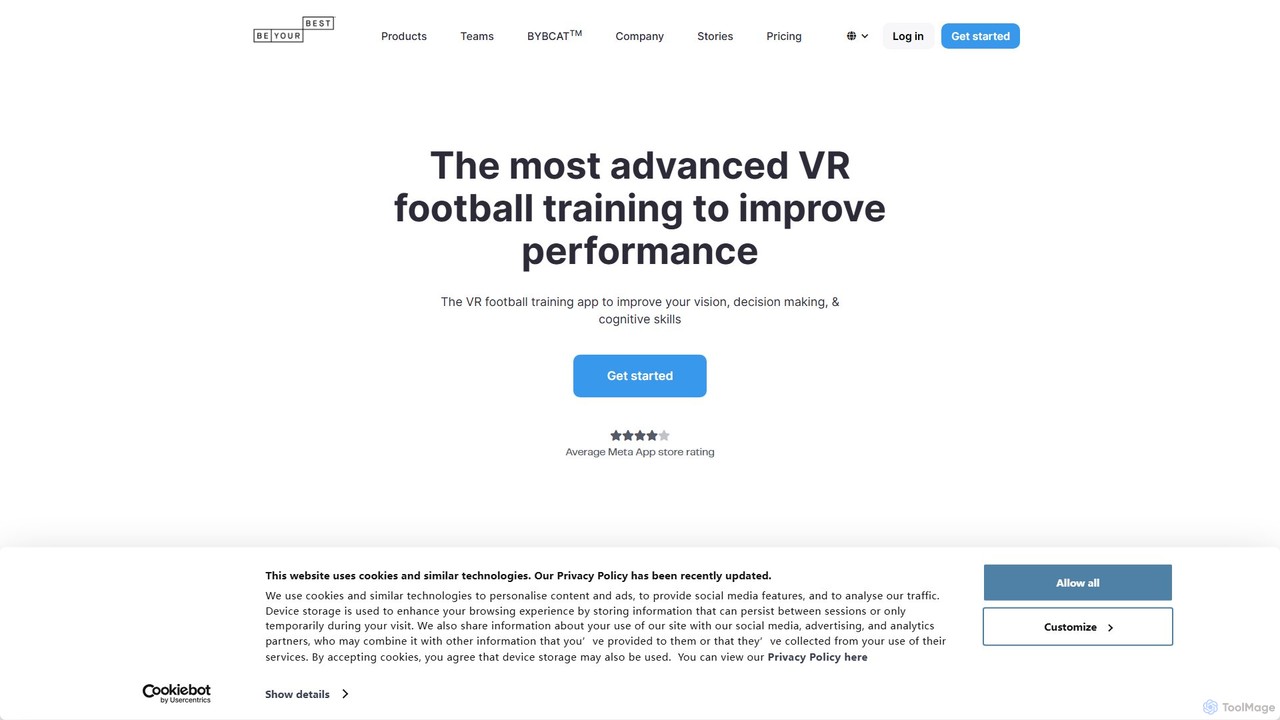
Be Your Best is a cutting-edge VR football (soccer) training platform powered by AI. Used by professional players …
Be Your Best is a cutting-edge VR football (soccer) training platform powered by AI. Used by professional players and top clubs, it enhances cognitive skills like game intelligence, decision-making, and spatial awareness through immersive, data-driven virtual scenarios. Train smarter, not just harder, and gain a competitive edge on the pitch.
About Virtual Reality Training
Virtual Reality Training tools are immersive software platforms that use AI to create realistic, interactive simulations for skill development. These tools leverage AI algorithms to generate dynamic scenarios, track user performance with high precision, and provide real-time, data-driven feedback. Primarily used in sports, healthcare, and high-risk industries, they offer a safe, repeatable, and measurable environment to master complex physical and cognitive skills. Unlike traditional methods, AI-powered VR training can adapt difficulty levels automatically and simulate rare situations that are impractical to replicate in real life.
Core Features
- AI-Driven Scenario Generation: Creates dynamic and unpredictable training environments that adapt to user actions.
- Biometric Performance Tracking: Monitors eye movement, body posture, and reaction times for detailed analysis.
- Real-Time Feedback & Coaching: Provides instant audio-visual cues and performance corrections during the simulation.
- Personalized Difficulty Adaptation: Automatically adjusts challenge levels based on the user's real-time proficiency and learning pace.
- Predictive Analytics: Analyzes performance data to identify skill gaps, predict future outcomes, and suggest improvement areas.
Applicable Scenarios
This technology is crucial for roles requiring high-stakes decision-making and motor skills. For instance, athletes use it to practice game-day scenarios against AI opponents, surgeons rehearse complex procedures to improve precision, and pilots simulate emergency landings. It is also increasingly adopted in corporate settings for leadership and soft skills training in controlled, repeatable virtual environments.
Selection Criteria
When choosing a Virtual Reality Training tool, consider the simulation's fidelity, including the realism of its graphics, physics, and AI behavior. Evaluate its hardware compatibility with specific VR headsets and tracking systems. Assess the depth of the data analytics and reporting features to ensure they provide actionable insights. Finally, check the platform's capacity for customization and scalability to meet specific training objectives and team sizes.
Virtual Reality TrainingUse Cases
Elite Athlete Decision-Making Training
A professional quarterback or soccer midfielder uses a VR training tool to improve split-second decision-making under pressure. The platform generates thousands of unique defensive formations controlled by an adaptive AI, forcing the athlete to read plays and identify open targets in real-time. The system analyzes eye-tracking data to confirm the athlete is scanning the field correctly and measures reaction time to a millisecond. This allows for intensive, high-volume practice without physical wear and tear, leading to faster cognitive processing and improved performance on game day.
Surgical Procedure Rehearsal and Training
A surgical resident prepares for a complex laparoscopic procedure by rehearsing it multiple times in a hyper-realistic VR simulation. The tool provides haptic feedback to simulate the feel of surgical instruments and tissue resistance. An AI instructor monitors every movement, flagging deviations from optimal technique and providing real-time corrective guidance. The system tracks metrics like procedural time, economy of motion, and error rates, allowing the resident to build muscle memory and confidence in a zero-risk environment before entering the operating room.
High-Risk Emergency Response Simulation
A team of firefighters trains for a hazardous materials incident in a dynamic VR environment. The AI scenario generator creates unpredictable challenges, such as sudden chemical spills or equipment malfunctions, forcing the team to adapt their strategy. The simulation tracks communication patterns, adherence to safety protocols, and decision-making under stress. After the session, a detailed debrief report highlights areas for improvement in teamwork and procedural execution, preparing them for real-world emergencies more effectively and safely than physical drills alone.
Corporate Soft Skills and Leadership Training
A new manager practices difficult conversations, such as delivering negative feedback or mediating a conflict, with AI-powered avatars. These virtual characters exhibit realistic emotional responses and can steer the conversation down multiple paths based on the manager's word choice and tone. The system provides a post-session analysis of communication effectiveness, highlighting moments of empathy or assertiveness. This private, judgment-free environment allows leaders to build confidence and refine their interpersonal skills before applying them in real workplace situations.
Technical Skill Training for Field Technicians
An aerospace technician learns to assemble a complex engine component using a VR training module. The system overlays a step-by-step 3D guide onto the virtual component, highlighting correct parts and tool usage. The AI verifies that each step is completed correctly and in the right sequence before allowing the user to proceed. This hands-on virtual practice reduces the risk of damaging expensive physical equipment and accelerates the learning curve, ensuring technicians are fully competent before working on real assets.
Public Speaking and Presentation Practice
An executive preparing for a major conference presentation uses a VR tool to practice in front of a simulated audience. The AI controls the audience's behavior, from attentive listeners to distracting individuals, to mimic real-world conditions. The platform analyzes the speaker's performance, providing feedback on pacing, use of filler words, eye contact with different parts of the virtual room, and vocal modulation. This allows for repeated, realistic rehearsals that build confidence and polish delivery in a way that practicing in an empty room cannot.