ToolMage
Sign in

Best 6 Text Summarizer AI tools for Summarizer

Popular Text Summarizer AI tools in Summarizer include Coral AI, File AI, moyonote, SumyAI, summaletter, and Baoyue AI, helping you work more efficiently.

Baoyue AI
Freemium

Baoyue AI

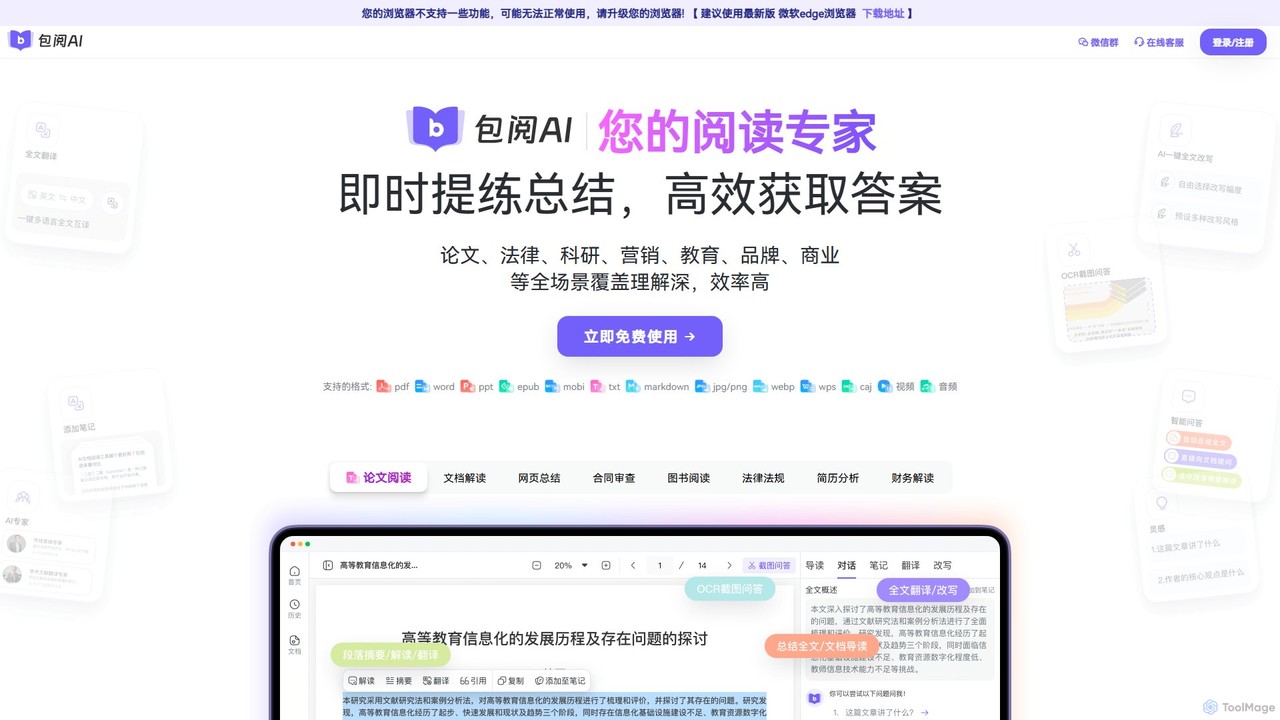
Baoyue AI is an intelligent AI-powered reading assistant designed to enhance productivity. It allows users to instantly summarize, analyze, and interact with various documents, webpages, and media files through a conversational interface, making information comprehension and extraction fast and efficient.

Contract Management
Visits 4.2KFavorites 135Likes 140
File AI
Freemium

File AI

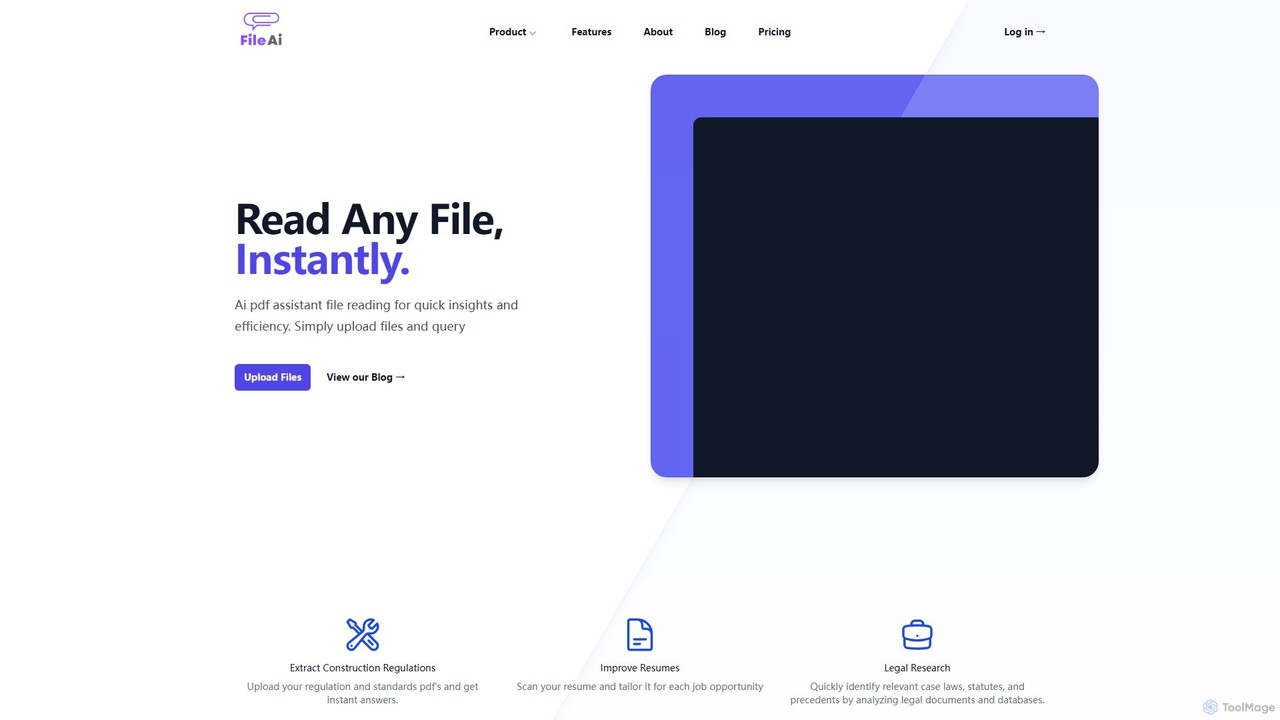
File AI is an intelligent document assistant that allows you to chat with your files. Instantly read, summarize, and extract key information from various document types like PDFs, DOCX, and more. It's designed to boost productivity for students, researchers, legal professionals, and anyone working with documents.

Research
Visits 6.7KFavorites 123Likes 119
summaletter
Freemium

summaletter

summaletter is an AI-powered tool that automatically summarizes your newsletters and long emails into concise, easy-to-read digests. Reclaim your time and conquer inbox overload by getting the key insights without reading every word.

Email Assistant
Visits 4.7KFavorites 96Likes 108
moyonote
Freemium

moyonote

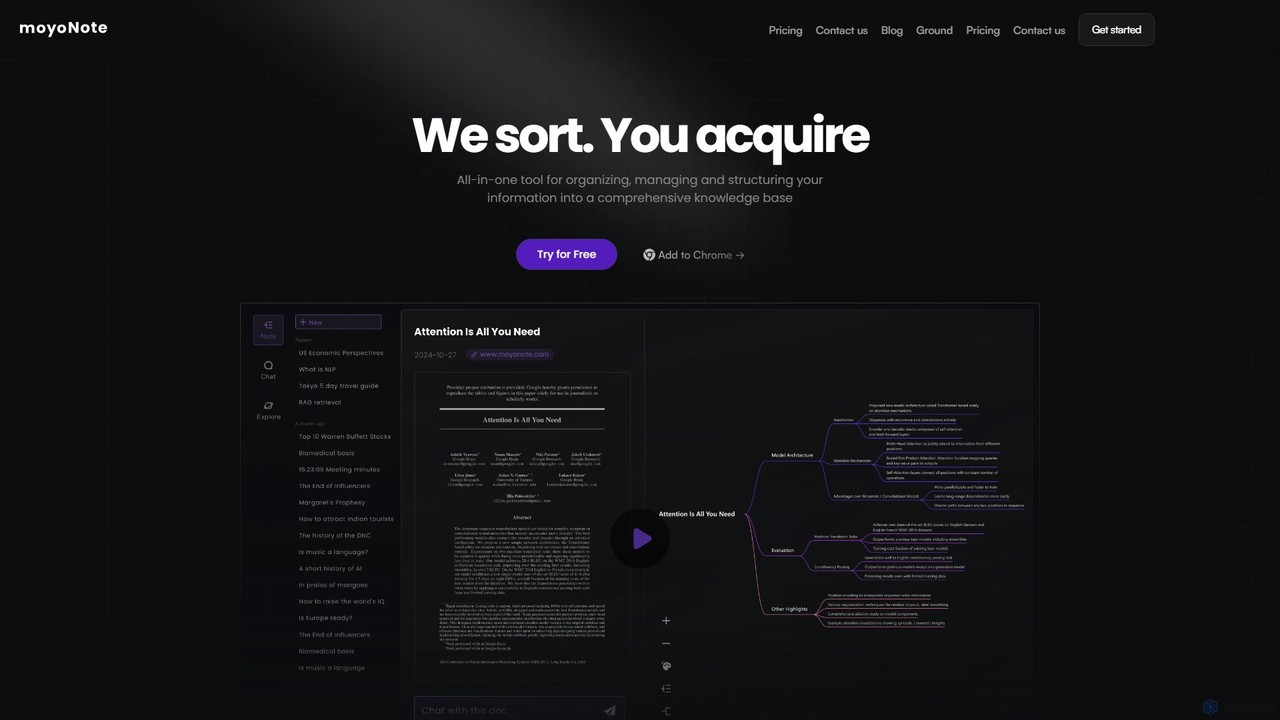
moyonote is an AI-powered tool that automatically transforms documents, text, and various files into structured, interactive mind maps. It helps users quickly sort and acquire knowledge, enhancing productivity for students, professionals, and teams by simplifying complex information.

Document Analysis
Visits 6.5KFavorites 127Likes 133
SumyAI
Freemium

SumyAI

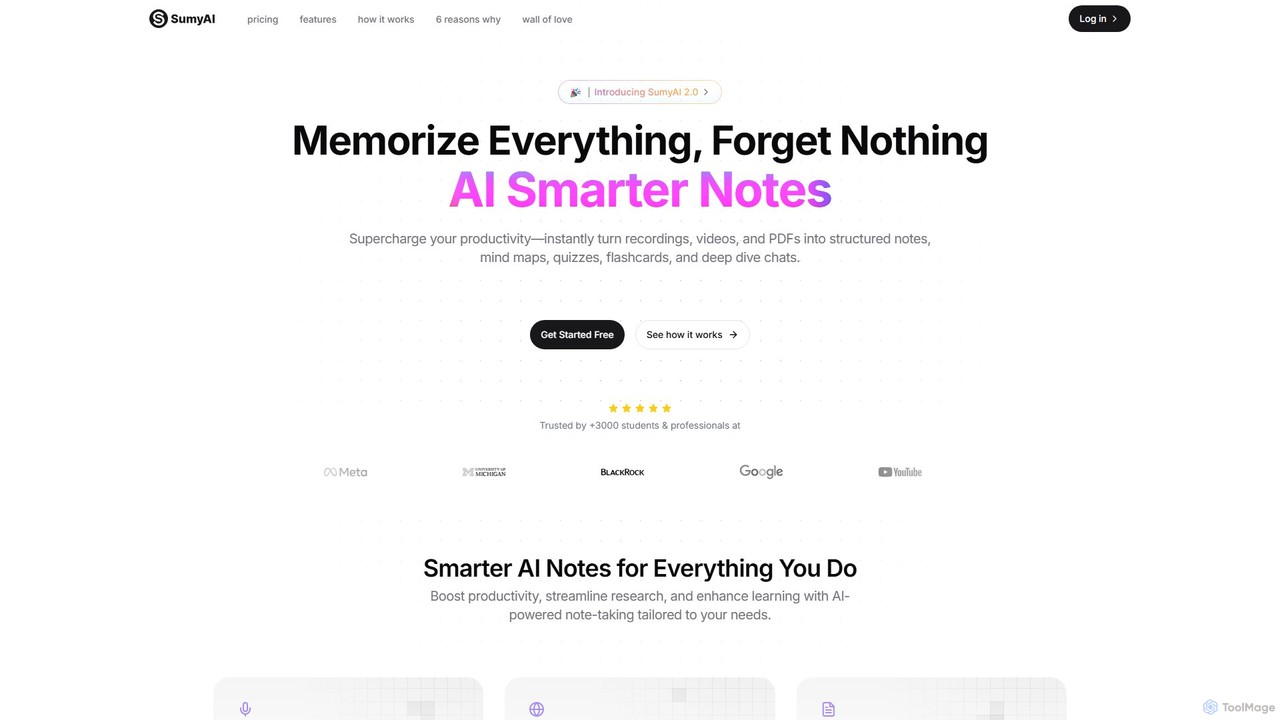
SumyAI is an AI-powered note-taking tool that enhances productivity and learning. It instantly transforms audio recordings, videos, and PDFs into structured notes, summaries, mind maps, quizzes, and flashcards. Supporting over 100 languages, it's designed for students, professionals, and researchers to capture, organize, and interact with information effortlessly.

Transcription
Visits 5.4KFavorites 86Likes 93
Coral AI
Freemium

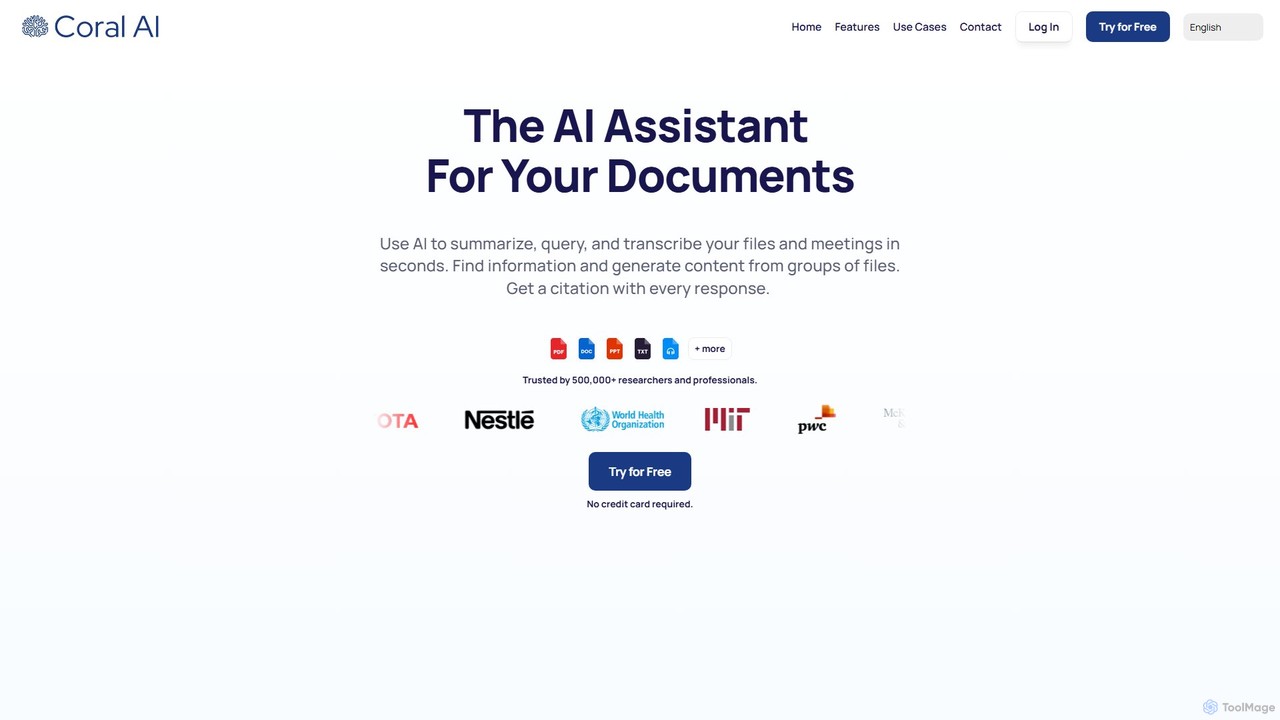
Coral AI

Coral AI is an intelligent assistant that transforms your documents, audio, and video files into interactive resources. Upload your files to summarize content, ask specific questions, extract key information, and transcribe media in seconds. It provides precise, citable answers, making it an essential tool for students, researchers, and professionals to enhance productivity and understanding.

Transcription
Visits 29.9KFavorites 113Likes 112

About Text Summarizer

Text Summarizer tools are AI-powered applications designed to automatically condense long pieces of written content into shorter, coherent summaries. Leveraging Natural Language Processing (NLP), these tools analyze documents, articles, or reports to identify key ideas and present them concisely. This enables users to quickly grasp the core message of extensive texts without reading them in their entirety. As a specialized subset of summarization tools, Text Summarizers focus exclusively on written language, offering higher accuracy and contextual understanding for documents compared to multi-modal summarizers.

Core Features

  • Extractive & Abstractive Methods: Offers two approaches—extractive, which pulls key sentences directly, and abstractive, which generates new sentences to capture the main idea.
  • Customizable Summary Length: Allows users to define the desired output length, from a single paragraph to a detailed list of bullet points.
  • Key Point Identification: Automatically highlights and lists the most critical sentences or concepts from the source text.
  • Multi-Format Support: Processes text from various sources, including direct copy-paste, document uploads (PDF, DOCX), and web page URLs.
  • Language Versatility: Capable of summarizing texts in multiple languages, often with translation capabilities included.

Use Cases

These tools are widely used by students and researchers for literature reviews, business analysts for digesting market reports, and journalists for quickly processing press releases. Legal professionals also use them to get high-level overviews of lengthy case files or contracts, significantly accelerating preliminary research and analysis.

How to Choose

When selecting a Text Summarizer, consider the quality and coherence of the generated summaries. Evaluate the tool's support for both extractive and abstractive methods, as your needs may vary. Also, check the input limits (character or word count), supported file formats, and whether it offers integrations like browser extensions or APIs for a smoother workflow.

Featured tool rankings

Text Summarizer use cases

1

Accelerating Academic Research and Literature Reviews

For students and researchers, reviewing dozens of academic papers is a time-consuming but essential task. A Text Summarizer drastically cuts down this effort. Instead of reading every paper in full, a researcher can upload a batch of PDFs or paste article text to generate concise abstracts. This allows for rapid screening of numerous sources to identify the most relevant studies for a literature review. The tool extracts key findings, methodologies, and conclusions, enabling the user to focus their deep-reading time on a smaller, more critical set of papers, thereby accelerating the entire research cycle.

2

Efficient News Monitoring and Market Analysis

Business analysts, journalists, and marketing professionals need to stay informed about industry trends, competitor activities, and news. Sifting through numerous articles daily is inefficient. By using a Text Summarizer, often via a browser extension, they can instantly condense lengthy online articles, press releases, or market reports into key bullet points. This allows them to quickly assess the importance of a piece of information, track multiple topics simultaneously, and compile daily or weekly briefing reports for stakeholders in a fraction of the time it would normally take.

3

Streamlining Legal Document Review

Legal professionals often face mountains of text in the form of contracts, case law, and depositions. A Text Summarizer designed for legal documents can quickly process these dense files. By uploading a contract, a paralegal can generate a summary of key clauses, obligations, and deadlines. Similarly, a lawyer can summarize previous court rulings to quickly find relevant precedents. This doesn't replace detailed legal analysis but serves as a powerful first-pass tool, saving countless hours in preliminary review and allowing legal teams to focus their expertise on strategic aspects of a case.

4

Enhancing Content Creation and Curation

Content marketers and social media managers can leverage Text Summarizers to repurpose existing long-form content. For example, a lengthy blog post or a detailed whitepaper can be automatically summarized to create multiple social media snippets, a concise email newsletter section, or key takeaways for a presentation. This process not only saves significant time in content creation but also ensures consistency in messaging across different platforms. It allows a single piece of core content to be efficiently distributed to a wider audience in formats they prefer.

5

Improving Internal Communication and Meeting Prep

In any organization, team members receive long email threads, detailed project updates, and lengthy meeting minutes. A Text Summarizer helps employees quickly catch up on discussions they missed. Before a meeting, a project manager can summarize a long chain of emails or a progress report to create a concise agenda with key discussion points. After the meeting, the transcript can be summarized to highlight action items and key decisions. This practice ensures everyone is aligned and informed without having to spend hours reading through internal communications.

6

Personal Learning and Skill Development

Individuals committed to lifelong learning can use Text Summarizers to accelerate their knowledge acquisition. When exploring a new topic, a user can gather several long articles or book chapters and summarize them to get a high-level overview first. This helps in building a foundational understanding quickly. It's particularly useful for digesting dense technical documentation, complex historical texts, or philosophical essays. By getting the gist of the material upfront, learners can better decide where to focus their in-depth study and improve their overall learning efficiency.

Text Summarizer FAQ

What is an AI Text Summarizer?

An AI Text Summarizer is a tool that uses artificial intelligence, specifically Natural Language Processing (NLP), to automatically condense a long piece of text into a shorter version. It identifies the most important information and presents it as a concise summary, paragraph, or set of bullet points. These tools are designed to save time by allowing users to quickly understand the core message of articles, reports, and documents without reading them in their entirety.

How to choose the right Text Summarizer?

When selecting a Text Summarizer, consider these factors:

  • Summarization Quality: Check for accuracy and coherence. The summary should retain the original text's core meaning without introducing errors.
  • Summarization Methods: Determine if you need an extractive summarizer (for factual accuracy) or an abstractive one (for more natural, human-like summaries), or a tool that offers both.
  • Input Options: Ensure the tool supports your required formats, such as text paste, URL import, or document uploads (PDF, DOCX).
  • Customization: Look for features that allow you to control the summary length or specify key areas of focus.
  • Usage Limits: Be aware of any character or document limits, especially in free versions, and choose a plan that fits your needs.
What's the difference between extractive and abstractive summarization?

Extractive and abstractive summarization are two different techniques used by AI text summarizers.

  • Extractive Summarization: This method works by identifying and selecting the most important sentences or phrases directly from the original text and combining them to form a summary. It's like using a highlighter to pick out key points. This approach guarantees factual accuracy as it doesn't alter the original wording.
  • Abstractive Summarization: This method involves generating new sentences that capture the core meaning of the source text, much like a human would. It uses advanced AI to understand the context and rephrase the information concisely. This can result in more fluent and readable summaries but carries a small risk of misinterpreting the original content.
Are Text Summarizers different from general Summarizer tools?

Yes, there is a key distinction. 'Text Summarizer' is a specific sub-category of the broader 'Summarizer' category. While all Text Summarizers are Summarizers, not all Summarizers are exclusively for text.

  • Text Summarizers: These tools are specialized for processing written content like articles, documents, and reports. They employ NLP models finely tuned for understanding grammar, syntax, and context in written language.
  • General Summarizers: This is a broader category that can include tools for summarizing other media types, such as video (e.g., summarizing a YouTube video), audio (e.g., summarizing a podcast), or even conversations.

If your primary need is to condense documents and articles, a dedicated Text Summarizer will typically provide more accurate and relevant results.

Who can benefit from using a Text Summarizer?

A wide range of individuals and professionals can benefit from Text Summarizers:

  • Students and Researchers: To quickly review academic papers and articles for literature reviews.
  • Business Professionals: To digest market reports, competitor analysis, and long email threads efficiently.
  • Journalists and Content Creators: To quickly grasp the essence of source materials and repurpose content.
  • Legal Professionals: For a first-pass review of lengthy contracts, case files, and legal precedents.
  • Lifelong Learners: Anyone looking to learn new topics faster by summarizing dense educational content.

Essentially, anyone who needs to process a large volume of written information quickly and effectively can find value in using a text summarization tool.