uPresenter
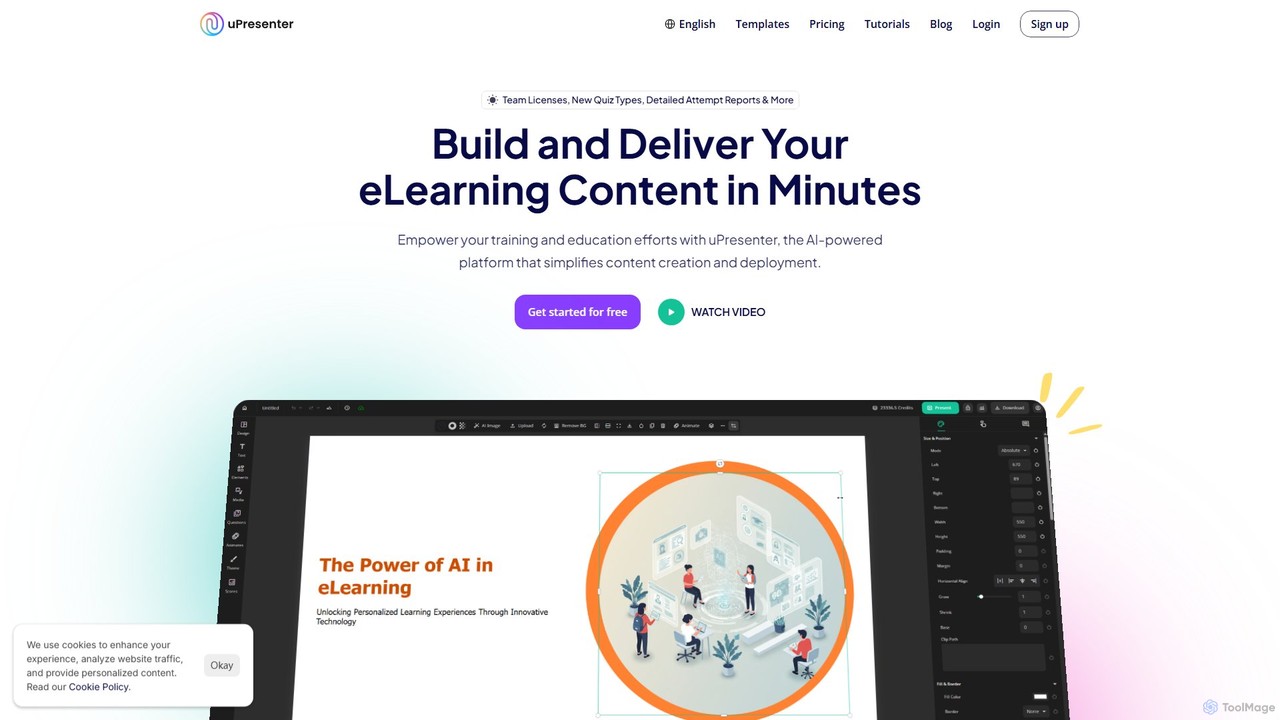
uPresenter is an AI-powered platform for creating interactive eLearning content like presentations, quizzes, and training modules. It simplifies …
uPresenter is an AI-powered platform for creating interactive eLearning content like presentations, quizzes, and training modules. It simplifies content creation with an AI assistant, templates, and multimedia imports. Designed for educators and corporate trainers, it offers an all-in-one solution for building, sharing, and tracking learning materials without needing a complex LMS, complete with analytics and collaboration features.
About Course Authoring
Course Authoring tools are AI-powered platforms designed to streamline and enhance the creation of educational content and online courses. These tools leverage artificial intelligence to automate various aspects of instructional design, from generating lesson plans and multimedia assets to crafting interactive quizzes and personalized learning paths. They empower educators, trainers, and content creators to rapidly develop high-quality, engaging e-learning experiences, significantly reducing the time and effort traditionally required in course development. As a specialized subset within Teacher Tools, Course Authoring AI focuses specifically on the content creation phase, offering advanced functionalities beyond general teaching aids.
Core Features
- AI Content Generation: Automatically generates lesson text, summaries, learning objectives, and quiz questions based on input topics.
- Multimedia Integration: Suggests or creates relevant images, videos, and audio elements, including AI-generated voiceovers, to enrich course materials.
- Interactive Assessment Design: Facilitates the creation of diverse quiz formats, assignments, and automated feedback mechanisms for student evaluation.
- Personalized Learning Paths: Adapts course content and progression based on learner performance and preferences, offering a tailored educational journey.
- Course Structure & Organization: Provides templates and frameworks to logically organize modules, lessons, and topics for optimal learning flow.
Applicable Scenarios
These tools are invaluable for a wide range of educational and training contexts. Online educators can quickly transform raw knowledge into structured, engaging courses for platforms like Coursera or Udemy. Corporate learning and development teams utilize them to rapidly develop employee training modules, ensuring consistent and up-to-date skill development. Academic institutions can leverage Course Authoring AI to create supplementary materials, blended learning components, or even entire digital curricula, enhancing accessibility and engagement for students.
How to Choose
When selecting an AI Course Authoring tool, consider its core AI capabilities, such as the quality of content generation and personalization features. Evaluate its compatibility and integration options with existing Learning Management Systems (LMS) like Moodle or Canvas. Assess the range of multimedia support and interactive elements it offers, ensuring it meets your pedagogical needs. Finally, factor in the platform's ease of use, scalability for future growth, and pricing model to align with your budget and team's technical proficiency.

Course AuthoringUse Cases
Rapidly Develop Online University Courses
University professors and instructional designers can utilize AI course authoring tools to quickly outline new online courses, generate initial lecture content, and design interactive assignments. By inputting course objectives and key topics, the AI assists in structuring modules and suggesting relevant resources, significantly accelerating the development cycle for academic programs.
Accelerate Corporate Training Module Creation
Corporate learning and development specialists use AI Course Authoring tools to quickly design and deploy new e-learning modules for employee onboarding, compliance training, or skill enhancement. By inputting key topics and learning objectives, the AI generates initial content drafts, suggests relevant multimedia, and structures the module, reducing development time by up to 60% compared to traditional methods. This ensures employees receive timely and consistent training, keeping pace with evolving business needs.
Create Engaging Corporate Training Modules
Corporate learning and development teams can employ these tools to build comprehensive training modules for employee onboarding, compliance, or skill development. The AI helps in transforming complex company policies or technical information into digestible lessons, incorporating quizzes and scenario-based learning to ensure effective knowledge retention and application.
Design Adaptive University Courses
University professors and instructional designers leverage these tools to create highly personalized academic courses. The AI can analyze student profiles and learning styles to suggest adaptive learning paths, recommend supplementary resources, and generate varied assessment questions. This allows for a more tailored educational experience, catering to individual student needs and improving engagement and learning outcomes in complex subjects, from humanities to STEM fields.
Launch Personalized E-learning Products for Independent Educators
Independent educators and subject matter experts can leverage AI course authoring to transform their expertise into marketable e-learning products. The tools assist in structuring content, generating diverse learning activities, and even suggesting personalized learning paths for students, enabling them to create high-quality, engaging courses without extensive instructional design experience.
Craft Engaging Independent Online Tutorials
Independent educators and content creators utilize Course Authoring AI to build interactive and engaging online tutorials for platforms like YouTube or personal websites. The tools assist in scripting video lessons, designing interactive exercises, and creating compelling visual aids. This enables creators to produce professional-grade educational content efficiently, attracting a wider audience and providing a richer learning experience without extensive technical or design expertise.
Automate Quiz and Assessment Generation
Teachers and trainers often spend considerable time creating assessments. AI course authoring tools can automate this process by generating a variety of quiz questions (e.g., multiple-choice, fill-in-the-blank) based on course content. This saves time, ensures alignment with learning objectives, and allows for quick creation of formative and summative evaluations.
Streamline K-12 Assessment Creation
K-12 teachers employ AI Course Authoring tools to automate the generation of quizzes, tests, and homework assignments. By simply providing the lesson content or learning standards, the AI can generate a diverse range of question types, including multiple-choice, true/false, and short-answer questions, along with answer keys. This significantly reduces the administrative burden on teachers, allowing them more time to focus on direct instruction and student support.
Convert Existing Materials into Interactive Digital Lessons
Organizations with extensive legacy content (e.g., PDFs, presentations, videos) can use AI course authoring tools to convert these static materials into dynamic, interactive digital lessons. The AI can analyze the content, suggest ways to break it down, add interactive elements like polls or discussion prompts, and embed knowledge checks, making the learning experience more engaging.
Localize Global Training Programs
International organizations and global training companies use AI Course Authoring tools for efficient localization of their educational content. These tools can translate course materials, including text, quizzes, and even voiceovers, into multiple languages while maintaining contextual accuracy. This capability ensures that training programs are accessible and culturally relevant to a diverse global workforce or student body, facilitating consistent learning across different regions.
Design Adaptive Learning Paths for Students
For personalized education, AI course authoring tools can help design adaptive learning paths. Based on a student's pre-assessment results or ongoing performance, the AI can recommend specific modules, additional resources, or remedial content, ensuring each learner receives instruction tailored to their individual needs and pace, maximizing learning outcomes.
Develop Targeted Professional Skill Programs
Professional development organizations and HR departments use these AI tools to design targeted skill-based training programs. The AI helps in identifying key competencies, structuring modules around specific skills, and generating practical exercises or simulations. This ensures that training directly addresses skill gaps, providing employees with actionable knowledge and improving overall workforce capabilities in areas like leadership, technical skills, or communication.