ToolMage
Sign in

Best 1 Translation AI tools for Text

Popular Translation AI tools in Text include smudge.ai, helping you work more efficiently.

smudge.ai
Freemium

smudge.ai

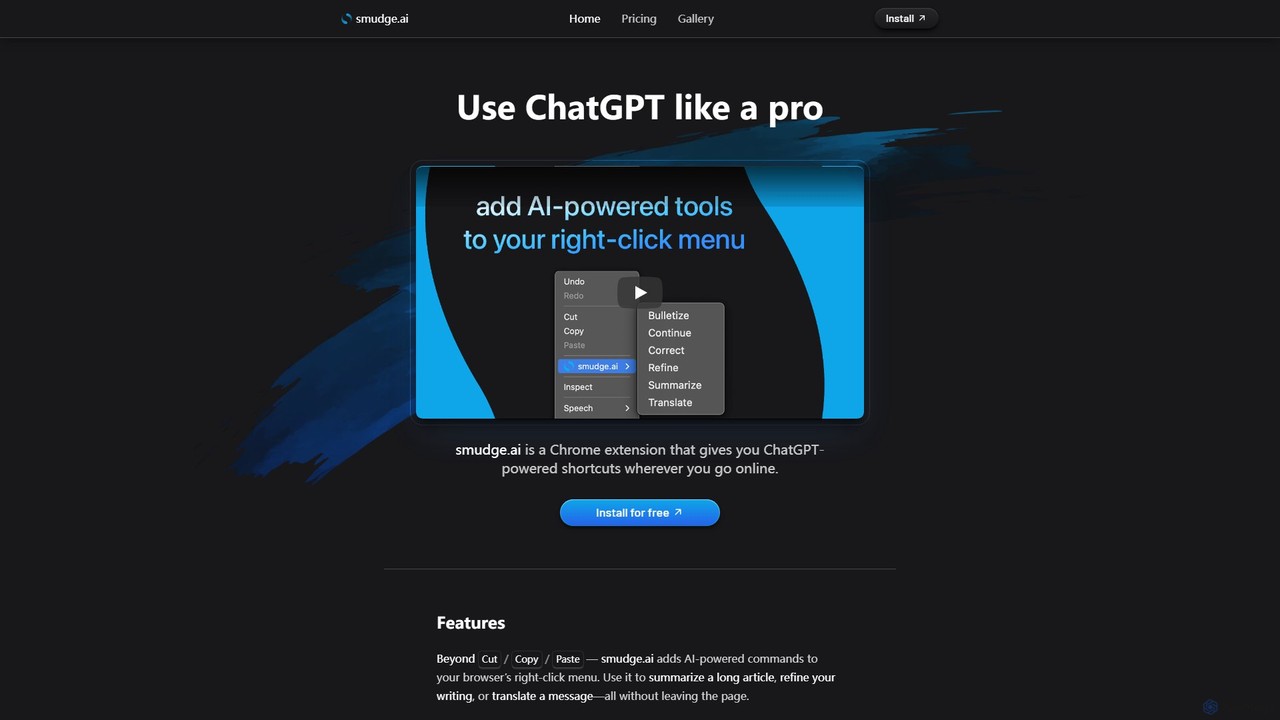
smudge.ai is a powerful Chrome extension that integrates ChatGPT-powered shortcuts directly into your browser's right-click menu. Instantly summarize articles, refine your writing, translate text, and create custom commands without ever leaving your current page, streamlining your online workflow.

Chrome Extensions
Visits 12KFavorites 138Likes 125

About Translation

AI Translation tools are a specialized category within AI text tools, designed to automatically convert text or speech from one language to another while preserving meaning and context. Leveraging advanced natural language processing (NLP) and machine learning, these tools analyze source content, understand its nuances, and generate fluent, grammatically correct translations. They significantly reduce manual translation effort, accelerate global communication, and enable businesses and individuals to overcome language barriers efficiently.

Core Features

  • Neural Machine Translation (NMT): Utilizes deep learning models to produce more natural and contextually accurate translations than traditional methods.
  • Contextual Understanding: Analyzes surrounding text to ensure words and phrases are translated appropriately based on their meaning in a given sentence or paragraph.
  • Glossary & Terminology Management: Allows users to upload custom glossaries and style guides to ensure consistent translation of specific terms, brand names, or industry jargon.
  • Document & File Translation: Supports direct translation of entire documents (e.g., PDFs, Word files) while retaining original formatting.
  • Real-time Translation: Provides instant translation for live conversations, chat applications, or streaming content.

Use Cases

AI translation tools are indispensable for global operations, content localization, and cross-cultural communication. They are widely adopted by multinational corporations for internal communications, marketing teams for localizing campaigns, and customer support departments for assisting international clients. Additionally, researchers and academics use them to access and understand foreign language publications, while individuals leverage them for travel and personal learning.

How to Choose

When selecting an AI translation tool, prioritize accuracy and fluency for your target languages, especially for specialized content. Evaluate the range of supported language pairs and the availability of customization options like glossaries and translation memories. Consider integration capabilities with existing workflows (e.g., CMS, CRM) and robust data security measures. Finally, assess the pricing model and scalability to ensure it aligns with your usage volume and budget.

Translation use cases

1

Facilitate Global Business Communication

Multinational corporations use AI translation tools to facilitate seamless internal and external communication across diverse linguistic teams and partners. This includes translating emails, reports, presentations, and meeting transcripts, ensuring all stakeholders understand critical information regardless of their native language. It accelerates decision-making and fosters better collaboration in a globalized work environment.

2

Website & Software Localization

Companies aiming to expand their market reach utilize AI translation for localizing websites, mobile applications, and software interfaces. This involves translating UI elements, help documentation, and marketing copy into multiple languages, making digital products accessible and culturally relevant to international users. It significantly reduces the time and cost associated with manual localization efforts.

3

Enhance Multilingual Customer Support

Customer service teams deploy AI translation to provide efficient support to a global customer base. Tools can instantly translate incoming customer queries (via chat, email, or tickets) and agent responses, enabling real-time communication in the customer's preferred language. This enhances customer satisfaction, reduces response times, and allows support agents to handle a wider range of international inquiries.

4

Localize Content Creation & Marketing

Content creators and marketing professionals leverage AI translation to adapt their campaigns and materials for different regional markets. This includes translating blog posts, social media updates, advertisements, and product descriptions. The tools help maintain brand voice and messaging consistency while ensuring the content resonates culturally with local audiences, driving engagement and conversions.

5

Translate Academic & Research Documents

Researchers, academics, and students use AI translation to access and comprehend scholarly articles, journals, and research papers published in foreign languages. This capability breaks down language barriers in scientific collaboration and knowledge sharing, allowing for quicker literature reviews and a broader understanding of global advancements in various fields. It accelerates the research process and fosters international academic exchange.

6

Process Legal & Technical Documents

Legal firms and engineering companies employ AI translation for processing large volumes of specialized documents such as contracts, patents, technical manuals, and regulatory filings. While human review is often essential for final accuracy, AI tools provide rapid first-pass translations, identifying key information and accelerating the overall review process. This is particularly valuable for due diligence and compliance in international contexts.

Translation FAQ

What are AI translation tools?

AI translation tools are software applications that use artificial intelligence, specifically neural machine translation (NMT) and natural language processing (NLP), to automatically convert text or speech from one language to another. Unlike older rule-based or statistical methods, these tools learn from vast amounts of data to produce more natural-sounding and contextually accurate translations, making them a powerful subset of AI text tools.

How do AI translation tools differ from traditional machine translation?

The primary difference lies in their underlying technology. Traditional machine translation (like rule-based or statistical MT) relies on predefined linguistic rules or statistical models derived from parallel texts. AI translation, particularly NMT, uses deep learning neural networks to translate entire sentences or paragraphs at once, considering the full context. This results in significantly more fluent, coherent, and human-like translations, with fewer grammatical errors and better handling of nuances.

How can I choose the best AI translation tool for my needs?

To choose the best AI translation tool, consider several factors: Accuracy and Fluency in your specific language pairs and subject matter; the Range of Supported Languages; Customization Options like glossaries, translation memories, and custom models for specialized terminology; Integration Capabilities with your existing software (e.g., CMS, CAT tools); Data Security and Privacy policies, especially for sensitive content; and the Pricing Model based on your usage volume.

What advanced features do modern AI translation tools offer?

Modern AI translation tools offer advanced features beyond basic text conversion. These include Glossary and Terminology Management for consistency, Customizable Translation Models trained on specific domain data, Document Translation that preserves original formatting, Real-time Translation for live communication, API Access for seamless integration into other applications, and Speech-to-Text/Text-to-Speech capabilities for comprehensive multilingual solutions.

What are the limitations of AI translation, and when is human translation still necessary?

While powerful, AI translation has limitations. It can struggle with highly nuanced language, cultural references, humor, sarcasm, and creative writing, where literal translation misses the intended meaning. For critical content like legal documents, medical reports, marketing taglines, or literary works, human translation or post-editing by a professional linguist is often necessary to ensure absolute accuracy, cultural appropriateness, and stylistic quality. AI provides a strong first draft, but human expertise refines it.