EnergeticAI
EnergeticAI is an open-source Node.js library for integrating AI models into applications, specifically optimized for serverless environments. It …
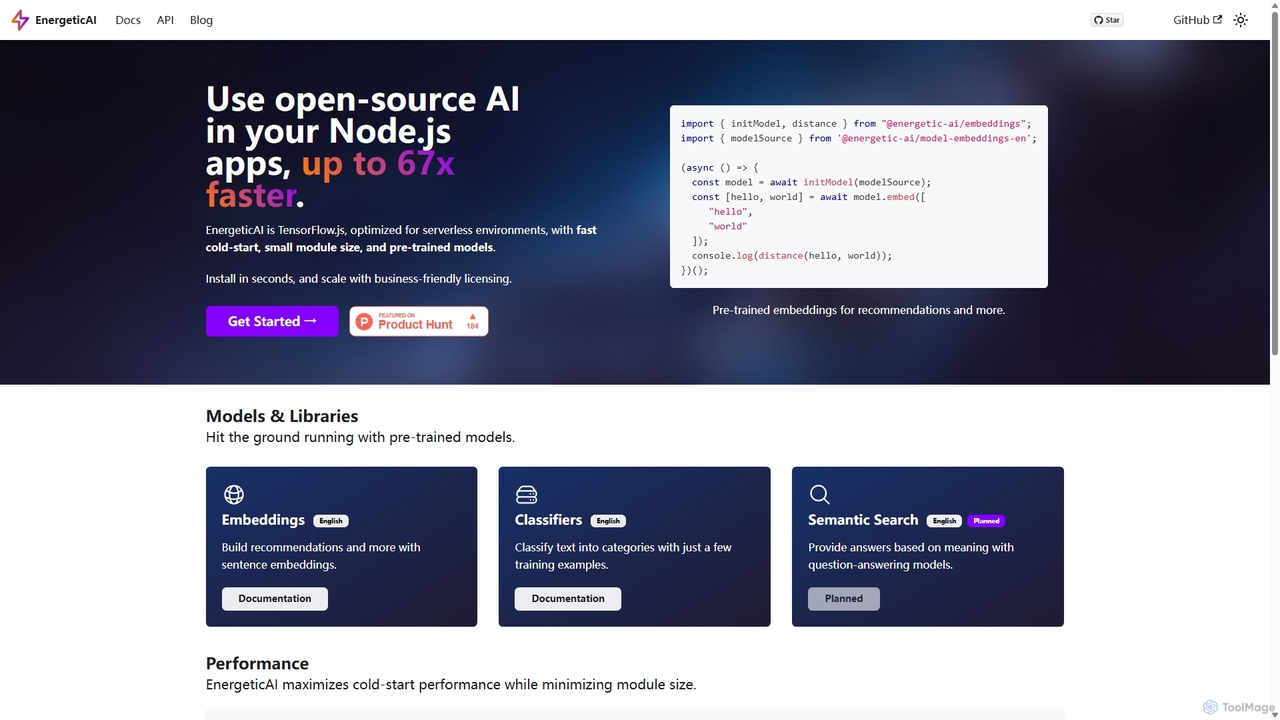
EnergeticAI is an open-source Node.js library for integrating AI models into applications, specifically optimized for serverless environments. It provides a high-performance, low-latency alternative to standard TensorFlow.js, featuring a minimal module size and rapid cold-start times. With pre-trained models for embeddings and few-shot text classification, developers can easily build features like semantic search, recommendations, and content categorization without relying on third-party APIs, ensuring data privacy and cost control.
About Text Analysis
Text Analysis tools are AI-powered solutions designed to automatically extract meaningful insights, patterns, and structured data from unstructured text. Leveraging advanced Natural Language Processing (NLP) techniques, these tools can understand, interpret, and categorize vast amounts of textual information. They provide businesses and researchers with the ability to transform raw text into actionable intelligence, enabling data-driven decision-making and a deeper understanding of customer feedback, market trends, and internal communications.
Core Features
- Sentiment Analysis: Automatically identifies and quantifies the emotional tone (positive, negative, neutral) within text.
- Entity Recognition: Detects and classifies named entities such as people, organizations, locations, and dates in text.
- Topic Modeling: Uncovers abstract "topics" that occur in a collection of documents, helping to categorize content.
- Keyword Extraction: Identifies the most important words and phrases that summarize the main content of a text.
- Text Summarization: Generates concise summaries of longer documents while retaining key information.
Applicable Scenarios
Text Analysis tools are indispensable across various sectors. Marketing teams use them to gauge brand perception from social media, while customer service departments analyze feedback to pinpoint common issues. Researchers leverage these tools to process academic papers, identifying key themes and accelerating literature reviews. Legal professionals can extract critical information from contracts and case files, streamlining due diligence processes.
How to Choose
When selecting a Text Analysis tool, consider its accuracy and robustness in handling diverse text types and languages. Evaluate the specific NLP capabilities offered, such as sentiment analysis depth or custom entity recognition. Assess scalability for processing large data volumes and integration options with existing platforms. Finally, review pricing models and the level of technical expertise required for implementation and ongoing use.

Text AnalysisUse Cases
Analyze Customer Feedback for Product Improvement
Product managers and development teams use Text Analysis to process thousands of customer reviews, support tickets, and survey responses. By applying sentiment analysis and topic modeling, they can quickly identify recurring pain points, popular feature requests, and overall satisfaction levels. This allows for data-backed prioritization of product enhancements and bug fixes, leading to more user-centric development.
Monitor Brand Reputation on Social Media
Marketing and PR professionals deploy Text Analysis tools to continuously scan social media platforms, news articles, and forums for mentions of their brand, competitors, and industry trends. Sentiment analysis helps gauge public perception in real-time, enabling rapid response to negative sentiment or amplification of positive buzz. Topic modeling reveals emerging conversations and influencer identification.
Automate Information Extraction from Legal Documents
Legal firms and compliance departments utilize Text Analysis to efficiently extract critical information from contracts, agreements, and regulatory filings. Entity recognition can automatically identify parties, dates, clauses, and obligations, significantly reducing manual review time. This accelerates due diligence, contract management, and compliance auditing processes, minimizing human error.
Categorize and Route Customer Support Tickets
Customer service operations leverage Text Analysis to automatically categorize incoming support emails, chat transcripts, and helpdesk tickets based on their content and urgency. Topic modeling and keyword extraction can assign tickets to the correct department or agent, and even suggest relevant knowledge base articles. This streamlines workflows, reduces resolution times, and improves customer satisfaction.
Identify Research Trends in Academic Literature
Academics and researchers employ Text Analysis to sift through vast collections of scientific papers, journals, and patents. Topic modeling helps identify emerging research areas, influential authors, and interdisciplinary connections. Keyword extraction and summarization assist in quickly grasping the core arguments and findings of numerous documents, accelerating literature reviews and grant proposal development.
Summarize News Articles and Reports for Quick Insights
Business intelligence analysts and busy executives use Text Analysis tools for automated text summarization of daily news feeds, industry reports, and internal communications. This allows them to quickly grasp the main points and key takeaways from lengthy documents without reading every word. It saves significant time, ensuring they stay informed on critical developments and make timely decisions.