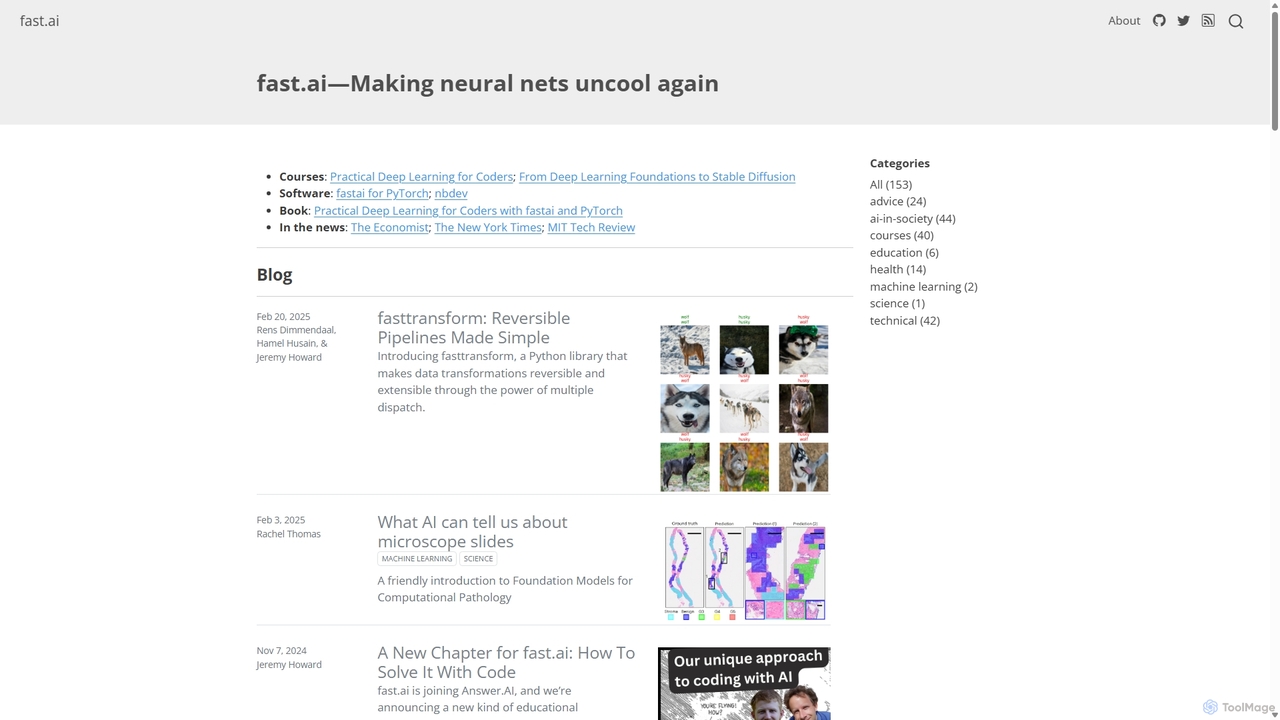
Fast.ai
Fast.ai is a research institute dedicated to making deep learning accessible to everyone. It offers free courses, an …
Fast.ai is a research institute dedicated to making deep learning accessible to everyone. It offers free courses, an open-source software library (fastai), cutting-edge research, and a vibrant community, empowering coders of all backgrounds to become deep learning practitioners.
EnergeticAI
EnergeticAI is an open-source Node.js library for integrating AI models into applications, specifically optimized for serverless environments. It …
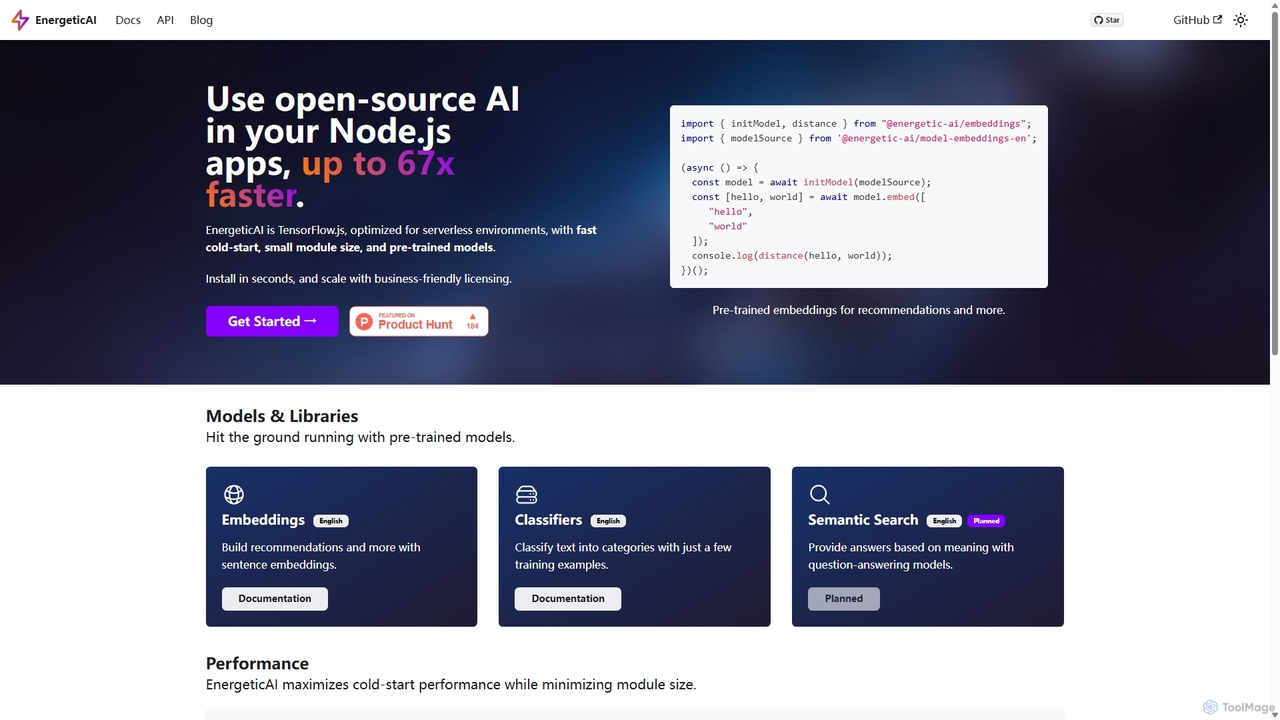
EnergeticAI is an open-source Node.js library for integrating AI models into applications, specifically optimized for serverless environments. It provides a high-performance, low-latency alternative to standard TensorFlow.js, featuring a minimal module size and rapid cold-start times. With pre-trained models for embeddings and few-shot text classification, developers can easily build features like semantic search, recommendations, and content categorization without relying on third-party APIs, ensuring data privacy and cost control.
Pydantic
Pydantic is a comprehensive platform for developers, offering powerful data validation, AI development tools, and a full-stack observability …
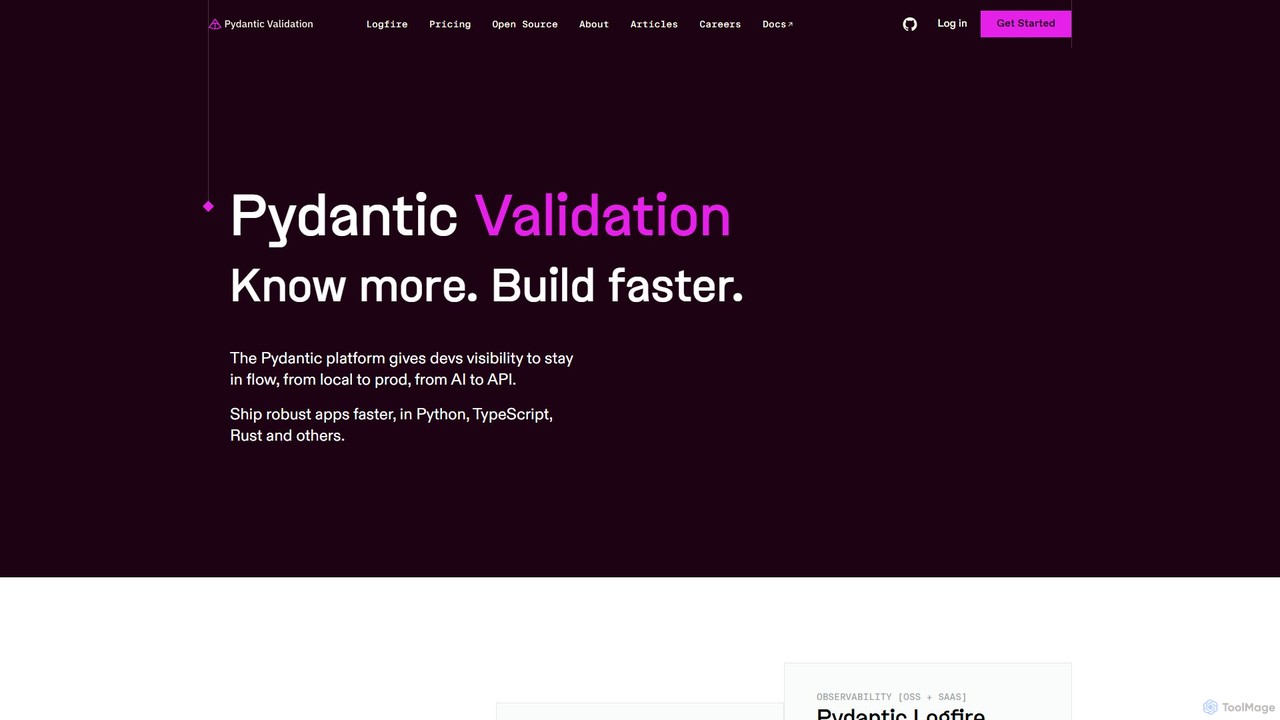
Pydantic is a comprehensive platform for developers, offering powerful data validation, AI development tools, and a full-stack observability solution. It enables faster, more robust application development in Python and other languages by leveraging type hints for runtime data validation and providing deep insights from local development to production.
VisActor
VisActor is an open-source, narrative-oriented intelligent visualization solution from ByteDance. It provides a comprehensive suite of tools, including …
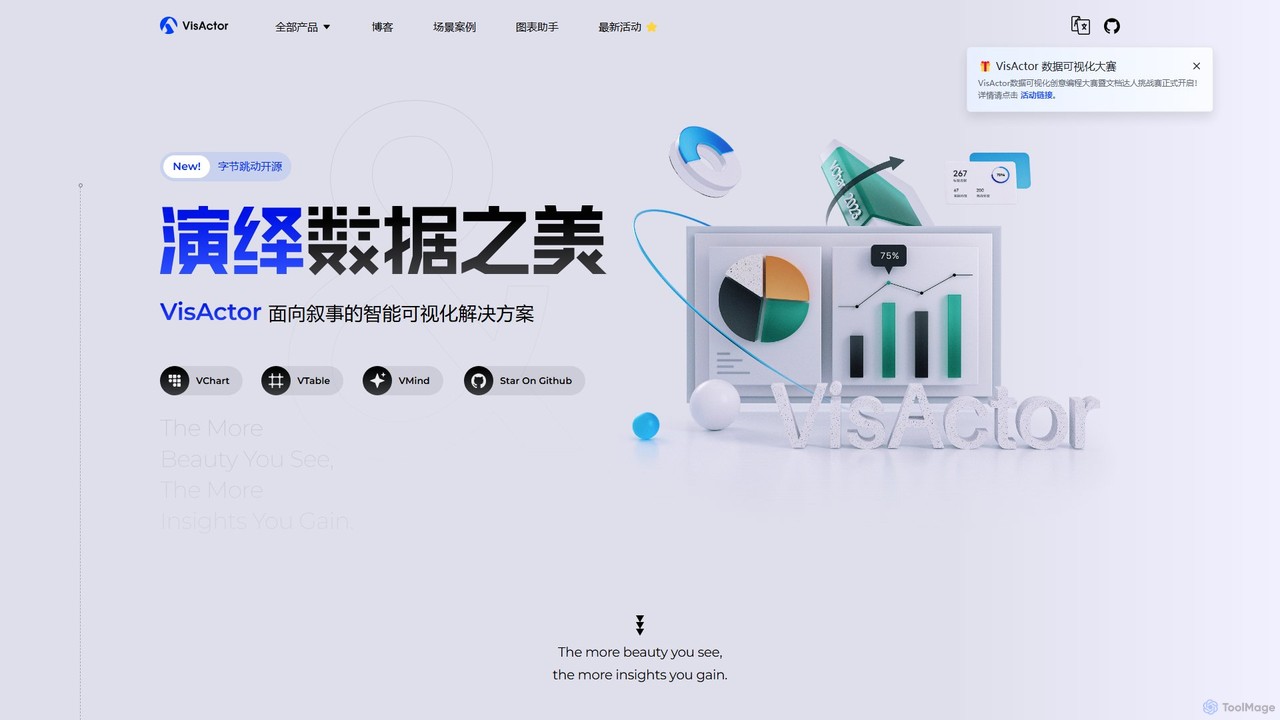
VisActor is an open-source, narrative-oriented intelligent visualization solution from ByteDance. It provides a comprehensive suite of tools, including VChart and VTable, to transform data into compelling visual stories. With its AI-powered component, VMind, it simplifies chart creation and enables dynamic, cross-platform data presentations.
reachat
reachat is an open-source ReactJS component library designed for developers to rapidly build sophisticated AI chat interfaces. It …
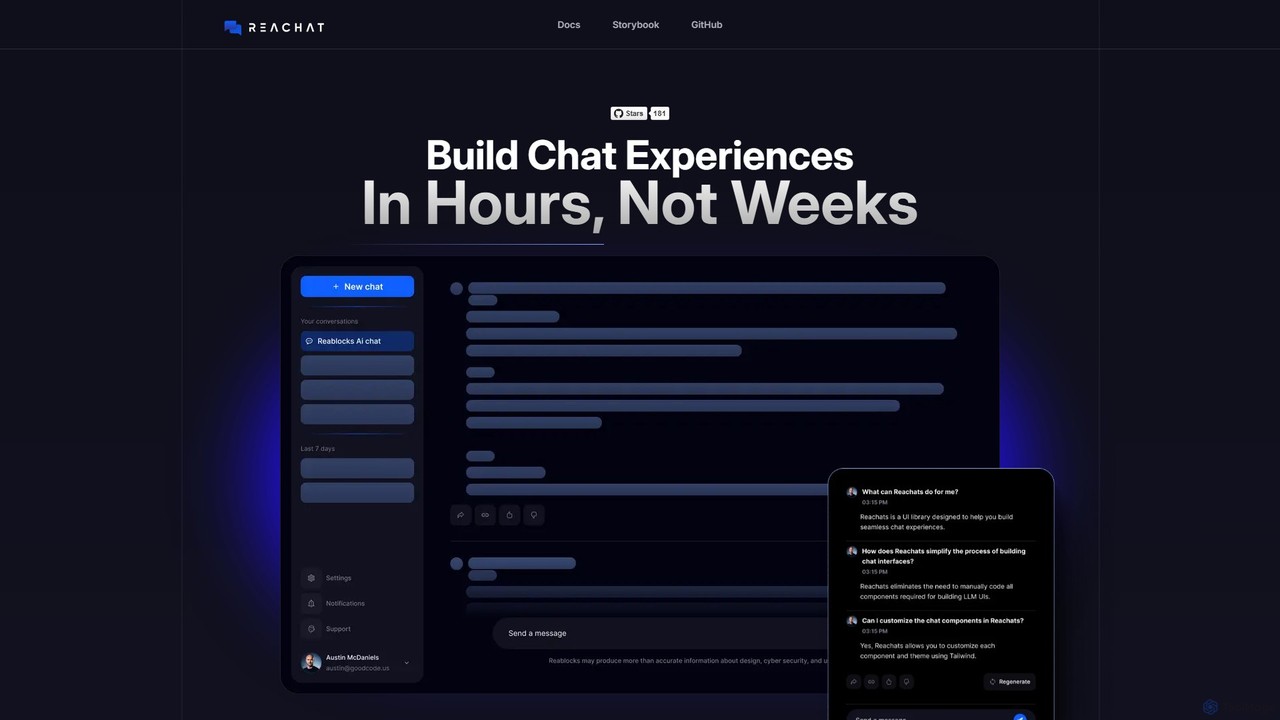
reachat is an open-source ReactJS component library designed for developers to rapidly build sophisticated AI chat interfaces. It provides highly customizable, backend-agnostic components, enabling the integration of any LLM and supporting rich media for enhanced user experiences. Build production-ready chat UIs in hours, not weeks.
About Libraries & Frameworks
AI Libraries & Frameworks are foundational toolkits that provide developers with pre-written code, functions, and a structured environment to build, train, and deploy machine learning models. These tools abstract complex mathematical operations and low-level hardware interactions, offering high-level APIs for defining neural networks and data processing pipelines. By using them, developers can significantly accelerate the development lifecycle, from prototyping to production, while leveraging optimized performance for tasks like computer vision and natural language processing. They form the essential backbone of modern AI application development within the broader Developer Tools ecosystem.
Core Features
- Pre-built Architectures: Provides access to tested and optimized model architectures like Transformers, CNNs, and RNNs.
- Automatic Differentiation: Automatically computes gradients for model parameters, which is essential for training neural networks via backpropagation.
- Hardware Acceleration: Includes built-in support for GPUs and TPUs to drastically reduce model training and inference times.
- Model Optimization & Deployment Tools: Offers utilities for quantizing, pruning, and packaging models for efficient deployment on servers, mobile, or edge devices.
- Data Handling APIs: Features efficient data loaders and transformation pipelines to handle large-scale datasets seamlessly.
Use Cases
These tools are indispensable for AI researchers, machine learning engineers, and data scientists. They are used to create applications ranging from image recognition systems in manufacturing and healthcare to sophisticated language models for chatbots and content generation. In finance, they power algorithmic trading and fraud detection systems.
How to Choose
When selecting an AI library or framework, consider the project's specific needs. Key factors include the richness of the ecosystem and community support, the balance between ease of use (high-level APIs) and flexibility (low-level control), the robustness of its production deployment tools, and primary programming language support (e.g., Python, C++, JavaScript).
Libraries & FrameworksUse Cases
Develop a Custom Image Recognition Model
A machine learning engineer at an e-commerce company needs to build a system to automatically categorize new product images. Using a deep learning framework like TensorFlow or PyTorch, the engineer can leverage a pre-trained Convolutional Neural Network (CNN) as a base. They then fine-tune this model on the company's specific product dataset. The framework's data loading utilities efficiently process thousands of images, and its GPU acceleration capabilities reduce the training time from weeks to just a few days, resulting in a highly accurate categorization model ready for production.
Build a Context-Aware Customer Service Chatbot
A developer is tasked with creating a chatbot for a SaaS company's support portal. Instead of building a language model from scratch, they use a library like Hugging Face Transformers. This provides access to powerful pre-trained models like BERT or GPT. The developer can fine-tune one of these models on the company's knowledge base and past support tickets. The framework handles the complex tokenization and model inference logic, allowing the developer to focus on the application's business logic and user interface, delivering a helpful, context-aware chatbot in a fraction of the time.
Create a Predictive Analytics System for Sales Forecasting
A data scientist wants to predict future sales trends for a retail chain. They use a library like scikit-learn, which offers a wide range of classical machine learning algorithms. They can quickly experiment with different models such as Linear Regression, Random Forest, or Gradient Boosting on historical sales data. The library provides tools for data preprocessing, feature engineering, and model evaluation. This allows the data scientist to rapidly iterate and identify the best-performing model, delivering accurate quarterly sales forecasts to business stakeholders without needing to implement the algorithms manually.
Accelerate AI Research and Prototyping
An AI researcher at a university is developing a novel neural network architecture. Using a flexible framework like JAX or PyTorch allows for rapid prototyping. Instead of writing complex gradient calculation code, they can define the model's forward pass, and the framework's automatic differentiation handles the rest. This enables them to test new ideas, modify architectures, and run experiments in hours instead of weeks. The framework's seamless integration with scientific computing libraries further streamlines the research process, accelerating the path to publication and discovery.
Deploy AI Models on Edge Devices
An IoT developer needs to run a real-time object detection model on a low-power smart camera. A large model trained with a standard framework would be too slow and resource-intensive. They use a specialized library like TensorFlow Lite or ONNX Runtime to convert and optimize the trained model. These tools apply techniques like quantization (reducing numerical precision) and pruning to create a smaller, faster model. The resulting lightweight model can be deployed directly on the camera's hardware, enabling on-device inference with low latency and without requiring constant cloud connectivity.
Train a Large-Scale Distributed Language Model
An AI research lab aims to train a foundation model with hundreds of billions of parameters. Training such a model on a single machine is impossible. The team uses a framework like PyTorch combined with a distributed training library like DeepSpeed. These libraries automate the complex process of splitting the model and data across hundreds or thousands of GPUs in a cluster. They handle challenges like memory optimization, efficient communication between nodes, and fault tolerance. This enables the team to successfully train a state-of-the-art model that would otherwise be computationally infeasible.