ToolMage
Sign in

Best 1 Lead Generation AI tools for Website

Popular Lead Generation AI tools in Website include Chunky, helping you work more efficiently.

Chunky
Freemium

Chunky

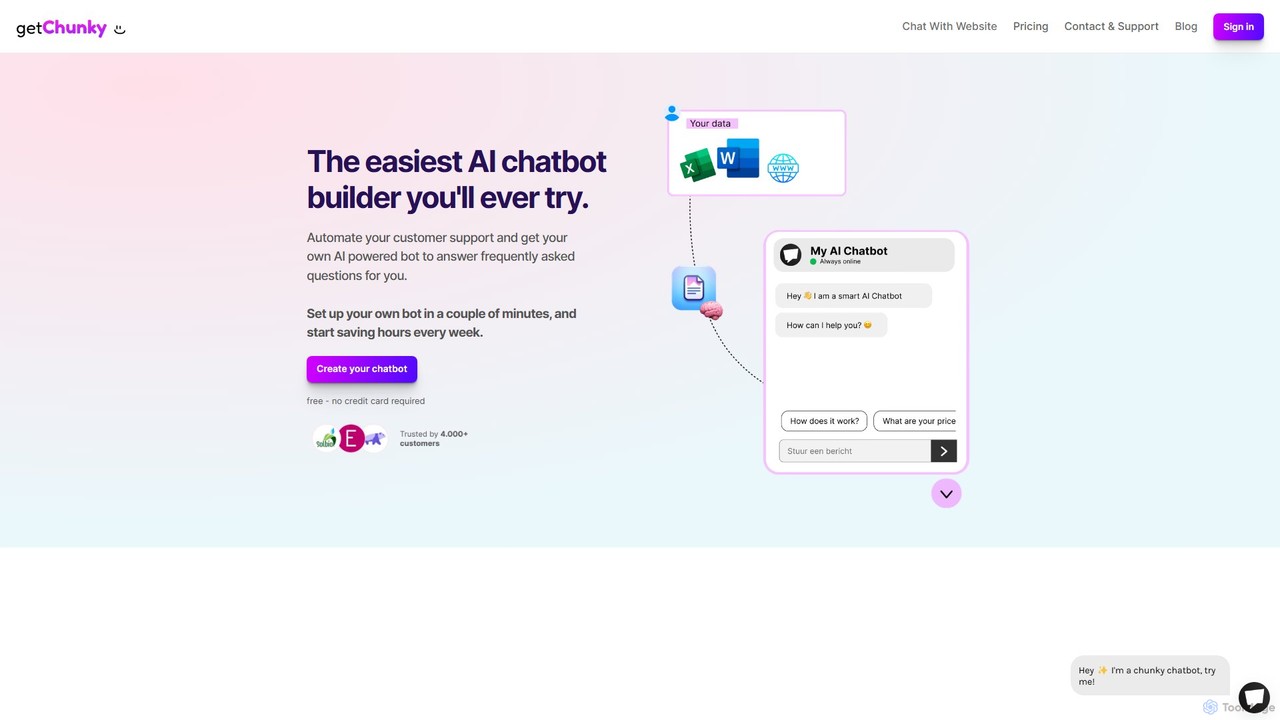
Chunky is an intuitive AI chatbot builder that allows you to create human-like chatbots in minutes. Train your bot using your website URL, PDFs, or Google Sheets to automate customer support and answer frequently asked questions. It's designed for simplicity, offering easy website integration, customization, and a generous free-forever plan.

Chatbot
Visits 5.6KFavorites 146Likes 138

About Lead Generation

Lead Generation tools are AI-powered platforms specifically designed to identify, attract, and qualify potential customers for businesses. These sophisticated tools leverage advanced machine learning algorithms to analyze vast datasets, predict customer behavior, and automate various stages of the lead acquisition process, from initial discovery to nurturing. By intelligently streamlining the identification and engagement of prospects, AI lead generation solutions empower companies to expand their customer base more efficiently, optimize marketing spend, and significantly boost the effectiveness of their sales pipeline, ultimately driving revenue growth.

Core Features

  • Prospect Identification: Automatically discovers and profiles potential leads by analyzing public data, social media, and industry trends based on predefined criteria, target demographics, and behavioral patterns.
  • Lead Scoring & Qualification: Ranks leads by their likelihood to convert into paying customers, using predictive analytics to help sales teams prioritize and focus on high-value opportunities, improving conversion efficiency.
  • Automated Personalized Outreach: Crafts and automates highly personalized communication across channels like email, social media messages, and chatbots, ensuring timely and relevant engagement with prospects at scale.
  • Data Enrichment & Segmentation: Augments existing lead profiles with additional demographic, firmographic, and behavioral data, enabling precise segmentation for targeted marketing campaigns and deeper customer insights.
  • Predictive Analytics & Forecasting: Utilizes historical data and machine learning to forecast future lead performance, identify emerging trends, and provide actionable insights to continuously refine and optimize lead generation strategies.

Applicable Scenarios

AI lead generation tools are indispensable for sales and marketing teams across diverse industries, from B2B SaaS companies seeking enterprise clients to e-commerce businesses targeting individual consumers. They are primarily used to pinpoint ideal customer profiles, automate initial contact and follow-ups, and ensure that sales efforts are strategically focused on the most promising prospects. This strategic application leads to a significantly more efficient sales funnel, reduced customer acquisition costs, and ultimately, higher conversion rates and revenue.

How to Choose

When selecting an AI lead generation tool, it is crucial to consider its seamless integration capabilities with your existing CRM, marketing automation platforms, and other sales enablement tools. Evaluate the accuracy, breadth, and real-time nature of its data sources, along with the customization options available for lead scoring models and personalized outreach campaigns. Scalability to accommodate your business growth and user-friendliness for your team are also paramount. Finally, look for robust analytics and reporting features that provide clear insights into performance tracking and ROI.

Featured tool rankings

Lead Generation use cases

1

Identifying High-Value B2B Prospects

A B2B sales development representative (SDR) uses an AI lead generation tool to scan company databases and professional networks. By inputting criteria such as industry, company size, technology stack, and recent funding rounds, the tool automatically identifies and scores potential client companies and key decision-makers who are most likely to be interested in their solution. This allows the SDR to focus their outreach on highly qualified leads, significantly reducing research time and improving conversion rates.

2

Automating Personalized Email Campaigns

A digital marketing manager leverages an AI lead generation platform to create and send personalized email sequences to newly identified prospects. The AI analyzes each lead's profile and online behavior to tailor email content, subject lines, and send times for maximum engagement. This automation ensures consistent follow-ups and nurtures leads through the sales funnel without manual intervention, freeing up the marketing team to focus on strategy rather than repetitive tasks.

3

Qualifying Inbound Website Leads

An e-commerce business uses an AI lead generation tool integrated with their website's contact forms. When a visitor submits an inquiry, the AI instantly analyzes their provided information, browsing history, and engagement patterns on the site. It then scores the lead based on predefined qualification criteria, routing high-priority leads directly to the sales team for immediate follow-up, while low-priority leads receive automated nurturing content. This ensures no valuable lead is missed and response times are optimized.

4

Enriching CRM Data for Better Segmentation

A CRM administrator employs an AI lead generation tool to enrich existing customer and prospect data within their CRM system. The AI automatically searches for and adds missing information such as job titles, company details, social media profiles, and recent news about the lead's company. This enriched data allows the marketing team to create more precise customer segments, enabling highly targeted campaigns and more relevant communication, ultimately improving engagement and conversion.

5

Predicting Lead Conversion Likelihood

A sales operations manager utilizes an AI lead generation platform with predictive analytics capabilities. The AI analyzes historical sales data, lead behavior, and demographic information to predict the likelihood of each new lead converting into a customer. This predictive scoring helps sales teams prioritize their efforts, allocate resources more effectively, and focus on leads with the highest potential, leading to increased sales efficiency and a better understanding of the sales pipeline.

6

Generating Targeted Ad Audiences

A paid advertising specialist uses an AI lead generation tool to identify and build highly specific custom audiences for social media and search engine advertising campaigns. The AI analyzes existing customer data and market trends to find lookalike audiences or new segments that share characteristics with ideal customers. This enables the specialist to target ads more effectively, reducing ad spend waste and increasing the quality and volume of incoming leads from advertising efforts.

Lead Generation FAQ

What are AI Lead Generation tools?

AI Lead Generation tools are software solutions that leverage artificial intelligence and machine learning to automate and optimize the process of identifying, attracting, and qualifying potential customers. They analyze vast amounts of data to find prospects, score their potential, and often automate initial outreach. These tools aim to streamline the sales funnel, reduce manual effort, and improve the quality and quantity of leads for businesses.

How do AI Lead Generation tools work?

AI Lead Generation tools typically work by collecting and analyzing data from various sources, such as public databases, social media, and website interactions. They use machine learning algorithms to identify patterns, predict behaviors, and score leads based on predefined criteria. This often involves natural language processing for content analysis, predictive analytics for scoring, and automation for tasks like data enrichment and personalized outreach. The AI continuously learns and refines its strategies for better results.

What are the main benefits of using AI for lead generation?

The main benefits of using AI for lead generation include significantly increased efficiency and accuracy in identifying high-quality prospects. AI automates repetitive tasks, saving time and resources for sales and marketing teams. It provides data-driven insights for better decision-making, enables personalized outreach at scale, and improves lead scoring precision. Ultimately, this leads to a more robust sales pipeline, higher conversion rates, and a lower cost per acquisition.

How do AI Lead Generation tools differ from traditional methods?

AI Lead Generation tools differ from traditional methods primarily through automation, data analysis capabilities, and predictive power. Traditional methods often rely on manual research, cold calling, or broad marketing campaigns, which can be time-consuming and less targeted. AI tools, conversely, can process massive datasets, identify subtle patterns, and predict lead behavior with greater accuracy, enabling highly personalized and efficient outreach that traditional methods struggle to match.

How to choose the right AI Lead Generation tool for my business?

Choosing the right AI Lead Generation tool involves several key considerations. First, assess its integration capabilities with your existing CRM and marketing automation platforms. Second, evaluate the quality and breadth of its data sources and lead scoring accuracy. Third, consider the level of customization offered for outreach campaigns and lead qualification criteria. Finally, look at scalability, user-friendliness, and the availability of robust analytics to measure performance and ROI. A free trial can also be very helpful.