ToolMage
Sign in

Best 1 Prompt Generation AI tools for Writing

Popular Prompt Generation AI tools in Writing include TaoPrompt, helping you work more efficiently.

TaoPrompt
Freemium

TaoPrompt

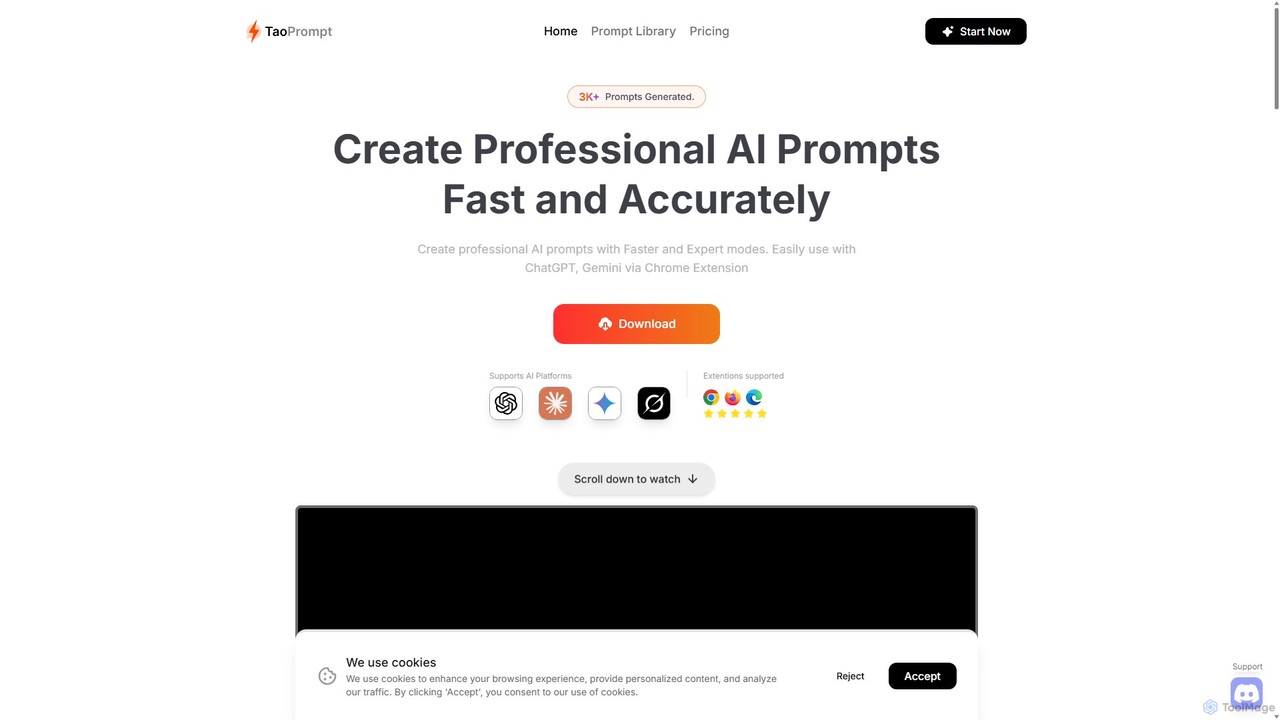
An AI-powered tool that helps users create professional, high-quality prompts for major AI chatbots. It simplifies prompt engineering, allowing anyone to generate optimized requests to turn AI into a domain expert, saving time and improving accuracy.

Code Assistant
Visits 6.5KFavorites 191Likes 201

About Prompt Generation

Prompt Generation tools are specialized AI utilities designed to help users create, refine, and optimize instructions for generative AI models. They function by taking a user's basic idea and expanding it into a detailed, structured prompt that includes specific context, tone, style, and constraints. This process significantly improves the quality, relevance, and consistency of outputs from large language models (LLMs) and image generators. As a key part of the Writing toolkit, these tools focus on perfecting the input to ensure superior AI-generated content.

Core Features

  • Prompt Expansion: Automatically adds detail, context, and relevant keywords to a simple user idea.
  • Style & Tone Modifiers: Provides options to specify output styles like professional, casual, persuasive, or academic.
  • Template Libraries: Offers a collection of pre-built, effective prompts for common tasks like blog writing or social media posts.
  • Parameter Control: Allows users to define specific constraints such as word count, format, or elements to exclude (negative prompting).
  • Prompt Variation Generation: Creates multiple versions of a prompt to test which one produces the best AI response.

Use Cases

These tools are valuable for content creators, marketers, developers, and researchers who need precise control over AI outputs. They are used to craft complex narratives for creative writing, generate structured code documentation, design A/B tests for marketing copy, and formulate detailed queries for academic research.

How to Choose

When selecting a Prompt Generation tool, consider the AI models it supports (e.g., GPT-4, Claude, Midjourney). Evaluate the depth of its template library and the flexibility of its customization options. Also, assess its user interface for ease of use and whether it offers integrations like browser extensions or API access for seamless workflow integration.

Prompt Generation use cases

1

Crafting High-Converting Ad Copy

A digital marketer needs to create multiple ad variations for a new product campaign on social media. Using a prompt generation tool, they input the core product features and target audience. The tool generates five distinct prompts, each emphasizing a different benefit (e.g., cost-saving, luxury, ease-of-use) and tailored for different platforms like Instagram and LinkedIn. This allows the marketer to efficiently A/B test AI-generated ad copy, leading to a more optimized campaign with higher engagement rates.

2

Developing Complex AI Art Prompts

A concept artist wants to generate a series of images for a fantasy video game. Instead of simple text, they use a prompt generator to build a highly detailed prompt. They specify the character's appearance, the moody lighting ('cinematic, volumetric lighting'), the artistic style ('style of Rembrandt'), and the camera angle ('low-angle shot'). The tool structures this into a complex prompt that an AI image generator can interpret accurately, producing consistent and high-quality concept art that matches the project's vision.

3

Streamlining Technical Documentation

A software developer is tasked with writing API documentation. To ensure consistency across all endpoints, they use a prompt generation tool with a custom template. The template requires inputs for the function name, parameters, return value, and an example. The tool then generates a perfectly formatted prompt for an LLM to write the documentation in a clear, uniform style. This process saves significant time and reduces the chance of human error or stylistic inconsistencies.

4

Enhancing Creative Writing and Storytelling

An author is experiencing writer's block while developing a new chapter. They use a prompt generator to brainstorm ideas. They input the current plot point, character motivations, and desired emotional tone. The tool generates several 'what if' scenario prompts, such as 'Write a scene where the protagonist confronts their rival, but with a tone of reluctant respect.' This helps the author explore new narrative directions and overcome creative hurdles by leveraging the AI as a structured brainstorming partner.

5

Formulating Precise Academic Research Queries

A university student is writing a literature review on a complex scientific topic. To get targeted summaries from an AI research assistant, they use a prompt generator. They structure a query that asks the AI to summarize recent papers, specifically focusing on methodology, sample size, and key findings, while excluding review articles. This precise prompting ensures the AI returns highly relevant, structured information, accelerating the research process and improving the quality of the review.

6

Generating Consistent Brand Voice for Social Media

A social media manager for a global brand needs to create content that adheres to strict brand guidelines. They use a prompt generation tool to create a master prompt template. This template includes the brand's core values, target audience persona, approved tone of voice (e.g., 'witty but professional'), and a list of forbidden words. Now, any team member can input a simple topic, and the tool generates a detailed prompt that ensures the AI's output is always on-brand, maintaining consistency across all channels.

Prompt Generation FAQ

What are Prompt Generation tools?

Prompt Generation tools are applications that help users create detailed and effective instructions, known as prompts, for generative AI systems. Instead of relying on simple phrases, these tools allow you to add context, define a specific style, set constraints, and structure your request. This leads to higher quality, more accurate, and more consistent results from AI models like ChatGPT or Midjourney.

How do I choose the right Prompt Generation tool?

To choose the right tool, consider these factors:

  • Supported Models: Ensure it works with the AI systems you use (e.g., text-based LLMs, image generators).
  • Customization: Look for tools that offer deep control over parameters like tone, style, and negative prompts.
  • Template Library: A good library of pre-built prompts for common tasks can save you significant time.
  • Ease of Use: The interface should be intuitive, allowing you to build complex prompts without a steep learning curve.
What's the difference between a Prompt Generation tool and an AI Writing tool?

The key difference lies in their function. An AI Writing tool takes a prompt and generates the final content (e.g., a blog post). A Prompt Generation tool helps you create and refine the prompt itself. Think of it this way: the prompt generator is like a recipe writer, creating the perfect instructions, while the AI writer is the chef who follows those instructions to cook the meal.

Why is prompt engineering important for getting good AI results?

Prompt engineering is crucial because generative AI models are not mind-readers; their output quality is directly dependent on the input quality. A vague prompt leads to a generic or irrelevant response. A well-engineered prompt provides clear context, constraints, and goals, guiding the AI to produce a precise, relevant, and useful output. It's the difference between asking for 'a story' and asking for 'a detective story set in 1940s noir style about a lost cat.'

Who can benefit from using Prompt Generation tools?

Anyone who regularly uses generative AI and wants to achieve more professional or predictable results can benefit. This includes:

  • Marketers creating targeted ad copy and content.
  • Writers and Authors brainstorming ideas and developing stories.
  • Developers generating code snippets and documentation.
  • Designers and Artists crafting detailed prompts for AI image generators.
  • Researchers formulating complex queries for data analysis.