
Free
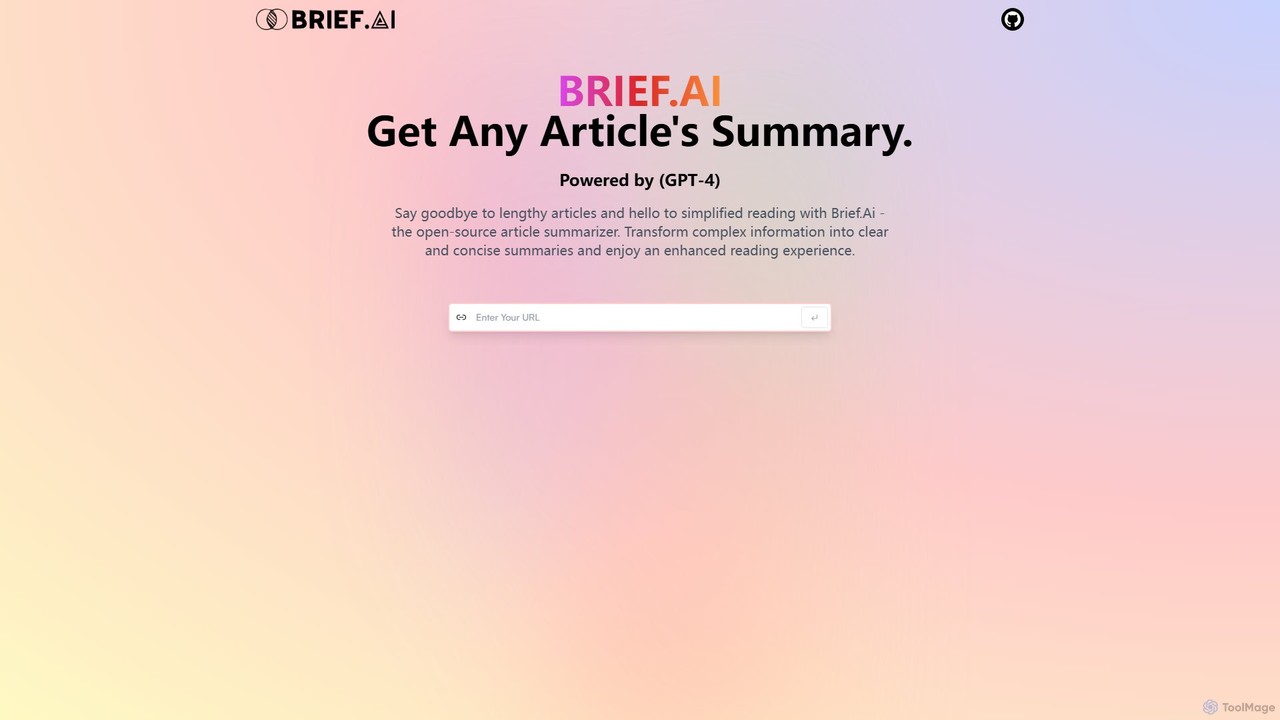
Popular Reading Assistant in Writing include Brief.Ai, helping you work more efficiently.
AI Reading Assistants are specialized tools designed to enhance text comprehension and accelerate information processing. They leverage Natural Language Processing (NLP) to analyze documents, articles, and other written content, providing users with concise summaries, key insights, and interactive Q&A capabilities. These assistants help users save significant time by quickly grasping the core ideas of lengthy materials, making them invaluable for research, learning, and professional analysis. Unlike general writing tools, their primary focus is on improving the efficiency and depth of information consumption.
AI Reading Assistants are widely used by students, researchers, business analysts, lawyers, and journalists. For instance, a researcher can summarize dozens of academic papers in a fraction of the time, while a business analyst can quickly extract key trends from market reports. They are also beneficial for anyone looking to stay informed by efficiently digesting daily news, articles, and long-form content.
When selecting an AI Reading Assistant, consider the types of documents you'll be working with (PDF, URL, etc.). Evaluate the quality and customizability of the summaries (e.g., length, format). Check for essential features like interactive Q&A and language support. Also, consider its integration capabilities with browsers, note-taking apps, or other workflow tools, as well as the pricing model's suitability for your usage volume.
For postgraduate students and academic researchers, reviewing dozens of scientific papers is a time-consuming necessity. An AI Reading Assistant can dramatically streamline this process. Users can upload multiple PDFs of research papers, and the tool will generate concise abstracts or bullet-point summaries for each. More importantly, they can use the interactive Q&A feature to ask specific questions like 'What was the sample size in this study?' or 'Compare the methodologies of these three papers.' This allows researchers to quickly identify relevant studies, understand key findings, and synthesize information for their literature review, reducing research time by hours or even days.
Business analysts and strategists constantly need to digest long market research reports, financial statements, and competitor analyses. An AI Reading Assistant allows them to quickly process these dense documents. By uploading a 100-page market report, an analyst can get a one-page executive summary in minutes. They can then ask targeted questions like 'What is the projected market growth rate for the APAC region?' or 'List all mentions of our main competitor.' This capability enables faster decision-making, more comprehensive competitive intelligence gathering, and saves valuable analyst hours that would otherwise be spent on manual reading and data extraction.
Legal professionals, including lawyers and paralegals, often face the daunting task of reviewing lengthy contracts, case files, and legal precedents. An AI Reading Assistant can serve as a powerful first-pass review tool. A paralegal can upload a complex service agreement and ask the AI to 'Summarize the key obligations for each party' or 'Identify all clauses related to liability and indemnification.' This doesn't replace expert legal analysis but significantly accelerates the initial review process, helping legal teams quickly pinpoint critical information, check for inconsistencies, and prepare for a more in-depth examination, ultimately improving productivity and reducing the risk of oversight.
Language learners can use an AI Reading Assistant to immerse themselves in authentic content like news articles or stories in their target language. When encountering an unknown word or complex phrase, instead of switching tabs to a dictionary, they can simply highlight the text. The assistant provides an instant definition, translation, and even example sentences within the same interface. Some advanced tools can also simplify complex sentences or explain grammatical structures. This creates a seamless and contextual learning experience, helping learners expand their vocabulary and improve their reading comprehension skills more naturally and efficiently.
For busy professionals, staying informed about daily news, industry updates, and thought leadership articles is crucial but time-consuming. An AI Reading Assistant, often integrated as a browser extension, can summarize web articles with a single click. A user can open ten different articles in their browser tabs, run the summarizer on each, and quickly scan the key takeaways in a fraction of the time it would take to read them all. This allows them to cover more ground, identify the most important articles for a deeper read, and efficiently stay current without being overwhelmed by information overload.
Team members often receive multiple documents (agendas, reports, proposals) as pre-reading material before a meeting. An AI Reading Assistant can help everyone come prepared without spending hours reading. A project manager can upload all relevant documents into the tool and share a single, consolidated summary of the key discussion points with the team. This ensures all participants have a consistent baseline understanding of the topics, leading to more focused, productive, and efficient meetings. It also helps late-joining team members get up to speed quickly by reviewing the summary instead of all the source documents.
An AI Reading Assistant is a software tool that uses artificial intelligence, specifically Natural Language Processing (NLP), to help users understand and process written text more efficiently. Its core purpose is to enhance reading comprehension and save time. Key functions typically include:
Selecting the best AI Reading Assistant depends on your specific needs. Consider these factors:
While both tools summarize text, an AI Reading Assistant is typically more comprehensive. A general AI summarizer's primary, and often only, function is to condense text. An AI Reading Assistant, on the other hand, is a broader platform for text interaction. It usually includes summarization as one of its core features, but adds other capabilities designed to deepen understanding, such as:
Yes, many advanced AI Reading Assistants are specifically trained on large datasets of technical, scientific, and academic literature. This allows them to understand complex jargon, intricate arguments, and data-heavy content. While the quality can vary between tools, the best-in-class assistants can accurately summarize research papers, extract methodologies, identify key findings, and even answer nuanced questions about the content. However, they should be used as a tool to accelerate understanding, not as a replacement for expert human analysis, especially in critical fields like medicine or engineering where misinterpretation can have serious consequences.
Security practices vary significantly among different AI Reading Assistant providers. Reputable services often use encryption for data both in transit and at rest. Many offer enterprise-grade plans with stricter security protocols and data handling policies. However, it's crucial to read the privacy policy and terms of service for any tool you consider. For highly confidential or sensitive information, look for providers that offer on-premise solutions or guarantee that your data is not used for training their AI models. Always exercise caution and avoid uploading documents with personal identifiable information (PII) or trade secrets unless you are confident in the provider's security measures.