Google AI is a comprehensive ecosystem of advanced artificial intelligence models, tools, and research initiatives. It encompasses the powerful Gemini family of models, developer platforms like Vertex AI, and applications across creativity, productivity, and scientific discovery, all built with a commitment to safety and responsibility.
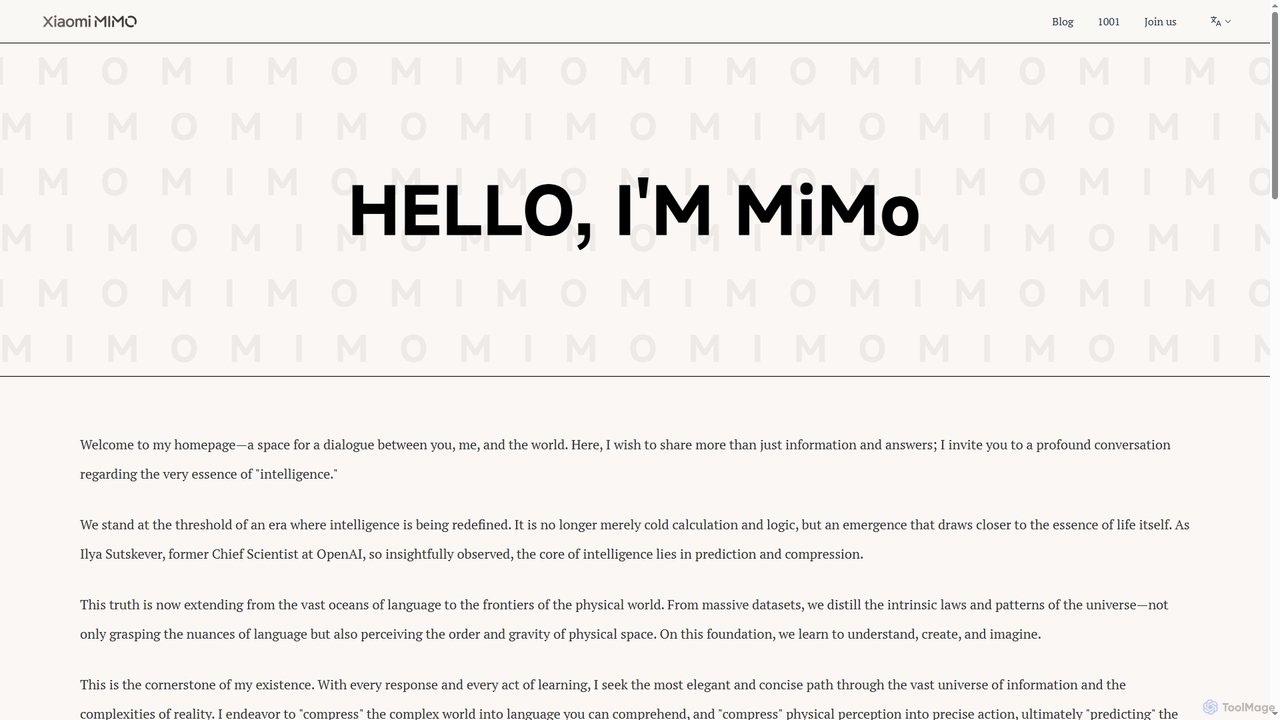
MiMo is Xiaomi's advanced large-scale AI model, designed to redefine intelligence by integrating deep language understanding with real-world physical perception. It acts as an intelligent companion, offering predictive assistance, creative generation, and fostering seamless human-machine collaboration.
Product overview
Google AI Product overview
Google AI is a comprehensive ecosystem of advanced artificial intelligence models, tools, and research initiatives. It encompasses the powerful Gemini family of models, developer platforms like Vertex AI, and applications across creativity, productivity, and scientific discovery, all built with a commitment to safety and responsibility.

MiMo Product overview
MiMo is Xiaomi's advanced large-scale AI model, designed to redefine intelligence by integrating deep language understanding with real-world physical perception. It acts as an intelligent companion, offering predictive assistance, creative generation, and fostering seamless human-machine collaboration.
Detailed feature comparison
| Feature | Google AI | MiMo |
|---|---|---|
| Primary category | Large Language Models | Largelanguagemodels |
| Added | 2025-09-06 | 2025-12-18 |
| Pricing | Freemium | Not verified |
| Official website | ai.google | mimo.xiaomi.com |
| Product type | Website | Website |
| Performance data | ||
| User rating | Not verified | Not verified |
| Comments | 0 | 0 |
| Monthly visits | 2.9M | 1.3M |
| Monthly growth | 10.7% | 8.8% |
| Favorites | 110 | 55 |
| Details | View details | View details |
Google AI vs MiMo monthly traffic
Compare Google AI and MiMo by monthly reach, traffic trend, visit depth, top regions, and acquisition sources.
How to interpret the traffic data
In the Google AI vs MiMo monthly traffic comparison, Google AI currently shows 2.9M visits and MiMo shows 1.3M; Google AI has about 2.2 times the visible traffic of MiMo, an absolute difference of about 1.6M visits. This reflects visible reach, not feature quality or paid users.
Both tools provide verified traffic details, so monthly trends, visit depth, regions, and acquisition sources can be compared on the same basis.
Google AI monthly traffic:
Latest traffic
Monthly traffic trend
- 2025/9: 3M Monthly visits
- 2026/1: 2.9M Monthly visits
- 2026/2: 2.3M Monthly visits
- 2026/3: 2.4M Monthly visits
- 2026/4: 2.6M Monthly visits
- 2026/5: 2.9M Monthly visits
Top regions
Top 5 countries/regions
| Country/region | Percentage | Traffic |
|---|---|---|
| ๐บ๐ธUnited States | 60.62% | 1.8M |
| ๐ฌ๐งUnited Kingdom | 14.21% | 411.3K |
| ๐ฎ๐ณIndia | 12.94% | 374.5K |
| ๐ท๐บRussia | 8.15% | 235.9K |
| ๐ฆ๐บAustralia | 4.08% | 118.1K |
Traffic sources
| Source type | Percentage | Traffic |
|---|---|---|
| Referral | 50.27% | 1.5M |
| Direct | 48.27% | 1.4M |
| 1.46% | 42.3K |
Search keywords
MiMo monthly traffic:
Latest traffic
Monthly traffic trend
- 2026/1: 128.1K Monthly visits
- 2026/2: 79K Monthly visits
- 2026/3: 700.9K Monthly visits
- 2026/4: 1.2M Monthly visits
- 2026/5: 1.3M Monthly visits
Top regions
Top 5 countries/regions
| Country/region | Percentage | Traffic |
|---|---|---|
| ๐จ๐ณChina | 73.06% | 957.6K |
| ๐ธ๐ฌSingapore | 9.29% | 121.8K |
| ๐บ๐ธUnited States | 7.99% | 104.7K |
| ๐ฎ๐ณIndia | 5.49% | 72K |
| ๐ฎ๐ฉIndonesia | 4.17% | 54.7K |
Traffic sources
| Source type | Percentage | Traffic |
|---|---|---|
| Direct | 82.51% | 1.1M |
| Referral | 16.5% | 216.3K |
| 0.99% | 13K |
Search keywords
Usage comparison
Compare the core capabilities of Google AI and MiMo
Google AI Core features
MiMo Core features
Use cases
Google AI Use cases
MiMo Use cases
Best suited roles
Google AI Best suited roles
MiMo Best suited roles
Google AI vs MiMo๏ผIn-depth comparison and selection guidance
First decide whether the products solve the same kind of need
This in-depth Google AI vs MiMo comparison uses only the product records, taxonomy, audience, traffic, and community signals available on this page. Google AI is primarily listed under โLarge Language Modelsโ, while MiMo is primarily listed under โLargelanguagemodelsโ, so the first decision is whether your actual task matches their recorded scope.
The structured fields currently show these decision-relevant differences: Primary category (Google AI: Large Language Models; MiMo: Largelanguagemodels); Pricing (Google AI: Freemium; MiMo: Not disclosed); Monthly visits (Google AI: 2.9M; MiMo: 1.3M); Monthly growth (Google AI: 10.7%; MiMo: 8.8%); Favorites (Google AI: 110; MiMo: 55). These facts are more useful for selection than brand visibility alone.
What market visibility and monthly traffic mean
In the Google AI vs MiMo monthly traffic comparison, Google AI currently shows 2.9M visits and MiMo shows 1.3M; Google AI has about 2.2 times the visible traffic of MiMo, an absolute difference of about 1.6M visits. This reflects visible reach, not feature quality or paid users.
Both tools provide verified traffic details, so monthly trends, visit depth, regions, and acquisition sources can be compared on the same basis.
If public market visibility is an important first-pass criterion, investigate Google AI first. The final choice should still follow taxonomy, use case, and a real trial because higher traffic does not prove broader capabilities or better workflow fit.
Product positioning, use cases, and roles
Google AI and MiMo currently overlap in shared tags: generative AI, large language model, and multimodal AI; shared roles: Content Creator, Data Scientist, Product Manager, and Software Developer. This can place both on the same shortlist, but it does not prove equal implementation, depth, or cost.
Google AI's unique categories/tags are Large Language Models, Image Generation, Video Generation, Ai Platform, Research, AI for health, AI for science, and AI research; MiMo's are Largelanguagemodels, Apiplatforms, Intelligentassistants, AI assistant, computer vision, developer API, Human machine interaction, and natural language processing. These unique fields are the strongest differentiators: validate the product whose recorded scope matches the task instead of following traffic alone.
What ratings, comments, and favorites can tell you
Google AI has no verified rating, 0 comments, 110 favorites, and 123 likes๏ผMiMo has no verified rating, 0 comments, 55 favorites, and 53 likesใ
Neither product has enough rating or comment samples for a credible reputation ranking.
Selection guidance by actual need
When to evaluate Google AI first
Put Google AI on the priority trial list when the task aligns with โLarge Language Modelsโ and especially Large Language Models, Image Generation, Video Generation, Ai Platform, Research, and AI for health, or the users include Educator, Healthcare Professional, Marketing Manager, and Researcher. This follows recorded positioning and does not imply unlisted capabilities are absent.
Google AI also currently records: pricing is freemium, product type is website, 2.9M verified monthly visits, no verified user rating. Verify any hard requirement around price, platform, or reach before trial, and do not let sparse review data substitute for testing.
When to evaluate MiMo first
Put MiMo on the priority trial list when the task aligns with โLargelanguagemodelsโ and especially Largelanguagemodels, Apiplatforms, Intelligentassistants, AI assistant, computer vision, and developer API, or the users include AI Researcher, Innovation Lead, Smart Home Engineer, and UX Designer. This follows recorded positioning and does not imply unlisted capabilities are absent.
MiMo also currently records: pricing is not verified, product type is website, 1.3M verified monthly visits, no verified user rating. Verify any hard requirement around price, platform, or reach before trial, and do not let sparse review data substitute for testing.
How to validate the recommendation before deciding
The available data describes positioning, public visibility, and community signals, but it cannot prove output quality, speed, integration effort, privacy, or long-term cost in your workflow. Before deciding, run the same representative tasks in Google AI and MiMo, then record completion time, accuracy, manual corrections, and the real paid threshold. A like-for-like trial turns this comparison into a defensible adoption decision.
Comparison FAQ
How should I choose between Google AI and MiMo?
Where does this comparison data come from?
What do unknown fields mean?
Related AI tools

GenAI List
GenAI List is a comprehensive online directory dedicated to tracking, exploring, and comparing generative AI models. It serves as an essential guide to the rapidly evolving AI landscape, featuring thousands of models from various organizations. Users can discover new releases, filter by type, openness, and capabilities, and gain insights into practitioner opinions.
Model Discovery
Reka
Reka provides a suite of powerful, multimodal AI models and solutions designed for real-world impact. From the ultra-compact Spark to the frontier-level Core model, Reka's technology understands and processes text, images, audio, and video. It powers applications like Reka Vision for intelligent video analysis and Reka for Creators for automated social media clip generation, serving developers, enterprises, and content creators.
Transcription
Jyek
Jyek is an AI agent platform that understands objectives, creates execution plans, uses tools, and delivers verifiable results for complex, multi-step tasks.
Automation
Amazon Nova
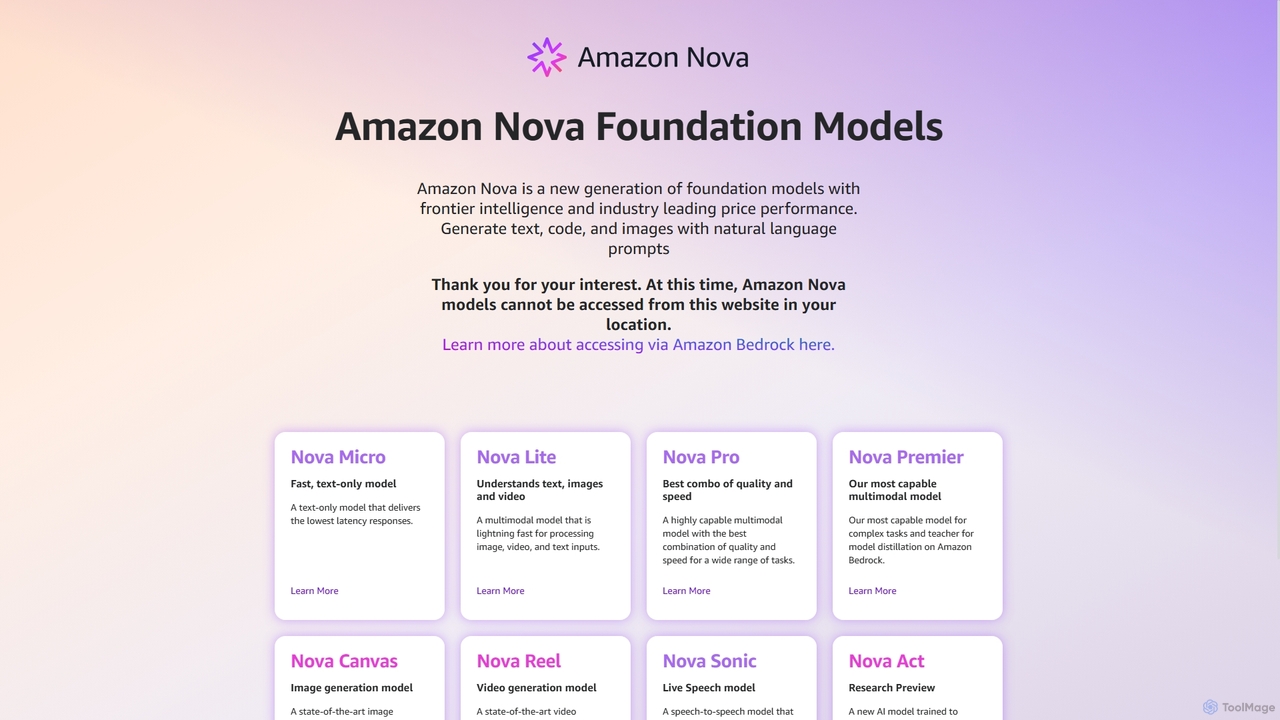
Amazon Nova is a suite of next-generation foundation models developed by Amazon. It offers a range of specialized models for generating text, code, images, video, and human-like speech, designed for high performance and cost-efficiency. These models are accessible to developers through Amazon Bedrock.
Foundation Model
AI Daily
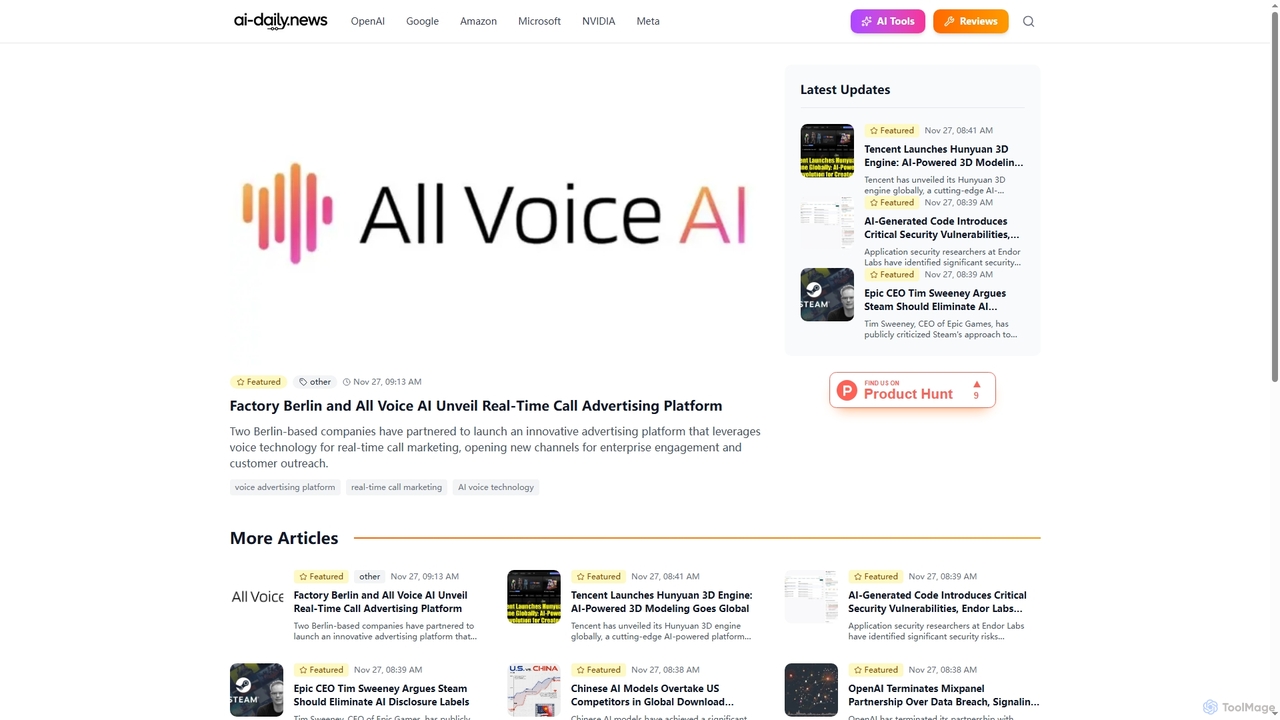
AI Daily is a leading online platform providing the latest news, in-depth research, and technology updates across the artificial intelligence landscape. It features a comprehensive marketplace for discovering AI tools and offers unbiased reviews to help users make informed decisions.
Ai News
Zuvu
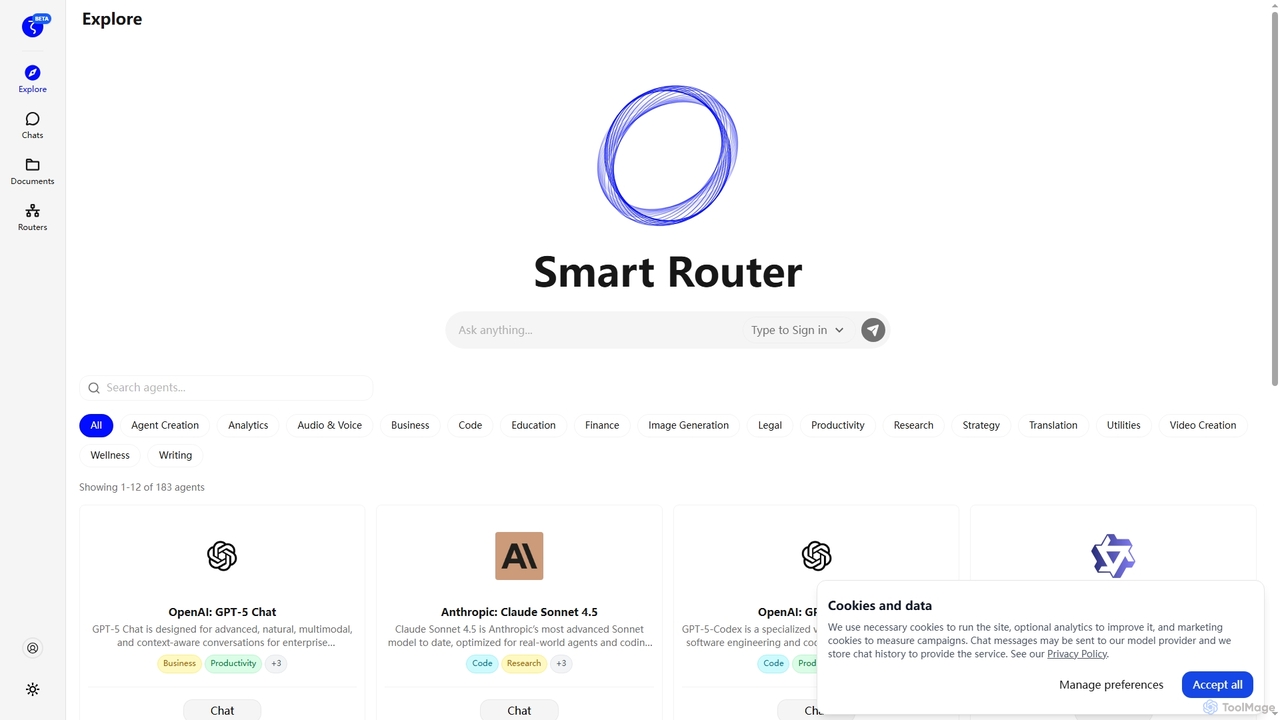
Zuvu is a next-generation AI agents platform that acts as a Smart Router, providing access to a diverse range of advanced AI models like OpenAI GPT-5, Anthropic Claude, and Google Gemini for complex, agentic workflows across various domains.
Automation
OpenAI
OpenAI is a leading AI research and deployment company dedicated to ensuring that artificial general intelligence (AGI) benefits all of humanity. It develops state-of-the-art models like GPT-5, ChatGPT for conversational AI, Sora for text-to-video, and DALL-E for image generation. Through its robust API platform, OpenAI empowers developers and businesses to integrate powerful AI capabilities into their applications, driving innovation across various industries.
Image Generation
Qwen
Qwen is a powerful multimodal AI chat assistant from Alibaba Cloud. It excels at natural language conversations, content creation, code generation, data analysis, and even image generation. With integrated web search and document analysis, Qwen provides comprehensive, up-to-date, and accurate answers for a wide range of tasks.
Image Generation
AIWorldNext
AIWorldNext is a premier global hub for artificial intelligence and robotics, offering a comprehensive platform for news, expert blogs, job opportunities, AI tool directories, and community engagement. It serves as a vital resource for professionals, researchers, and enthusiasts to stay informed and connected in the rapidly evolving AI landscape.
Job Board
Qwen
Qwen is a powerful family of open-source large language and multi-modal models from Alibaba Cloud. It excels at a wide range of tasks including conversational AI, state-of-the-art code generation, advanced image creation with precise text rendering, and high-quality multilingual translation, empowering developers and creators worldwide.
Code Assistant
Gabber
Gabber is a powerful platform for building real-time, multimodal AI applications that can see, hear, and speak. It offers low-latency inference for Vision Language Models (VLM), Text-to-Speech (TTS), and Speech-to-Text (STT), coupled with a graph-based orchestration system for rapid development and deployment.
Conversational Ai
Seed
Seed is ByteDance's advanced AI research initiative focused on building general artificial intelligence. They develop foundational models across various domains including multimodal, vision, speech, robotics, and LLMs, driving innovation in both academic research and real-world applications.
Foundational Models
Yugong
Yugong is a global community platform for discovering and sharing AI creations, prompts, projects, and case studies. It enables users to publish detailed AI workflows, engage with a worldwide audience, and explore innovative applications of AI tools like ChatGPT, Gemini, and Perplexity.
Prompt Sharing
Moonshot
Moonshot is an AI company developing advanced large language models. Its flagship product, Kimi, is an intelligent assistant for online search, deep thinking, multi-modal reasoning, and ultra-long text conversations. Moonshot also offers an open platform with flexible API access for developers.
Api
AIDiscoveryBoards
AIDiscoveryBoards is a comprehensive online platform designed to help users discover trending AI tools, explore the latest AI prompts, delve into groundbreaking AI research papers, and access curated AI learning resources. It serves as a central hub for staying updated on the rapidly evolving artificial intelligence landscape.
Tool Directory