
ToolMage
Sign in

Best 1 Foundation Model AI tools for Ai Model

Popular Foundation Model AI tools in Ai Model include Amazon Nova, helping you work more efficiently.

Amazon Nova

Amazon Nova

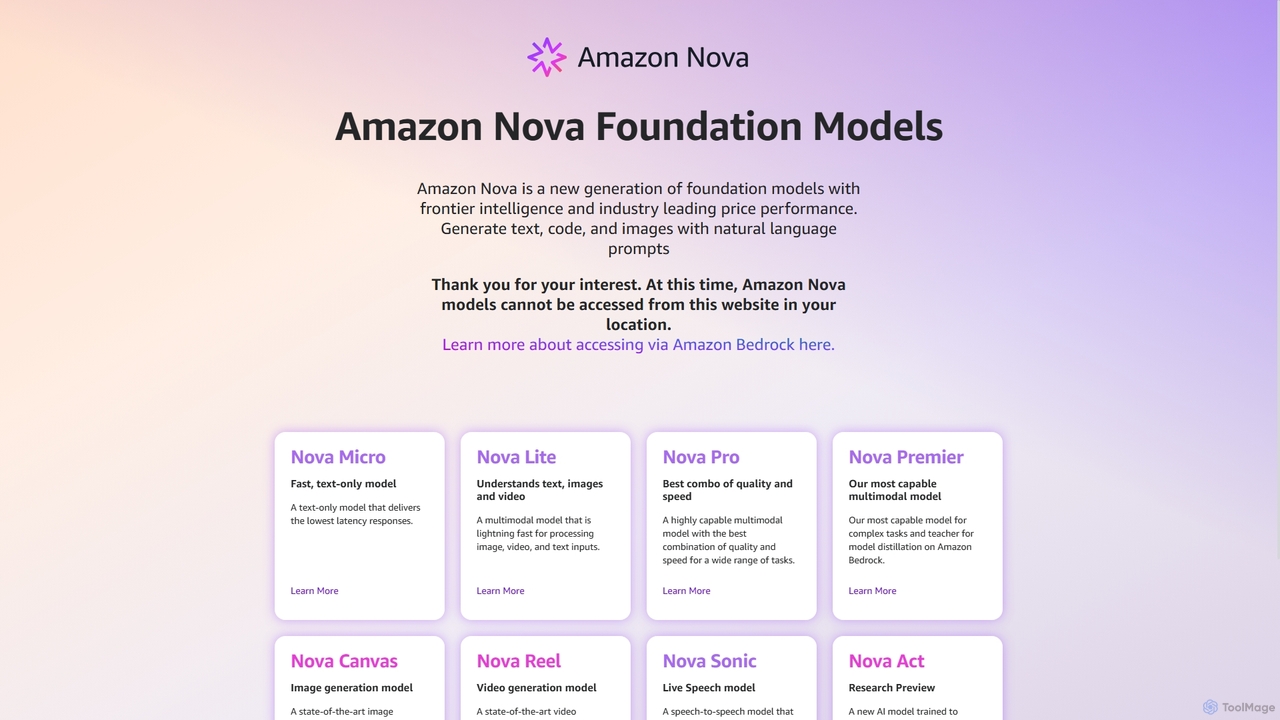
Amazon Nova is a suite of next-generation foundation models developed by Amazon. It offers a range of specialized models for generating text, code, images, video, and human-like speech, designed for high performance and cost-efficiency. These models are accessible to developers through Amazon Bedrock.

Foundation Model
Visits 121.5KFavorites 104Likes 115

About Foundation Model

Foundation Models are a class of large-scale artificial intelligence models trained on vast and diverse datasets, designed to be adaptable across a wide spectrum of tasks. These models leverage advanced architectures, primarily transformers, to learn general representations and emergent capabilities from raw data. They serve as a powerful base for developing specialized AI applications, significantly reducing the need for training task-specific models from scratch and accelerating innovation across various industries.

Core Features

  • General Purpose Learning: Capable of understanding and generating diverse data types, including text, images, and code, enabling broad applicability.
  • Transfer Learning: Can be efficiently fine-tuned with smaller, task-specific datasets to achieve high performance on new, specialized problems.
  • Emergent Capabilities: Exhibit advanced reasoning, problem-solving, and common-sense understanding that arise from their scale and diverse training.
  • Massive Scale: Built with billions or trillions of parameters, allowing them to capture complex patterns and relationships in data.

Use Cases

Foundation Models are pivotal in various advanced AI applications. They power sophisticated conversational agents, generate high-quality content for marketing and publishing, and enable complex data analysis for scientific research. Their versatility makes them invaluable for rapid prototyping and deployment of AI solutions across enterprises.

How to Choose

Selecting a Foundation Model involves evaluating its pre-training data diversity, model architecture, and the specific emergent capabilities required for your application. Consider the ease of fine-tuning, available APIs, computational resource requirements for deployment, and the model's ethical guidelines and bias mitigation strategies. Compatibility with existing infrastructure and community support are also critical factors.

Featured tool rankings

Foundation Model use cases

1

Developing Advanced Conversational AI Agents

For businesses aiming to create highly intelligent chatbots or virtual assistants, Foundation Models provide the underlying language understanding and generation capabilities. Developers can fine-tune a pre-trained LLM (a type of Foundation Model) with company-specific data to build a customer service bot that handles complex queries, provides personalized responses, and maintains coherent conversations, drastically reducing development time compared to building from scratch.

2

Accelerating Content Creation and Summarization

Content creators and marketing teams can leverage Foundation Models to generate diverse forms of text, from blog posts and social media updates to product descriptions and email campaigns. By providing prompts or initial drafts, the model can expand, refine, or summarize long documents, enabling rapid content iteration and ensuring consistency in tone and style across various communication channels, saving significant manual effort.

3

Enhancing Code Generation and Software Development

Software engineers and developers utilize Foundation Models to assist with code generation, auto-completion, and debugging. By integrating these models into IDEs, developers can receive intelligent suggestions for code snippets, generate boilerplate code from natural language descriptions, or identify potential errors and vulnerabilities. This accelerates the development cycle, improves code quality, and allows engineers to focus on more complex problem-solving.

4

Powering Multimodal AI Applications

Researchers and product developers building applications that integrate different data types, such as text and images, rely on multimodal Foundation Models. For instance, creating an image captioning tool where the AI describes an image in natural language, or a visual search engine that understands complex queries, becomes feasible. These models bridge the gap between modalities, enabling richer and more intuitive user experiences.

5

Facilitating Scientific Discovery and Data Analysis

Scientists and researchers across various fields, from biology to material science, use Foundation Models to analyze vast datasets, identify patterns, and generate hypotheses. For example, a model trained on scientific literature and experimental data can summarize research papers, predict protein structures, or suggest new drug candidates, significantly accelerating the pace of discovery and reducing the burden of manual data interpretation.

6

Personalizing User Experiences at Scale

E-commerce platforms and digital service providers can deploy Foundation Models to offer highly personalized recommendations, search results, and user interfaces. By analyzing individual user behavior, preferences, and historical data, these models can dynamically adapt content and product suggestions, leading to improved engagement, higher conversion rates, and a more tailored experience for millions of users simultaneously.

Foundation Model FAQ

What are Foundation Models?

Foundation Models are large AI models pre-trained on broad data at scale, designed to be highly adaptable to a wide range of downstream tasks. They learn general patterns and representations, serving as a base for many specialized AI applications like chatbots, image generators, and code assistants. Their key characteristic is their ability to perform diverse tasks with minimal task-specific fine-tuning.

How do Foundation Models differ from traditional AI models?

Foundation Models differ from traditional, task-specific AI models primarily in their scale, generality, and adaptability. Traditional models are typically trained for a single, narrow task (e.g., classifying cats vs. dogs). Foundation Models, in contrast, are pre-trained on vast, diverse data to learn general capabilities, allowing them to be fine-tuned for many different tasks with far less data and effort, exhibiting emergent abilities not seen in smaller models.

What are the main benefits of using Foundation Models?

The main benefits of using Foundation Models include accelerating AI development, reducing the cost and time required to build specialized AI applications, and democratizing access to advanced AI capabilities. They enable rapid prototyping, consistent performance across various tasks, and allow developers to focus on application-specific innovation rather than foundational model training. They also exhibit emergent capabilities that can lead to novel solutions.

What types of tasks can Foundation Models perform?

Foundation Models can perform a wide array of tasks across different modalities. For text, they can generate content, summarize, translate, answer questions, and write code. For images, they can generate images from text, classify objects, and perform image editing. Multimodal Foundation Models can even bridge these, understanding and generating content across text, images, and other data types, making them incredibly versatile.

What should I consider when deploying a Foundation Model?

When deploying a Foundation Model, consider several factors: the computational resources required for inference and fine-tuning, the cost associated with API usage or infrastructure, data privacy and security implications, and the potential for biases inherited from the training data. Additionally, evaluate the model's performance on your specific tasks, its latency requirements, and the availability of support and documentation for integration and maintenance.