Qwen3 Coder
Qwen3 Coder is a state-of-the-art, open-source large language model by Alibaba Cloud, engineered for advanced code generation, comprehension, …
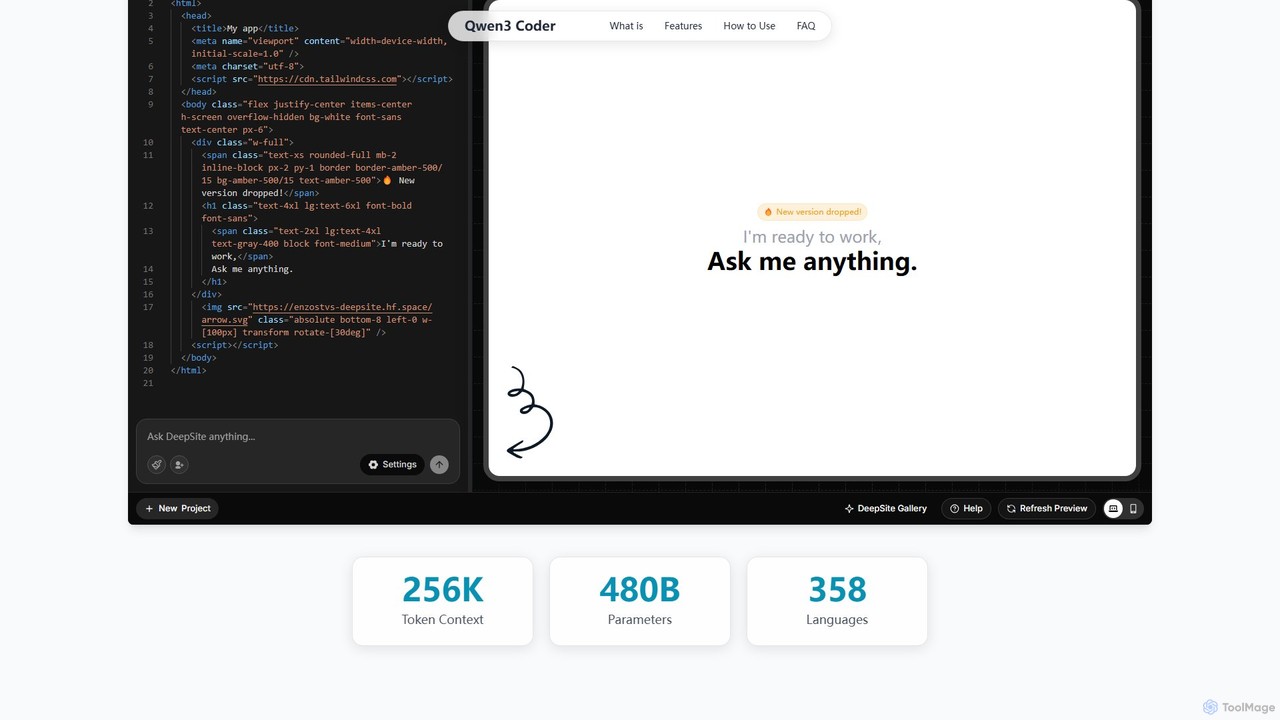
Qwen3 Coder is a state-of-the-art, open-source large language model by Alibaba Cloud, engineered for advanced code generation, comprehension, and agentic tasks. Featuring a 480B Mixture-of-Experts architecture and trained on 7.5 trillion tokens, it achieves GPT-4 level performance across 358 programming languages. It supports a massive 256K context window and is designed for complex, multi-step software development workflows.
About Large Language Model
Large Language Models (LLMs) are advanced AI models trained on massive datasets of text and code, designed to understand, generate, and process human language with remarkable fluency. Leveraging deep learning and transformer architectures, these models can perform a wide array of natural language tasks, revolutionizing content creation, information retrieval, and human-computer interaction. As a specialized type of AI model, LLMs enable intelligent automation and unlock new possibilities for businesses and individuals alike.
Core Features
- Text Generation: Crafting coherent and contextually relevant articles, emails, and creative content.
- Summarization: Condensing long documents, reports, or web pages into concise summaries.
- Translation: Converting text between multiple languages while preserving meaning and nuance.
- Question Answering: Providing accurate and informative answers to complex queries based on vast knowledge.
- Code Generation & Assistance: Writing, debugging, and explaining programming code across various languages.
Use Cases
LLMs are widely adopted across various sectors. Content creators use them to overcome writer's block and generate diverse drafts quickly. Customer service departments deploy LLM-powered chatbots to provide instant, personalized support and resolve common inquiries efficiently. Developers leverage LLMs for accelerating coding tasks, from generating boilerplate code to identifying and fixing bugs, significantly boosting productivity.
How to Choose
Selecting an LLM involves evaluating several factors. Consider the model's size and performance for your specific task, as larger models often offer greater capability but require more resources. Assess its fine-tuning capabilities for domain-specific adaptation, API accessibility for seamless integration, and the associated costs. Data privacy and security features are also crucial, especially for sensitive applications.

Large Language ModelUse Cases
Automated Content Creation for Marketing
Marketing professionals can use LLMs to quickly draft blog posts, social media updates, ad copy, and email newsletters. By providing a few keywords or a brief outline, the model generates multiple variations, saving significant time in content production and ensuring a consistent brand voice across platforms. This allows teams to scale their content efforts without increasing manual workload.
Enhancing Customer Support with AI Chatbots
Businesses deploy LLMs to power intelligent chatbots that provide instant, 24/7 customer support. These chatbots can understand complex queries, retrieve relevant information from knowledge bases, and offer personalized solutions. This reduces response times, frees up human agents for more complex issues, and significantly improves overall customer satisfaction.
Accelerating Software Development and Debugging
Developers utilize LLMs as coding assistants to generate code snippets, complete functions, and explain complex code logic. They can also assist in identifying potential bugs, suggesting fixes, and refactoring code for better performance. This dramatically speeds up the development cycle, reduces errors, and helps junior developers learn faster.
Summarizing Research Papers and Reports
Researchers and analysts can employ LLMs to quickly digest vast amounts of information by generating concise summaries of academic papers, market research reports, or legal documents. This capability allows them to extract key findings, identify trends, and make informed decisions without having to read every single word, enhancing efficiency in information synthesis.
Facilitating Multilingual Communication
Global teams and businesses leverage LLMs for real-time translation of documents, emails, and chat conversations. Unlike traditional translation tools, LLMs can better understand context and nuance, providing more accurate and natural-sounding translations. This breaks down language barriers, enabling seamless collaboration and expanding market reach.
Personalized Education and Tutoring
Educational platforms and individual tutors use LLMs to create personalized learning experiences. LLMs can generate tailored explanations for complex topics, provide practice questions, offer feedback on essays, and adapt content to a student's learning style. This makes education more accessible and effective, catering to individual needs and pace.