scrapetoai
scrapetoai is a free online tool that converts any website's content into clean, LLM-ready formats like Markdown, JSON, …
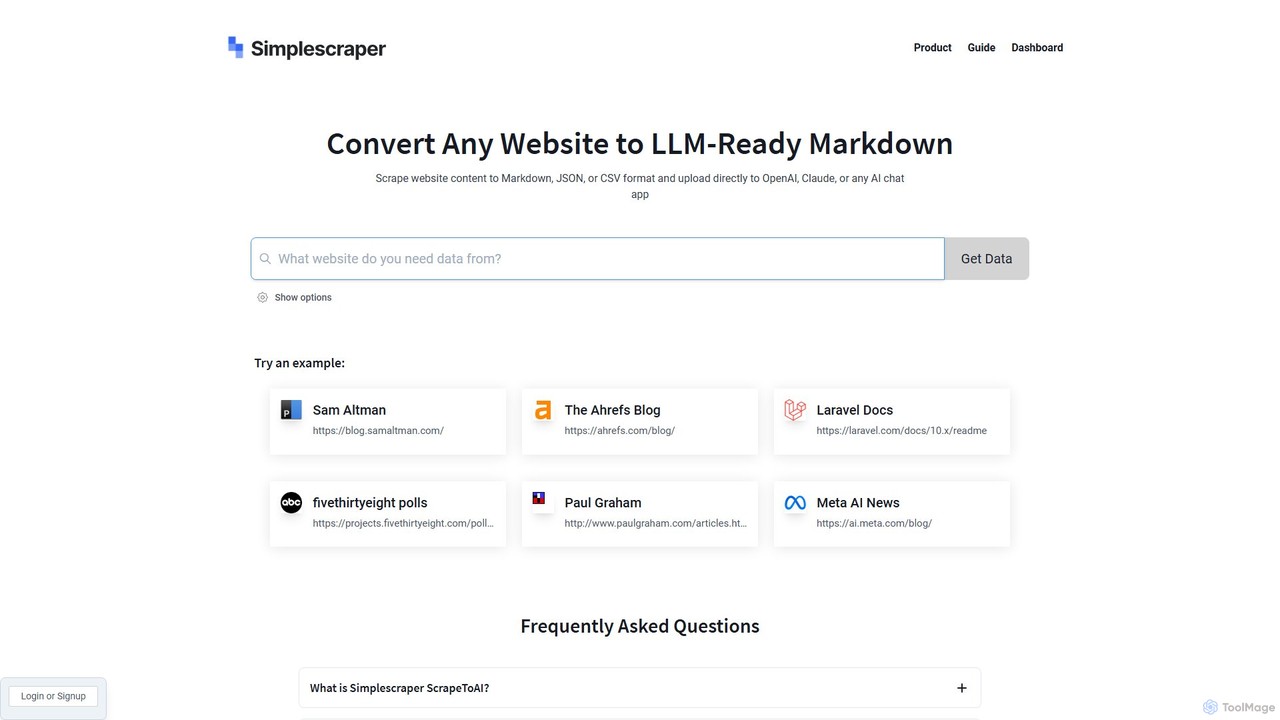
scrapetoai is a free online tool that converts any website's content into clean, LLM-ready formats like Markdown, JSON, or CSV. Simply enter a URL to scrape and format data, making it easy to upload to custom GPTs, Claude, or other AI models for building knowledge bases or providing context.
About Data Preparation
Data Preparation tools are AI-powered solutions designed to clean, transform, and organize raw data, making it suitable for AI model training and analysis. These tools leverage machine learning algorithms to automate complex data processing tasks. They are essential for ensuring data quality, reducing manual effort, and significantly improving the accuracy and performance of AI models. This category acts as a crucial bridge between raw, unstructured data and effective AI applications, streamlining the entire data pipeline.
Core Features
- Data Cleaning: Automatically identifies and corrects errors, handles missing values, and resolves inconsistencies within datasets.
- Data Transformation: Normalizes, scales, aggregates, and reshapes data to meet the specific input requirements of various AI models.
- Feature Engineering: Creates new, more informative features from existing raw data, enhancing the predictive power and performance of machine learning models.
- Anomaly Detection: Utilizes AI to automatically flag outliers or unusual data points that could negatively impact model training.
- Data Labeling & Annotation: Facilitates the process of adding labels or annotations to data (e.g., images, text) for supervised learning tasks.
Applicable Scenarios
Data Preparation tools are indispensable for professionals across various domains. Machine learning engineers use them to meticulously prepare diverse datasets for training robust AI models. Data scientists rely on these tools to clean and transform large, complex datasets, enabling accurate predictive analytics and insightful data exploration. Business analysts leverage them to standardize and refine raw business intelligence data, paving the way for AI-driven insights and automated reporting.
How to Choose
When selecting Data Preparation tools, consider the tool's capability to handle your specific data volume and variety, including structured, semi-structured, and unstructured data. Evaluate the level of automation offered for cleaning, transformation, and feature engineering, prioritizing solutions that minimize manual intervention. Assess its integration capabilities with your existing data sources, storage solutions, and AI/ML platforms. Finally, consider the user interface and overall ease of use, ensuring it caters to both technical and non-technical team members.

Data PreparationUse Cases
Preparing Customer Data for Churn Prediction
Data scientists and machine learning engineers utilize Data Preparation tools to clean and transform raw customer interaction logs, purchase history, and demographic data. This involves handling missing values, standardizing formats, and creating new features like 'frequency of last purchase' or 'average transaction value'. The prepared dataset is then used to train AI models that accurately predict customer churn, enabling proactive retention strategies.
Automating Medical Image Annotation
AI researchers and medical imaging specialists leverage Data Preparation tools to semi-automatically label anomalies in medical scans, such as tumors in X-rays or lesions in MRI images. These tools can pre-segment regions of interest or suggest labels, significantly accelerating the laborious process of creating high-quality, annotated datasets. This automation reduces human error and speeds up the development of diagnostic AI models, leading to faster and more accurate medical diagnoses.
Standardizing E-commerce Product Catalogs
E-commerce platform managers and data specialists use Data Preparation tools to normalize product descriptions, categories, and attributes from various suppliers. This ensures consistency across the entire product catalog, which is crucial for effective search functionality, recommendation engines, and inventory management. By automating the standardization process, businesses can quickly onboard new products and maintain a clean, unified product database, improving customer experience and operational efficiency.
Cleaning Sensor Data for IoT Analytics
IoT engineers and data analysts process noisy, incomplete sensor data from smart devices using Data Preparation tools. This involves removing outliers caused by faulty sensors, interpolating missing data points, and aggregating time-series data for trend analysis. By ensuring the cleanliness and integrity of IoT data, these tools enable accurate real-time anomaly detection, predictive maintenance, and optimized resource management in smart factories, smart cities, and other connected environments.
Feature Engineering for Financial Fraud Detection
Financial analysts and data scientists in banking use Data Preparation tools to transform raw transaction data into meaningful features for fraud detection models. This involves creating features like 'transaction frequency per hour', 'average transaction amount for a user', or 'ratio of international to domestic transactions'. These engineered features significantly improve the ability of AI models to identify subtle patterns indicative of fraudulent activities, thereby enhancing security and minimizing financial losses.
Text Data Preprocessing for NLP Models
NLP engineers and data scientists prepare large text corpora for natural language processing (NLP) models using Data Preparation tools. This involves cleaning text by removing special characters, stop words, and irrelevant information, as well as performing tasks like tokenization, stemming, and lemmatization. By meticulously preprocessing text data, these tools ensure that NLP models for sentiment analysis, chatbot development, or machine translation receive high-quality input, leading to more accurate and robust language understanding.