Google AI for Developers
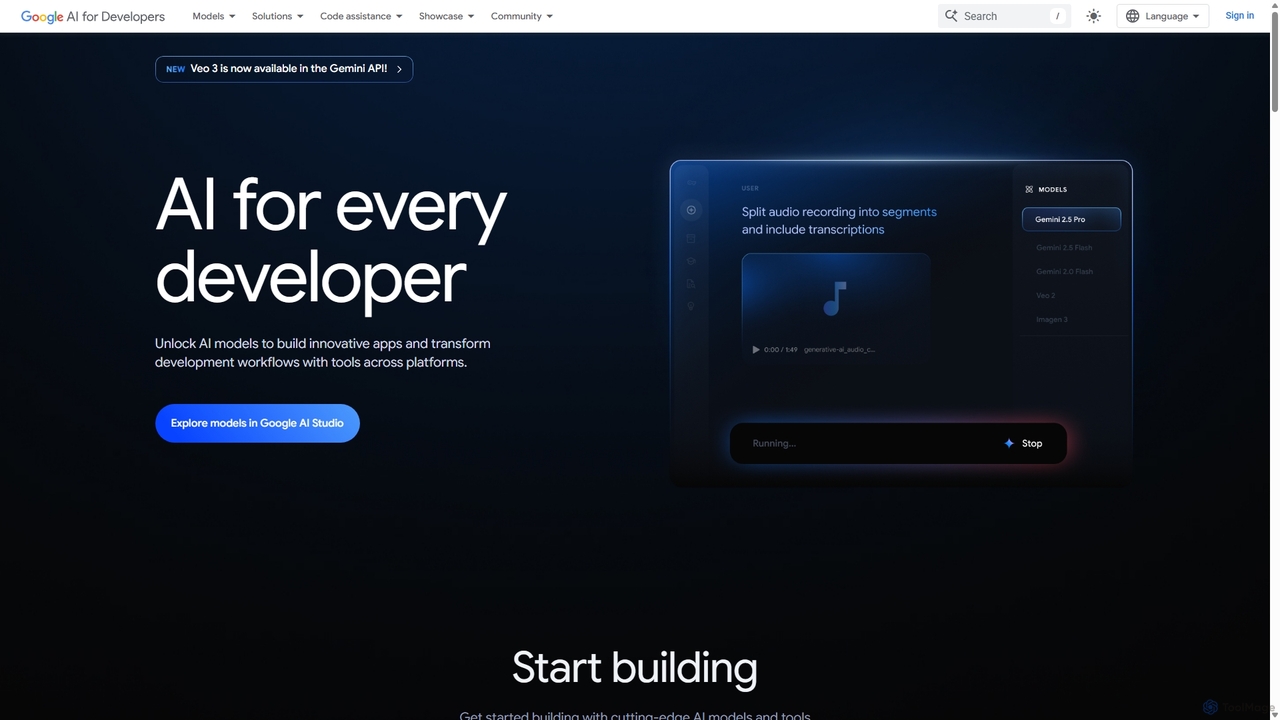
A comprehensive platform by Google providing developers with access to cutting-edge AI models like Gemini, Imagen, and Veo …
A comprehensive platform by Google providing developers with access to cutting-edge AI models like Gemini, Imagen, and Veo via API, alongside the open-source Gemma models. It includes tools like Google AI Studio for prototyping, AI Edge for on-device deployment, and integrated code assistance to build innovative applications and streamline development workflows responsibly.
Google AI
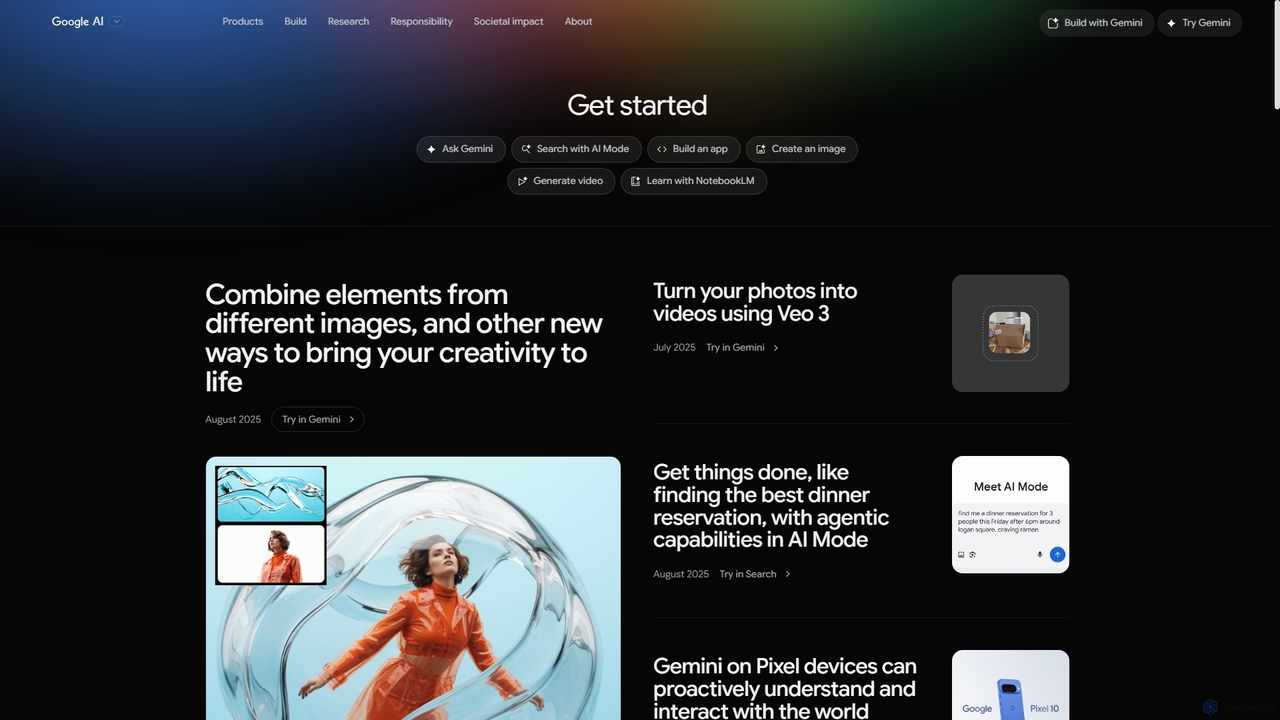
Google AI is a comprehensive ecosystem of advanced artificial intelligence models, tools, and research initiatives. It encompasses the …
Google AI is a comprehensive ecosystem of advanced artificial intelligence models, tools, and research initiatives. It encompasses the powerful Gemini family of models, developer platforms like Vertex AI, and applications across creativity, productivity, and scientific discovery, all built with a commitment to safety and responsibility.
FineCodeX
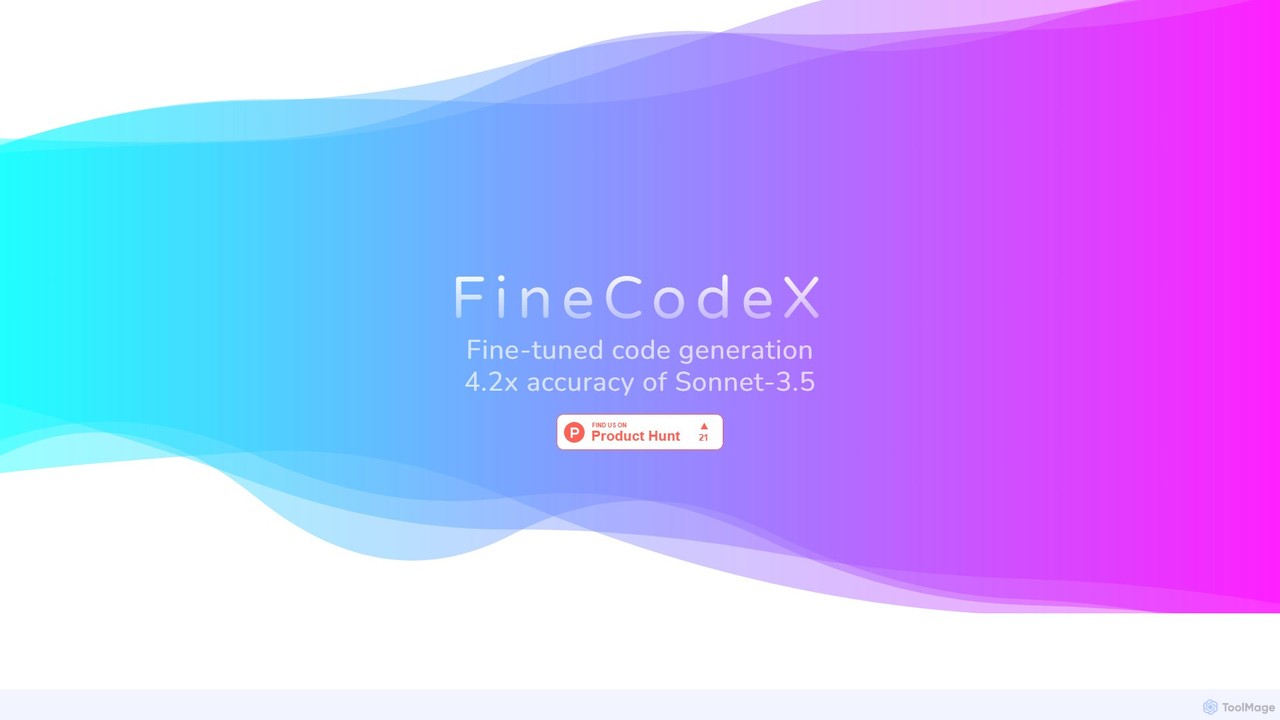
FineCodeX is an enterprise-grade AI code generation tool powered by a fine-tuned Llama-3.3-70B model. It delivers superior accuracy …
FineCodeX is an enterprise-grade AI code generation tool powered by a fine-tuned Llama-3.3-70B model. It delivers superior accuracy for creating correct code changes, offering up to 4.2x higher precision than leading models. Designed for privacy, it provides dedicated private API access or full model weights, ensuring your data never leaves your infrastructure. It's a cost-effective and secure solution for professional development teams.
Cerebras
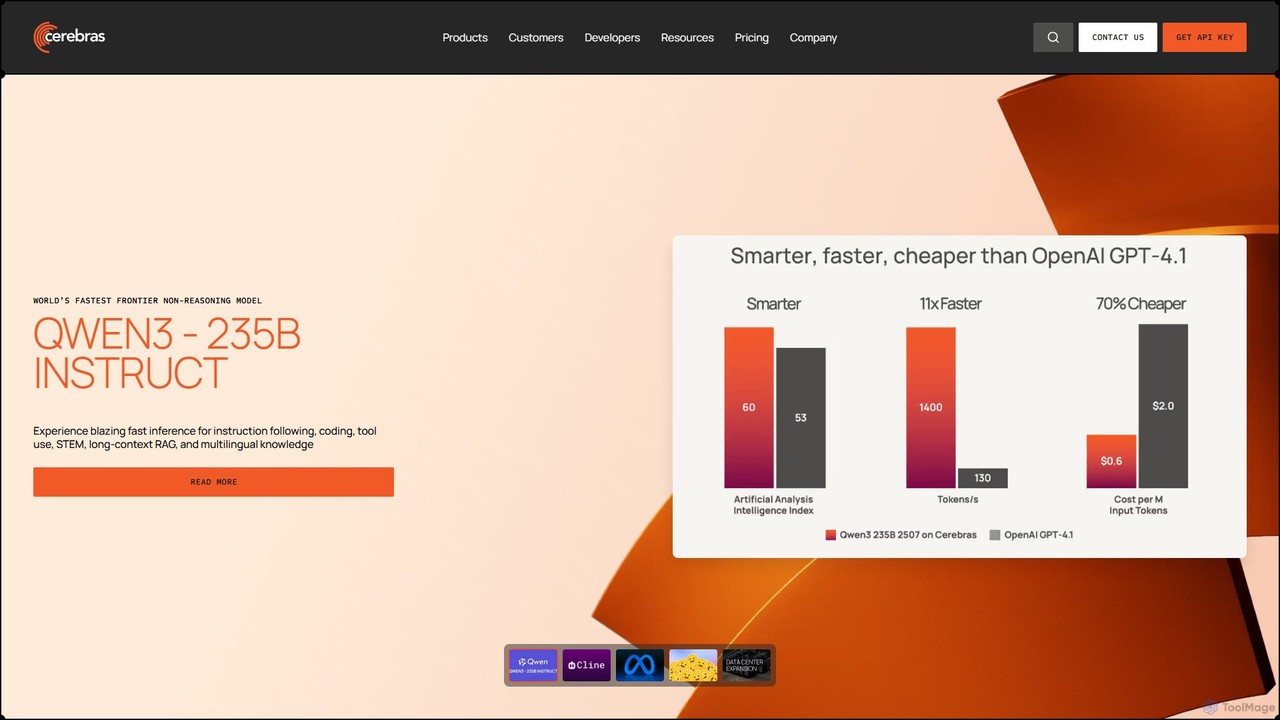
Cerebras provides the world's fastest AI inference and training platform, powered by its revolutionary Wafer Scale Engine (WSE). …
Cerebras provides the world's fastest AI inference and training platform, powered by its revolutionary Wafer Scale Engine (WSE). It offers unparalleled speed and low latency for the latest large language models like Llama 4 and Qwen3, enabling real-time AI applications for developers and enterprises through flexible cloud API and on-premises deployments.
About Large Language Models
Large Language Models (LLMs) are advanced AI models trained on vast amounts of text data to understand, generate, and process human language. These sophisticated models leverage deep learning architectures, primarily transformers, to identify complex patterns and relationships within language. They enable a wide range of applications, from sophisticated content creation to intelligent conversational agents, revolutionizing how humans interact with digital information and AI systems. Their ability to comprehend context and generate coherent, relevant text makes them foundational for many next-generation AI tools.
Core Features
- Natural Language Understanding (NLU): Accurately interprets user intent, sentiment, and complex linguistic nuances from input text.
- Natural Language Generation (NLG): Produces human-like, coherent, and contextually relevant text for various purposes, including articles, summaries, and creative writing.
- Contextual Learning: Maintains conversational context over extended interactions, allowing for more natural and continuous dialogue.
- Multitask Capabilities: Performs diverse language-related tasks such as translation, summarization, question answering, and code generation.
- Fine-tuning & Customization: Can be adapted and specialized with domain-specific data to improve performance for particular applications or industries.
Use Cases
LLMs are pivotal across numerous sectors, empowering professionals to automate and enhance language-centric tasks. Content creators utilize them for drafting articles, marketing copy, and social media posts, significantly accelerating their workflow. Developers integrate LLMs into applications for intelligent chatbots, code generation, and semantic search, building more intuitive and powerful user experiences. Businesses leverage LLMs for customer service automation, data analysis, and personalized communication, driving efficiency and improving customer engagement.
How to Choose
Selecting an LLM requires evaluating several key factors. Consider the model's size and performance benchmarks, as larger models often offer greater capability but demand more computational resources. Assess the availability of pre-trained models versus the need for custom training or fine-tuning, which impacts development time and cost. Evaluate the API accessibility, documentation quality, and community support for integration. Finally, review the pricing structure, data privacy policies, and ethical guidelines to ensure alignment with project requirements and responsible AI practices.

Large Language ModelsUse Cases
Automating Customer Support Responses
Customer service teams can deploy LLMs to automatically generate accurate and personalized responses to common customer inquiries. By integrating with ticketing systems, the LLM analyzes incoming messages, identifies the core issue, and drafts a suitable reply, which agents can review and send, significantly reducing response times and improving service efficiency.
Generating Marketing Copy and Content
Marketing professionals use LLMs to rapidly produce diverse marketing materials, including ad copy, social media posts, blog outlines, and email newsletters. Users provide a brief or keywords, and the LLM generates multiple creative variations, allowing marketers to quickly iterate and test different messages for optimal campaign performance.
Assisting Software Development with Code Generation
Developers leverage LLMs as intelligent coding assistants to generate code snippets, suggest functions, or even complete entire scripts based on natural language descriptions. This accelerates the development process, helps overcome coding blocks, and allows engineers to focus on higher-level architectural design and complex problem-solving.
Summarizing Long Documents and Research Papers
Researchers, analysts, and students utilize LLMs to distill lengthy articles, reports, or academic papers into concise summaries. The model identifies key information and main arguments, providing a quick overview that saves significant reading time and helps in rapid information extraction and knowledge synthesis.
Personalizing Educational Content and Tutoring
Educators and e-learning platforms employ LLMs to create personalized learning paths, generate practice questions, or provide tailored explanations for students. The LLM can adapt content difficulty and style based on individual student progress and learning preferences, offering a more engaging and effective educational experience.
Translating and Localizing Global Communications
Global businesses and content creators use LLMs for high-quality translation and localization of documents, websites, and multimedia content. Beyond direct translation, LLMs can adapt text to cultural nuances and idiomatic expressions of target languages, ensuring messages resonate effectively with diverse international audiences.