Moondream
Moondream is a powerful, open-source visual language model (VLM) that is incredibly lightweight and fast. With a tiny …
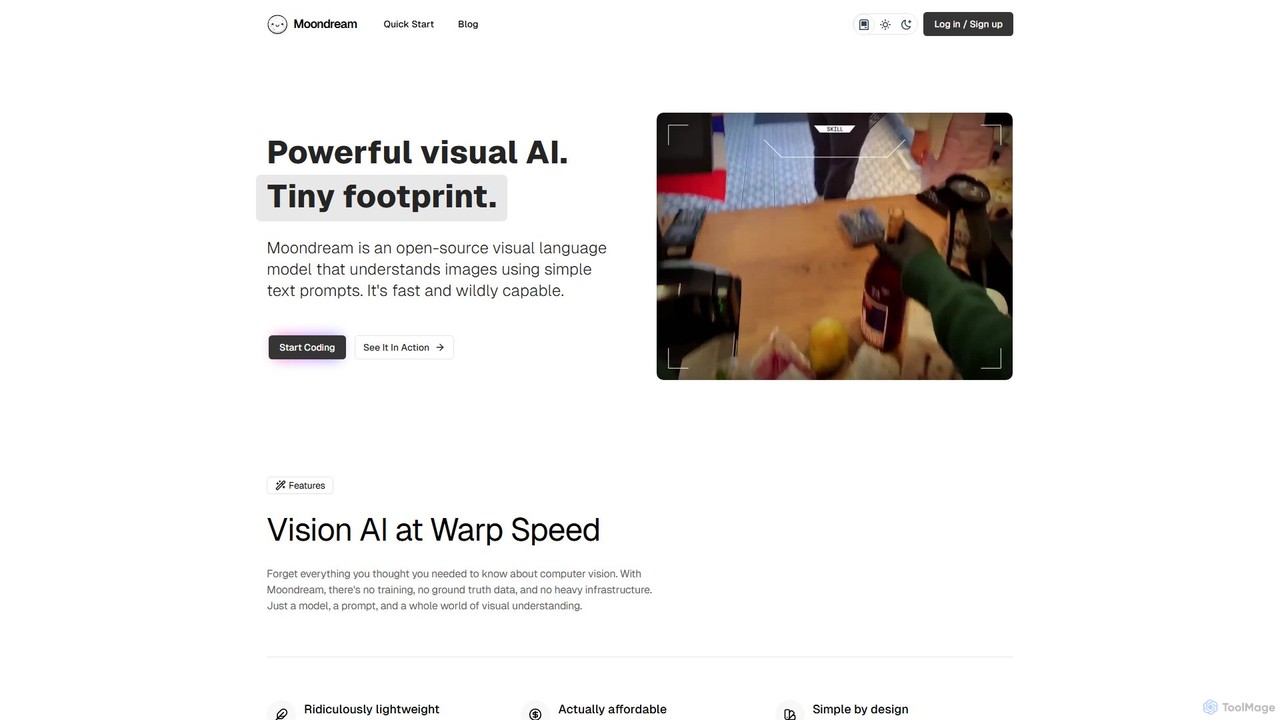
Moondream is a powerful, open-source visual language model (VLM) that is incredibly lightweight and fast. With a tiny 1GB footprint, it runs anywhere from edge devices to laptops. It allows developers to understand images through simple text prompts for tasks like captioning, object detection, OCR, and visual Q&A, without needing complex training or heavy infrastructure. It's designed for simplicity, versatility, and affordability.
Hume AI
Hume AI is a research lab and technology company that provides empathic AI tools. It features the world's …
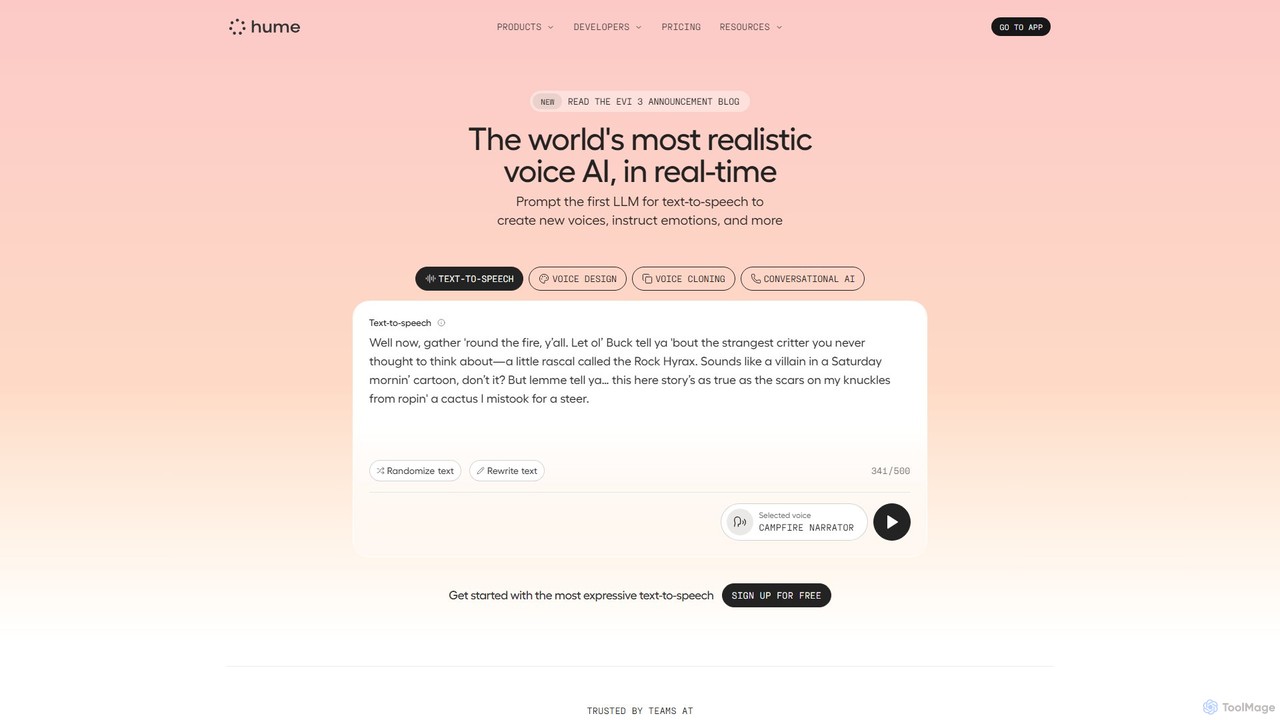
Hume AI is a research lab and technology company that provides empathic AI tools. It features the world's most realistic voice AI, including an advanced Text-to-Speech (TTS) engine, a Speech-to-Speech (EVI) model, and an Expression Measurement API. These tools allow developers and creators to build emotionally intelligent applications, generate expressive voices with nuanced control, and analyze human emotion from text, audio, and video.
About Language Models
Language Models are foundational AI systems trained on vast text datasets to understand, generate, and manipulate human language. As a core component of the broader AI Models category, these systems use complex neural networks like transformers to recognize patterns, context, and nuances in text. Their primary value lies in enabling developers and businesses to build sophisticated applications, from intelligent chatbots to automated content creation pipelines. They excel at tasks requiring deep linguistic comprehension, setting them apart from more specialized AI models.
Core Features
- Text Generation: Creating coherent and contextually relevant text, from short sentences to long articles.
- Natural Language Understanding (NLU): Interpreting user intent, extracting entities, and analyzing sentiment from unstructured text.
- Summarization and Translation: Condensing large documents into concise summaries and translating text between multiple languages.
- Code Generation: Writing functional code snippets in various programming languages based on natural language descriptions.
- Contextual Awareness: Maintaining context over long conversations or documents to provide relevant responses.
Use Cases
Language Models are primarily leveraged by developers, data scientists, and businesses to build AI-powered applications. In software development, they serve as coding assistants. Marketing teams integrate them to automate content generation, while customer support centers use them as the engine for advanced chatbots and ticket analysis systems.
How to Choose
Selecting a Language Model involves evaluating its performance on relevant benchmarks, the quality of its API and documentation, and its pricing structure (e.g., per-token costs). Also consider its fine-tuning capabilities for custom tasks, data privacy policies, and the latency of its responses, which is critical for real-time applications.

Language ModelsUse Cases
Building an Advanced Customer Support Chatbot
A developer for an e-commerce company uses a language model's API to create a support chatbot. Unlike rule-based bots, this one understands complex user queries, handles follow-up questions, and accesses order information to provide personalized responses. The model's NLU capabilities allow it to detect user frustration and escalate the conversation to a human agent when necessary, improving customer satisfaction and reducing agent workload by handling over 60% of initial inquiries automatically.
Automating Marketing Content Generation
A marketing team integrates a language model into their content workflow. They provide it with a topic, keywords, and a target audience profile to generate multiple drafts for blog posts, social media updates, and email newsletters. This accelerates the content creation process, allowing the team to test different messaging styles and produce a higher volume of SEO-optimized content, freeing up writers to focus on strategy and in-depth research.
Developing a Semantic Search Engine
A large enterprise uses a language model to build an internal knowledge base search tool. Employees can ask questions in natural language, such as "What was our revenue in Q3 last year?", instead of relying on keyword matching. The model understands the semantic meaning of the query, searches through documents, reports, and emails, and provides a direct, synthesized answer with links to source documents. This drastically reduces the time employees spend searching for information.
Extracting Insights from Financial Reports
A financial analyst uses a language model to process hundreds of pages of quarterly earnings reports and news articles. By prompting the model to summarize key financial metrics, identify management sentiment, and list potential risks mentioned, the analyst can quickly gather crucial information that would otherwise take hours of manual reading. This enables faster, more informed decision-making for investment strategies.
Assisting in Software Development and Debugging
A software developer uses a language model integrated into their code editor. The model provides intelligent code completion, suggests refactoring improvements, and generates boilerplate code from simple comments. When faced with a bug, the developer can paste the error message and relevant code, and the model explains the potential cause and offers solutions, acting as an on-demand pair programmer and accelerating the development lifecycle.
Prototyping Educational Language Tutors
An ed-tech startup leverages a language model to create an interactive language learning application. The model powers a conversational partner that students can practice with. It can correct grammar, explain nuances in vocabulary, and adapt the difficulty of the conversation based on the student's performance. This provides a scalable and personalized learning experience that was previously only possible with human tutors.