Upstage
Upstage provides high-performance, enterprise-grade AI models for businesses. Its suite includes the powerful Solar LLM for language tasks, …
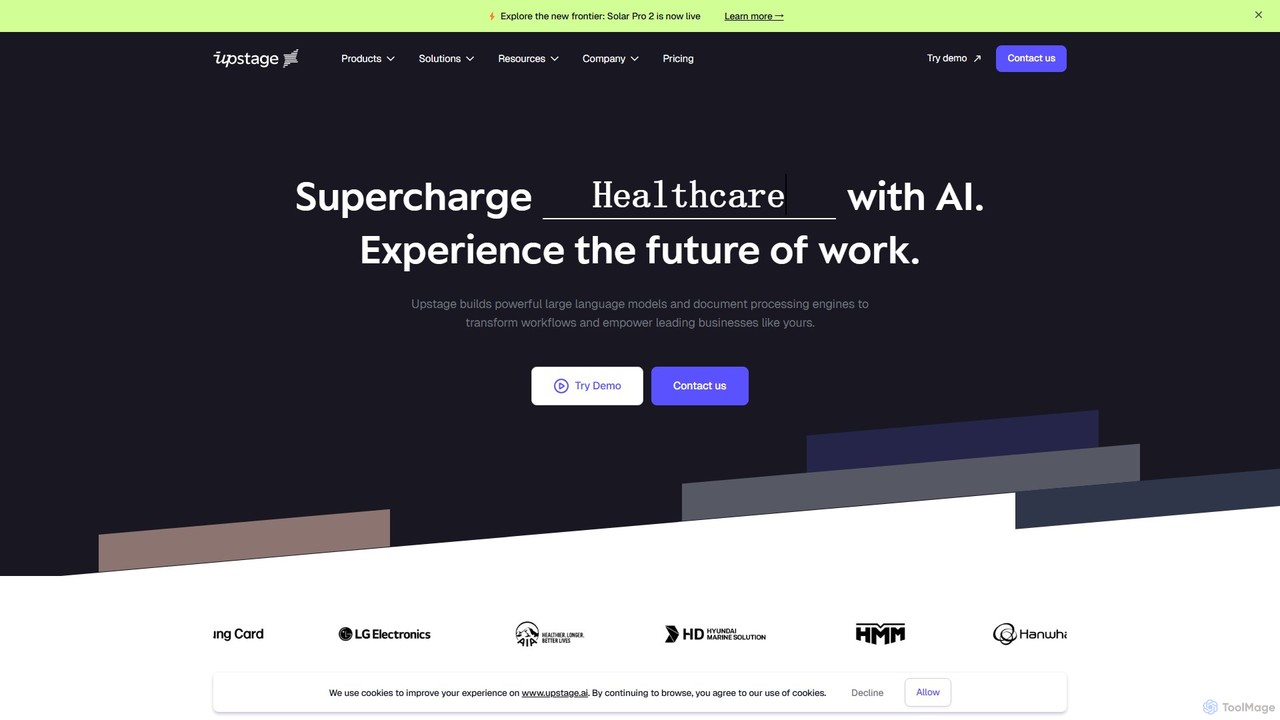
Upstage provides high-performance, enterprise-grade AI models for businesses. Its suite includes the powerful Solar LLM for language tasks, advanced Document AI for parsing and extracting data with high accuracy, and flexible deployment options (API, on-premise, cloud) to automate complex workflows.
About Llms
Large Language Models (LLMs) are a sophisticated type of AI model trained on vast datasets of text and code to understand and generate human-like language. These models utilize deep learning architectures, such as the Transformer, to process context, recognize patterns, and perform a wide range of natural language processing (NLP) tasks. Their primary value lies in powering applications that require advanced text comprehension, creation, and interaction, from conversational AI to complex data analysis. LLMs are distinguished by their versatility and ability to perform tasks with minimal specific training, a capability known as in-context learning.
Core Features
- Natural Language Understanding (NLU): Accurately interpreting user intent, sentiment, and context from text inputs.
- Text Generation: Creating coherent, contextually relevant, and stylistically appropriate text for various purposes like articles, emails, and code.
- In-Context Learning: Adapting to new tasks based on a few examples provided in the prompt, without needing retraining.
- Reasoning and Summarization: Analyzing complex information, performing logical deductions, and condensing long documents into concise summaries.
- Multilingual Capabilities: Processing, translating, and generating text across a wide array of different languages.
Use Cases
LLMs are primarily used by developers, data scientists, and businesses to build custom AI-powered applications. Common scenarios include developing advanced chatbots for customer service, creating automated content generation pipelines for marketing, analyzing unstructured text data for market research, and building co-pilots for software development and creative writing.
How to Choose
When selecting an LLM, consider the model's performance on relevant benchmarks for your specific task. Evaluate the API's latency, reliability, and pricing structure (e.g., per-token costs). Assess the availability of fine-tuning options to adapt the model to your proprietary data. Finally, consider the licensing terms (open-source vs. proprietary) and deployment options (cloud-based vs. on-premise) to ensure they align with your project's technical and business requirements.

LlmsUse Cases
Building an Intelligent Customer Support Chatbot
A developer at an e-commerce company is tasked with reducing the load on the human support team. By integrating a powerful LLM API, they build a chatbot that goes beyond simple keyword matching. This AI-powered assistant can understand complex customer queries, access order information, handle return requests, and provide personalized product recommendations in natural language. The result is a 24/7 support system that resolves over 60% of incoming queries automatically, significantly improving customer satisfaction and freeing up human agents to focus on more complex issues.
Automating Content Creation for Marketing
A marketing team needs to scale its content production for blogs, social media, and email campaigns. They use an LLM-based platform to generate initial drafts. By providing a topic, target audience, and key points, the LLM produces a well-structured article or a series of social media posts. The team then edits and refines this AI-generated content, reducing the time spent on initial research and writing by up to 70%. This allows them to publish more frequently, experiment with different content angles, and maintain a consistent brand voice across all channels.
Advanced Data Analysis and Summarization
A financial analyst needs to process hundreds of pages of quarterly earnings reports and market news daily. Instead of manually reading everything, they use a custom script that calls an LLM API. The script feeds the documents to the LLM, instructing it to extract key financial metrics, identify management sentiment, and generate a one-page executive summary. This process transforms hours of manual work into a task that takes minutes, enabling the analyst to make faster, more informed decisions by focusing on insights rather than data collection.
Code Generation and Debugging Assistance
A software developer is working on a new feature and needs to write a complex algorithm. They describe the logic in plain English to an LLM integrated into their code editor. The model generates a functional code snippet in Python, complete with comments and error handling. Later, when encountering a bug, they paste the problematic code and the error message into the LLM, which analyzes it and suggests a potential fix. This acts as a 'pair programmer', accelerating development cycles, reducing time spent on boilerplate code, and helping to solve tricky bugs more efficiently.
Multilingual Content Translation and Localization
A global software company needs to launch its new product in five different languages simultaneously. Their localization team uses an LLM fine-tuned on their existing documentation and marketing materials. This specialized model translates user interfaces, help articles, and press releases, not just word-for-word, but also adapting cultural nuances and technical jargon appropriately for each region. This approach drastically reduces the time and cost compared to traditional translation services and ensures a consistent, high-quality user experience across all markets from day one.
Creating Interactive Educational Tutors
An ed-tech platform aims to provide personalized learning experiences. They integrate an LLM to act as an AI tutor for subjects like history and science. Students can ask open-ended questions, request explanations in simpler terms, or ask for examples related to their interests. The LLM can generate quizzes on the fly, provide step-by-step solutions to problems, and adapt its teaching style based on the student's responses. This creates a highly engaging and effective learning environment that is accessible to students anytime, anywhere, scaling personalized education in a way that was previously impossible.