
Avian
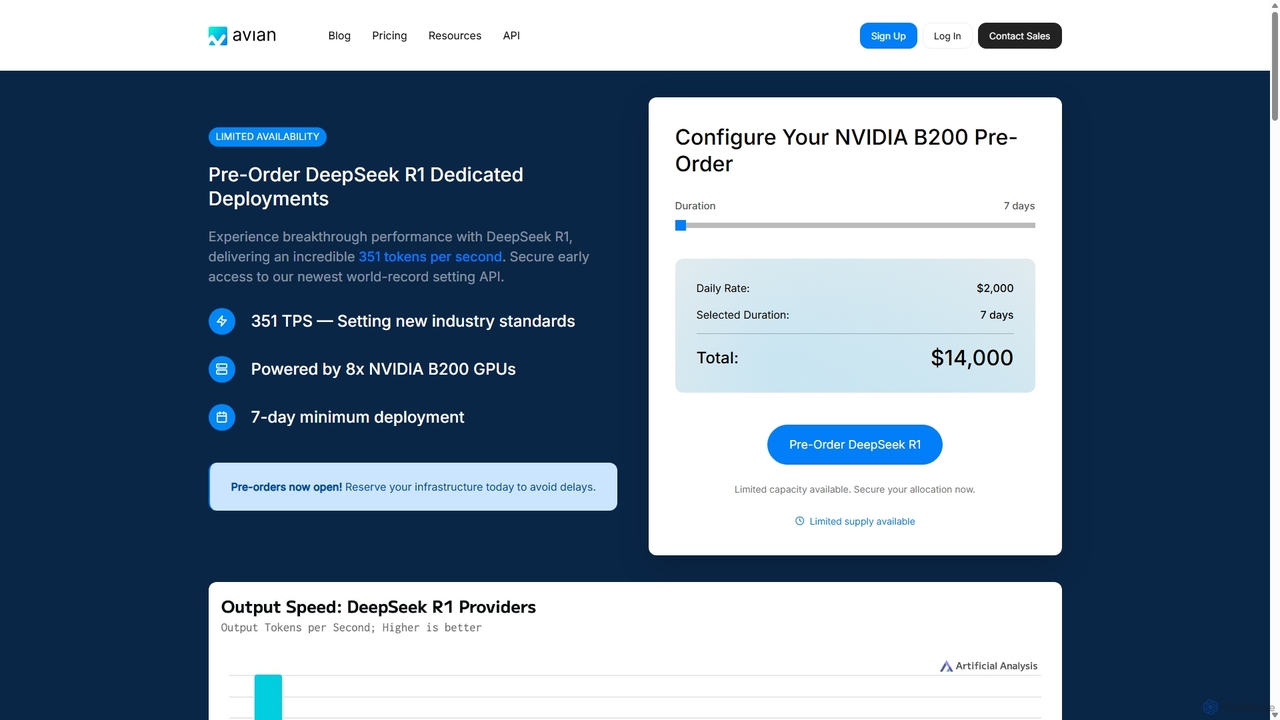
Avian is a high-performance AI inference platform offering world-record speeds for large language models (LLMs). It provides both …
Avian is a high-performance AI inference platform offering world-record speeds for large language models (LLMs). It provides both a serverless API for popular models and dedicated GPU deployments for custom models from HuggingFace. Designed for scalability and production workloads, Avian delivers 3-10x faster inference speeds than the industry average, with enterprise-grade security and competitive pricing.
About Model Deployment
Model Deployment refers to the critical process of integrating a trained machine learning model into a production environment, making it accessible for real-world applications. These tools streamline the transition from development to operation, ensuring models can serve predictions efficiently and reliably at scale. They bridge the gap between data science and engineering, enabling businesses to leverage AI insights directly. This involves packaging, serving, monitoring, and managing the lifecycle of AI models.
Core Features
- Model Packaging & Versioning: Encapsulating models with dependencies and managing different iterations for reproducibility and rollback.
- API Endpoint Creation: Generating secure and scalable endpoints for applications to interact with deployed models for inference.
- Scalability & Load Balancing: Automatically adjusting resources to handle varying inference request volumes and distributing traffic efficiently.
- Performance Monitoring: Tracking model latency, throughput, error rates, and resource utilization in real-time.
- Model Retraining & Updates: Facilitating seamless updates to deployed models with new versions or retraining, minimizing downtime.
Use Cases
Organizations utilize Model Deployment tools to operationalize their AI initiatives, moving beyond experimental phases. For instance, e-commerce platforms deploy recommendation engines to provide personalized product suggestions to millions of users. Healthcare providers deploy diagnostic AI models to assist clinicians with real-time analysis of medical images. Manufacturing companies use these tools to deploy predictive maintenance models that monitor equipment health and prevent failures.
How to Choose
When selecting a Model Deployment solution, consider its compatibility with your existing ML frameworks and infrastructure. Evaluate its scalability features to ensure it can handle anticipated inference loads and future growth. Look for robust monitoring and logging capabilities to track model performance and identify issues promptly. Assess the ease of integration with your CI/CD pipelines and the level of automation it offers for model updates and rollbacks.
Model DeploymentUse Cases
Deploying Real-time Recommendation Engines
E-commerce companies use Model Deployment tools to put personalized recommendation models into production. Data scientists train models that predict user preferences, and these tools then deploy them as low-latency APIs. This allows the website or app to instantly suggest relevant products to users, enhancing engagement and driving sales based on real-time browsing behavior.
Operationalizing Predictive Maintenance Models
Industrial manufacturers leverage Model Deployment platforms to integrate AI models that predict equipment failures. Sensors collect data from machinery, which is fed into deployed models. The tools ensure these models are always running, providing continuous analysis and alerting maintenance teams to potential issues before they occur, thereby minimizing downtime and optimizing operational costs.
Serving AI-powered Customer Service Chatbots
Customer service departments deploy natural language processing (NLP) models for intelligent chatbots using these tools. Once trained to understand customer queries and provide relevant responses, the deployment platform makes the model available as a service. This enables chatbots to handle a high volume of customer interactions efficiently, freeing up human agents for more complex issues.
Implementing Fraud Detection Systems
Financial institutions utilize Model Deployment solutions to integrate fraud detection AI models into their transaction processing systems. These models analyze incoming transactions in real-time to identify suspicious patterns. The deployment infrastructure ensures high availability and low latency, allowing for immediate flagging of potentially fraudulent activities and preventing financial losses.
Scaling Computer Vision Applications
Companies developing computer vision applications, such as quality control in manufacturing or autonomous driving, use Model Deployment tools to serve their image recognition and object detection models. These tools manage the computational resources required for processing high volumes of visual data, ensuring models can perform complex analyses quickly and reliably in production environments.
Automating Content Moderation
Social media platforms and content providers deploy AI models for automated content moderation. These models, trained to identify inappropriate or harmful content, are integrated into the platform's content pipeline via deployment tools. This enables rapid scanning and flagging of vast amounts of user-generated content, ensuring compliance with community guidelines and maintaining a safe online environment.