
AgentQL
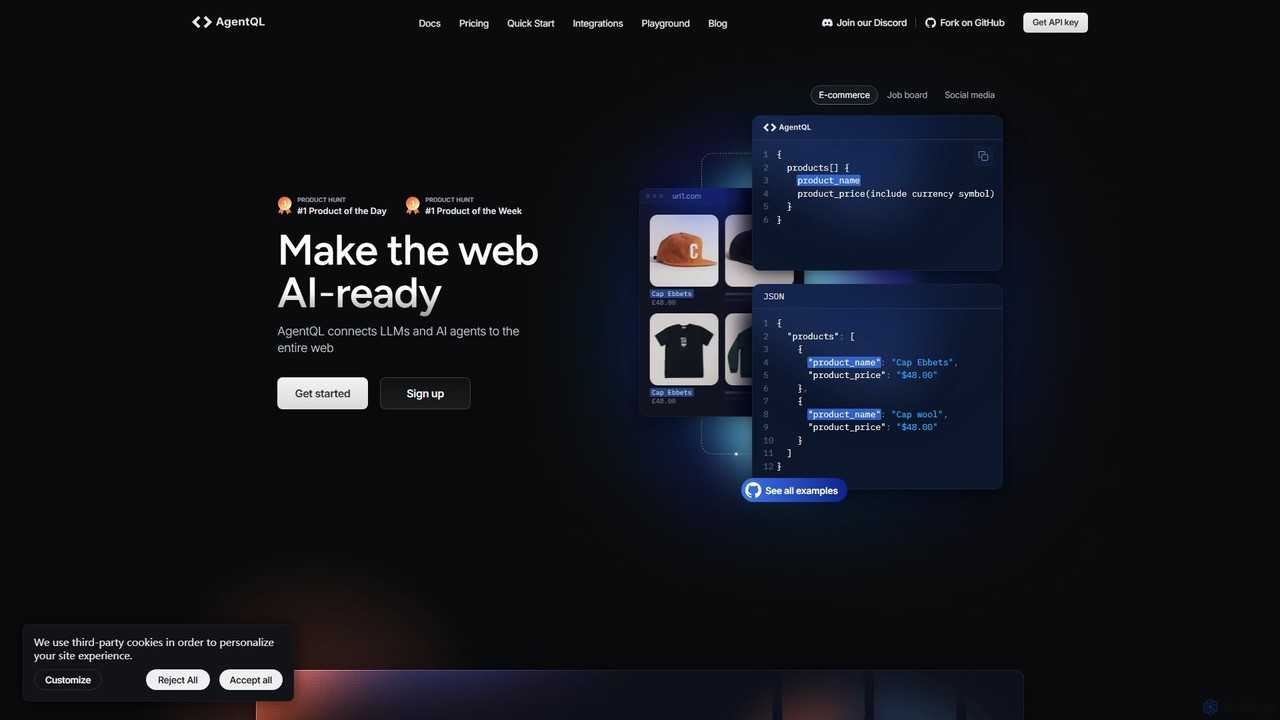
AgentQL is a developer toolset that connects LLMs and AI agents to the web. It uses an AI-powered …
AgentQL is a developer toolset that connects LLMs and AI agents to the web. It uses an AI-powered query language to robustly extract structured data and automate web interactions, serving as a powerful, self-healing alternative to fragile XPath and CSS selectors.
About Llm
LLMs (Large Language Models) are advanced AI models trained on vast datasets to understand, generate, and interact with human language. Utilizing deep learning and transformer architectures, these models excel at processing complex linguistic patterns. They offer unparalleled capabilities for automating content creation, enhancing conversational AI, and assisting in various language-centric tasks across industries.
Core Features
- Natural Language Understanding (NLU): Comprehends context, sentiment, and intent from human input.
- Natural Language Generation (NLG): Produces coherent, contextually relevant, and creative text outputs.
- Contextual Reasoning: Maintains conversational flow and applies learned knowledge across diverse topics.
- Multitask Learning: Adapts to various language tasks with minimal specific training, including translation and summarization.
- Code Generation: Assists developers by generating, completing, and debugging programming code.
Applicable Scenarios
LLMs are indispensable for content creators automating article generation, marketing teams crafting personalized ad copy, and customer service departments deploying intelligent chatbots. Developers leverage them for code assistance and documentation, while researchers use them for data summarization and knowledge extraction, significantly boosting productivity and innovation.
How to Choose
When selecting an LLM, consider its model size and performance benchmarks for your specific needs. Evaluate its fine-tuning capabilities for domain adaptation and the ease of API integration into existing systems. Assess the cost-effectiveness, scalability, and crucial data privacy and security measures to ensure it aligns with your project requirements and budget.
LlmUse Cases
Automating Content Creation for Marketing
Marketing specialists can leverage LLMs to rapidly generate diverse content, such as blog posts, social media captions, and email newsletters. By providing a few keywords or a brief outline, the LLM can produce multiple drafts, saving hours of manual writing and ensuring a consistent brand voice across various platforms. This allows teams to scale their content output and engage audiences more effectively.
Enhancing Customer Service with Intelligent Chatbots
Businesses can deploy LLM-powered chatbots to handle a wide range of customer inquiries, from answering FAQs to providing personalized support. These chatbots understand natural language, offer accurate and context-aware responses, and can even summarize complex customer interactions for human agents, significantly improving response times and customer satisfaction without increasing staff overhead.
Accelerating Software Development and Documentation
Developers utilize LLMs for code completion, generating boilerplate code, and debugging. An LLM can suggest code snippets, identify potential errors, and even write comprehensive documentation for existing codebases. This accelerates the development cycle, reduces repetitive coding tasks, and ensures better code quality and maintainability, allowing engineers to focus on complex problem-solving.
Personalizing Educational Content and Tutoring
Educators and e-learning platforms can use LLMs to create personalized learning paths, generate quizzes, and provide interactive tutoring. An LLM can explain complex topics in simplified terms, answer student questions in real-time, and adapt content to individual learning styles, making education more accessible and engaging. This supports a tailored learning experience for diverse student needs.
Streamlining Research and Information Synthesis
Researchers can employ LLMs to quickly summarize lengthy academic papers, extract key information from large datasets, and identify trends across multiple documents. This capability significantly reduces the time spent on literature reviews and data analysis, allowing researchers to focus on critical thinking and hypothesis generation. It transforms raw data into actionable insights efficiently.
Facilitating Multilingual Communication and Localization
Global businesses and content creators can use LLMs for high-quality translation and localization of content across multiple languages. LLMs can translate websites, marketing materials, and customer support documents while maintaining cultural nuances and context. This enables seamless communication with international audiences, expanding market reach and fostering global engagement.