JIT
JIT is a collaborative AI playground for developers and prompt engineers. It accelerates coding with smart code generation, …
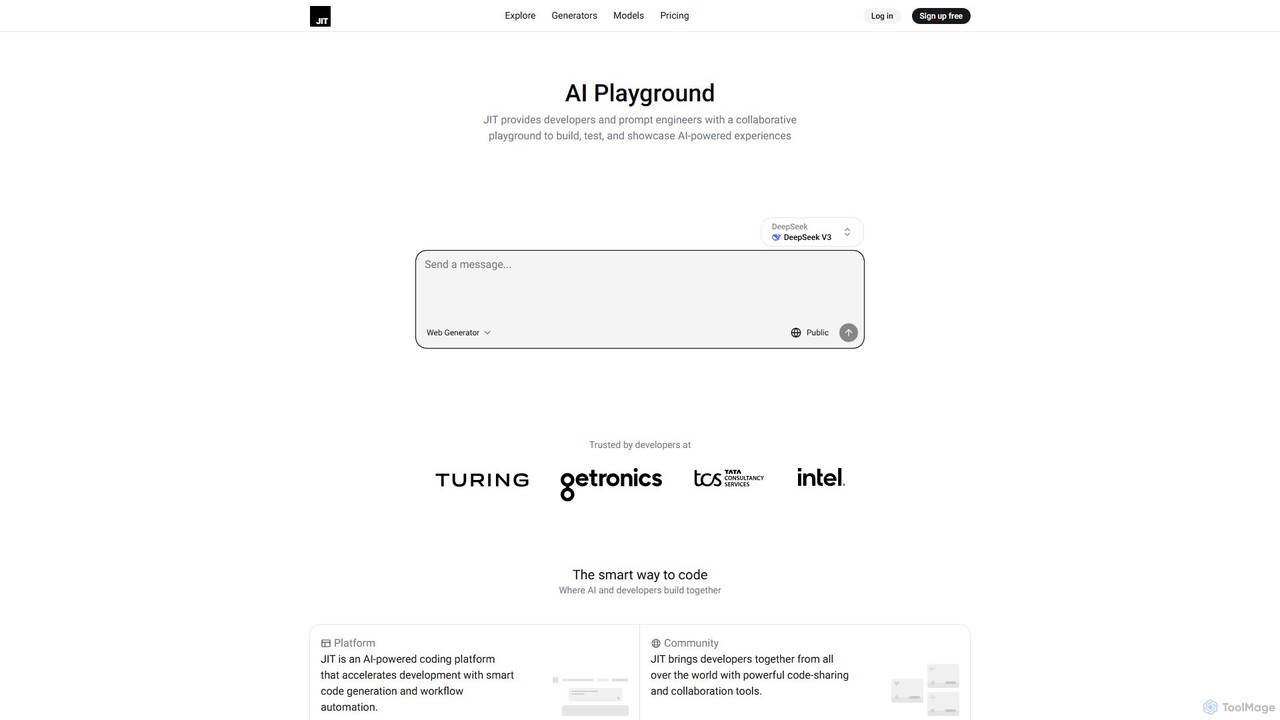
JIT is a collaborative AI playground for developers and prompt engineers. It accelerates coding with smart code generation, workflow automation, and multi-model chat. Build, test, and share AI-powered experiences using a vast library of code generators and community-driven tools.
About Code Generation
AI Code Generation tools are specialized applications that use large language models to automatically write, complete, and debug source code from natural language prompts. These tools are trained on vast repositories of public code, enabling them to understand programming logic, syntax, and common patterns across multiple languages. Their primary value lies in accelerating the development lifecycle, reducing repetitive boilerplate code, and serving as an intelligent assistant for developers. This allows engineers to focus more on complex problem-solving and software architecture rather than routine coding tasks.
Core Features
- Natural Language to Code: Translates plain English descriptions and requirements into functional code snippets, functions, or even entire classes.
- Intelligent Code Completion: Provides context-aware suggestions for completing lines or blocks of code, often anticipating the developer's intent.
- Code Refactoring & Optimization: Analyzes existing code and suggests improvements for readability, performance, or adherence to best practices.
- Automated Test Generation: Creates unit tests, integration tests, or end-to-end tests based on the source code to ensure quality and coverage.
- Debugging and Explanation: Identifies potential bugs in code, suggests fixes, and explains complex code blocks in simple terms.
Use Cases
These tools are widely used by software developers, data scientists, and students. Common applications include rapid prototyping of new features, automating the creation of data manipulation scripts, generating complex SQL queries from business questions, and helping developers learn new programming languages or frameworks by example.
How to Choose
When selecting an AI Code Generation tool, consider its support for your primary programming languages, the quality and depth of its integration with your preferred IDE (e.g., VS Code, JetBrains), the accuracy of its suggestions, and its capabilities for specialized tasks like test generation or security analysis. Also, evaluate the pricing model and any usage limits.

Code GenerationUse Cases
Rapid API Prototyping
A backend developer needs to build a proof-of-concept API for a new mobile application. Instead of manually writing all the boilerplate code for endpoints, request validation, and database models, they use an AI code generation tool. By providing simple prompts like "Create a REST API endpoint for user registration with email and password fields" and "Generate a database schema for a products table," the developer can produce functional backend code in minutes, not hours. This drastically accelerates the feedback loop with front-end and product teams.
Automating Unit Test Creation
A software engineer has just completed a complex business logic module. To ensure its reliability and prevent future regressions, they need to write a comprehensive suite of unit tests. Using an AI code generator, they can highlight a function and ask the tool to "generate unit tests for this function, covering edge cases like null inputs and empty arrays." The AI then produces a set of tests using the project's testing framework (e.g., Jest, PyTest), saving the engineer significant time and ensuring high test coverage, allowing them to move on to the next feature faster.
Generating Complex SQL Queries
A data analyst needs to extract specific insights from a large relational database but is not an expert in writing complex SQL. They need to find "the top 5 customers by total sales in the last quarter who also purchased products from the 'Electronics' category." Instead of struggling with multiple joins, subqueries, and date functions, they can type this request into an AI code generation tool. The tool translates the natural language query into an optimized, syntactically correct SQL statement, which the analyst can then execute to get the required data immediately.
Learning a New Programming Language
A Python developer is transitioning to a project that uses Go. To quickly get up to speed, they use an AI code generator as a learning companion. They can write a familiar concept in Python, such as a for-loop iterating over a dictionary, and ask the AI to "translate this Python code to idiomatic Go." The tool not only provides the correct Go syntax but can also add comments explaining the differences, such as Go's range clause and the absence of traditional while loops. This interactive, context-specific learning method is far more efficient than reading generic documentation.
Refactoring Legacy Code
A maintenance team is tasked with modernizing a large, aging codebase written in an older version of JavaScript. The code uses outdated patterns that are hard to maintain. An engineer can use an AI code generation tool to automate parts of the refactoring process. For example, they can select a large block of code and instruct the AI: "Refactor this promise chain into an async/await function for better readability." The tool performs the transformation, reducing the risk of manual errors and freeing up the engineer to focus on more complex architectural decisions for the modernization effort.
Creating Documentation and Code Comments
A developer has written a complex algorithm but needs to add clear documentation so other team members can understand and maintain it. Manually writing detailed comments and docstrings can be tedious. They can use an AI code generation tool to analyze a function and automatically generate a comprehensive docstring. This includes a summary of what the function does, a description of each parameter, and the expected return value. This ensures code is well-documented consistently across the project, improving team collaboration and long-term maintainability.