ToolMage
Sign in

Best 1 Question Answering AI tools for Ai Chatbots

Popular Question Answering AI tools in Ai Chatbots include TutorOcean, helping you work more efficiently.

TutorOcean
Freemium

TutorOcean

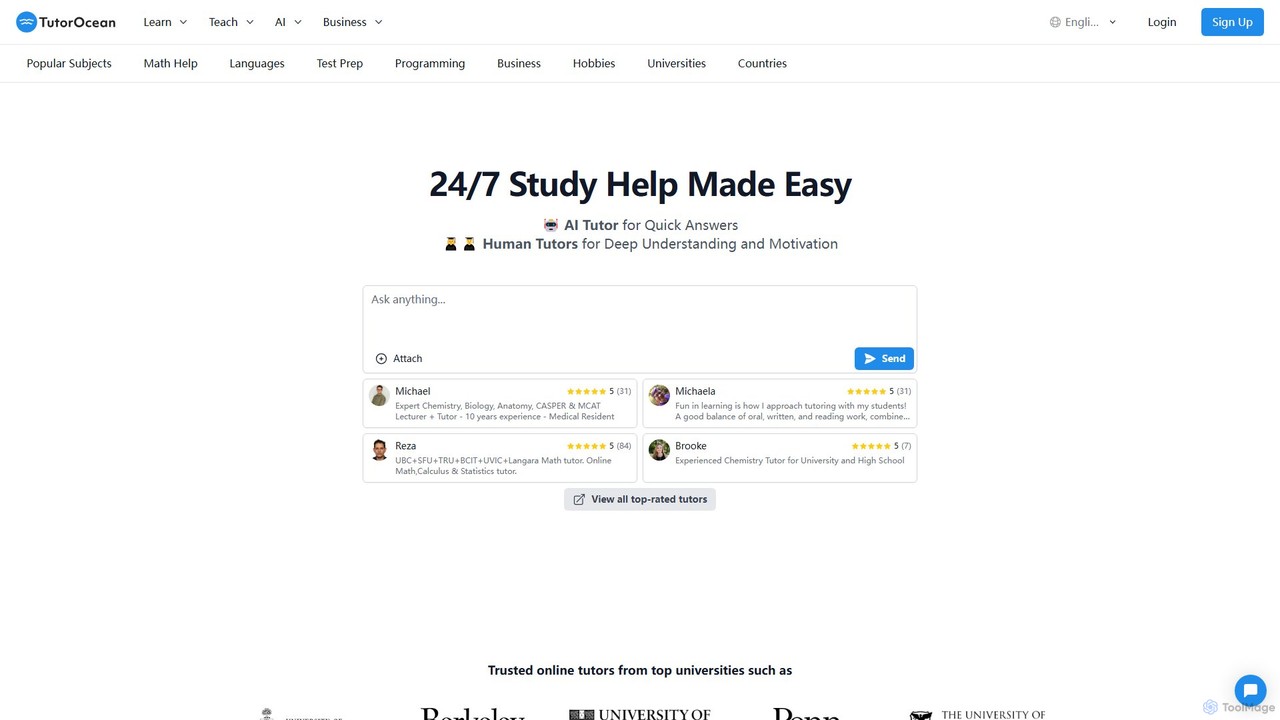
TutorOcean is a hybrid online learning platform offering 24/7 AI-powered instant answers and personalized one-on-one sessions with expert human tutors. Covering a vast range of subjects from math and science to test prep, it provides a flexible, pay-as-you-go solution for students of all levels to improve grades, build confidence, and achieve academic goals through its interactive virtual classroom.

Question Answering
Visits 153.5KFavorites 151Likes 139

About Question Answering

Question Answering tools are a specialized class of AI that automatically find precise answers from large volumes of text. Unlike general conversational chatbots, they focus on information retrieval and extraction, using natural language processing (NLP) to understand a user's query and pinpoint the exact information within a given document or knowledge base. These tools are valuable for quickly navigating complex documentation, internal wikis, or customer support articles to provide factual, context-aware responses. Their primary strength lies in delivering accurate, source-backed answers without requiring users to sift through entire documents manually.

Core Features

  • Contextual Analysis: Understands and processes provided documents, websites, or databases as a knowledge source.
  • Natural Language Querying: Allows users to ask questions in conversational language rather than using keywords.
  • Precise Answer Extraction: Identifies and extracts the specific sentence or data point that directly answers the query.
  • Source Citation: Provides a reference or link to the original source of the extracted answer for verification.
  • Knowledge Base Integration: Connects seamlessly with various internal and external knowledge sources like Confluence, SharePoint, or public websites.

Use Cases

These tools are widely used in corporate environments for internal knowledge management, allowing employees to quickly find answers in company policies or technical manuals. In customer support, they empower agents to locate solutions within extensive help documentation instantly. Legal and research professionals also use them to accelerate document review and literature analysis, drastically reducing manual search time.

How to Choose

When selecting a Question Answering tool, evaluate its ability to connect with your existing data sources (e.g., PDF, Word, websites). Consider the accuracy of its answer extraction and its support for different languages. Also, assess the ease of integration into your current workflows, the security measures for your data, and the scalability of the platform as your knowledge base grows.

Question Answering use cases

1

Streamlining Internal Knowledge Base Searches

An HR manager at a growing tech company needs to ensure all employees can easily find information about benefits, remote work policies, and IT procedures. Instead of manually answering repetitive questions, they implement an AI Question Answering tool connected to the company's internal wiki and HR documents. Now, employees can ask direct questions like 'What is the policy for international travel?' or 'How do I set up my VPN?' and receive instant, accurate answers with links to the source documents. This significantly reduces the HR team's workload and empowers employees with self-service access to information.

2

Accelerating Customer Support Responses

A customer support agent for a software company often deals with complex technical questions. To find an answer, they previously had to search through multiple product manuals and technical guides, which was time-consuming. By using an AI Question Answering tool that has indexed all support documentation, the agent can now type the customer's question directly into a search bar. The tool instantly extracts the precise solution, including step-by-step instructions or specific code snippets, from the relevant guide. This allows the agent to resolve customer issues in a fraction of the time, improving first-contact resolution rates and customer satisfaction.

3

Assisting with Academic and Scientific Research

A postgraduate researcher is conducting a literature review on a niche scientific topic, which involves analyzing hundreds of academic papers. Instead of reading each paper in full, they upload the entire collection of PDFs to an AI Question Answering platform. They can then ask specific questions like 'Which papers discuss the effects of protein X on cell Y?' or 'What was the methodology used in Smith et al., 2021?'. The AI scans all documents and provides direct answers, along with citations and page numbers from the source papers. This process transforms weeks of manual research into a few hours of targeted inquiry, dramatically accelerating the research process.

4

Efficient Legal Document Review

A paralegal is tasked with reviewing a 500-page contract to find all clauses related to liability and termination. This traditionally requires a meticulous, line-by-line reading. By using an AI Question Answering tool, the paralegal uploads the document and asks, 'Show me all clauses about termination for convenience' and 'What are the limitations of liability?'. The tool instantly highlights the relevant sections and extracts the exact legal text. This not only saves hours of tedious work but also reduces the risk of human error in overlooking a critical clause, ensuring a more thorough and accurate review.

5

Powering Intelligent Website Search

A company's website has an extensive FAQ and help section, but users still frequently contact support for answers already on the site. The web development team replaces the standard keyword-based search bar with an AI Question Answering system. Now, when a visitor asks 'How do I return an item I bought online?', instead of just showing a list of articles with the word 'return', the system provides a direct, concise answer extracted from the official return policy page. This improves the user experience, promotes self-service, and reduces the volume of inbound support tickets for easily answerable questions.

6

Verifying Information for Compliance and Audits

An internal auditor needs to verify that a company's operational procedures across multiple departments align with new regulatory standards. This involves checking dozens of lengthy policy documents. They use an AI Question Answering tool loaded with all relevant compliance and procedure manuals. The auditor can then pose direct queries like, 'What is the documented procedure for data retention in the marketing department?' or 'Confirm that the disaster recovery plan was updated after Q2 2023'. The tool retrieves the exact text from the documents, providing verifiable evidence and speeding up the audit process from weeks to days.

Question Answering FAQ

What are AI Question Answering tools?

AI Question Answering (QA) tools are specialized systems designed to find and extract precise, factual answers from a given body of text or data. Unlike search engines that return a list of documents, a QA tool provides a direct answer to a user's question in natural language. They work by using Natural Language Processing (NLP) to understand the context of the question and the source material, allowing them to pinpoint the exact information needed. These tools are commonly used to query internal knowledge bases, technical documentation, and legal contracts.

How is a Question Answering AI different from a general AI chatbot?

The primary difference lies in their core purpose. A Question Answering (QA) AI is an information retrieval system focused on accuracy and finding the best factual answer within a specific dataset (like a document). A general AI chatbot is a conversational system designed for interaction, understanding user intent, and performing tasks. While a chatbot might use a QA component to answer a question, its main role is to manage the entire dialogue.

  • Question Answering: Focuses on extracting a precise, correct answer from a known source.
  • AI Chatbot: Focuses on conversation flow, user engagement, and completing tasks or requests.
How do I choose the right Question Answering tool?

Choosing the right tool depends on your specific needs. Consider the following factors:

  • Data Sources: Can the tool connect to and process your specific data formats (e.g., PDFs, websites, Confluence, databases)?
  • Accuracy and Relevance: Evaluate the tool's ability to provide precise answers and handle complex questions. Many offer free trials for testing.
  • Integration: How easily can it be integrated into your existing workflows, such as your website's search bar, Slack, or internal applications?
  • Security and Privacy: Ensure the tool meets your organization's security standards, especially if you'll be using it with sensitive or proprietary data.
  • Scalability: Consider whether the tool can handle your data volume as it grows over time.
What are the key features of a Question Answering system?

Effective Question Answering systems typically include several core features:

  • Natural Language Understanding (NLU): The ability to comprehend user questions asked in everyday language, including nuances and intent.
  • Contextual Awareness: The capacity to understand the context from which a question is asked and use surrounding information to provide a relevant answer.
  • Answer Extraction: The core function of identifying and pulling the most accurate and concise answer from a large text source.
  • Source Citing: The ability to link back to the source document or specific passage where the answer was found, which builds trust and allows for verification.
  • Multi-format Support: The capability to ingest and query information from various file types, such as PDFs, DOCX, HTML, and plain text.
Who can benefit from using Question Answering tools?

A wide range of professionals and organizations can benefit from Question Answering tools. Key users include:

  • Enterprises: For internal knowledge management, allowing employees to quickly find information in policies, technical docs, and HR manuals.
  • Customer Support Teams: To help agents find accurate solutions in extensive help centers and knowledge bases, reducing response times.
  • Researchers and Academics: To accelerate literature reviews by asking direct questions to a large corpus of scientific papers.
  • Legal Professionals: For quickly locating specific clauses, precedents, and information within massive legal documents and contracts.
  • Website Owners: To enhance their site's search functionality, providing visitors with direct answers instead of just a list of links.