Ai Chatbots Best in category 1 results Specialized Assistant AI Tool

Popular AI tools in the Specialized Assistant field of Ai Chatbots include Lune, etc., helping you quickly improve efficiency.

Lune

Lune

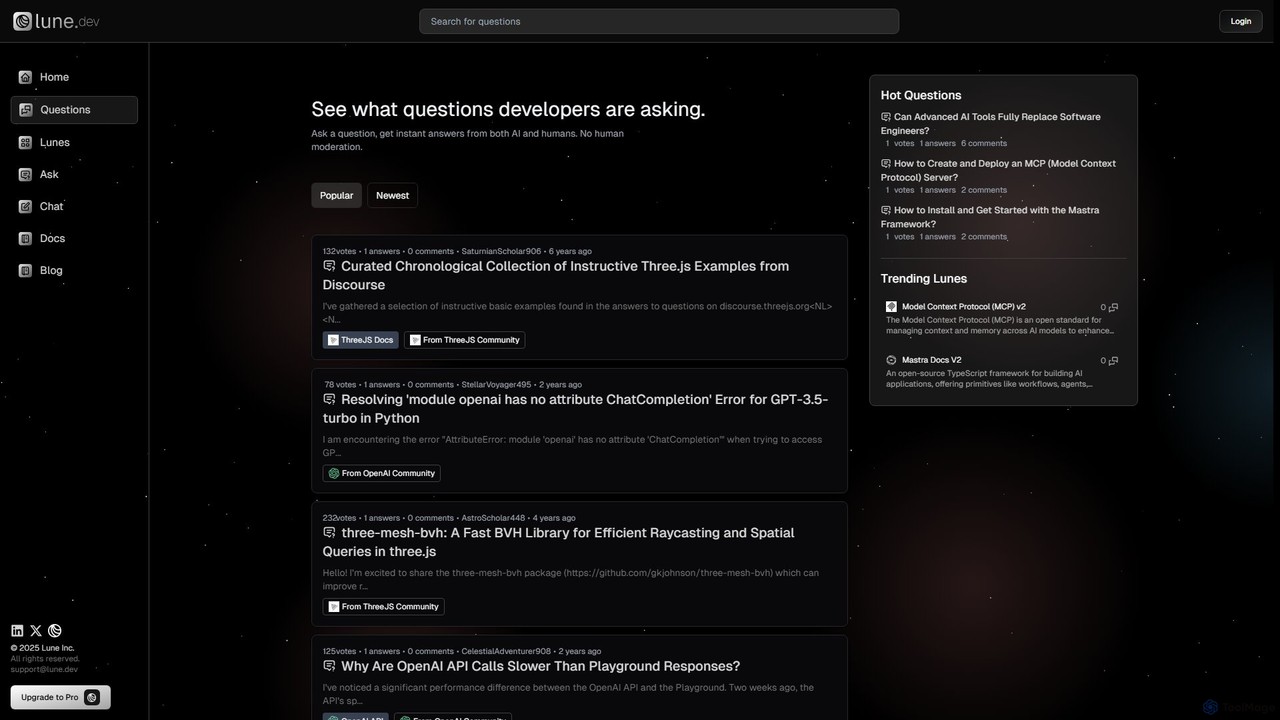
Lune is an AI-powered Q&A platform for developers, providing instant, accurate answers to technical questions. It leverages custom …

3.1K

About Specialized Assistant

Specialized Assistants are a class of AI chatbots designed to provide expert-level support within specific professional domains or for complex tasks. Unlike general-purpose chatbots, they are trained on curated, domain-specific datasets, enabling them to understand industry jargon, follow intricate workflows, and deliver highly accurate, context-aware responses. This focused approach allows them to function as intelligent co-pilots for professionals, significantly enhancing productivity and decision-making in fields like law, medicine, finance, and software development.

Core Features

  • Domain-Specific Knowledge: Trained on extensive, verified data from a particular field, such as legal case law, medical journals, or financial reports.
  • Task-Oriented Workflows: Guides users through structured processes like contract analysis, code debugging, or scientific literature reviews.
  • Contextual Integration: Connects with professional software (e.g., IDEs, CRMs, EHRs) to access relevant data and provide assistance within the user's existing workflow.
  • High Accuracy and Verifiability: Optimized for precision and often includes features for citing sources or explaining its reasoning to ensure reliability.

Use Cases

These assistants are widely used by professionals who require deep, reliable information. For example, lawyers use them for legal research and document drafting, developers for code generation and optimization, and financial analysts for market data analysis and report summarization. They are also valuable for academics conducting literature reviews and medical practitioners seeking clinical decision support.

How to Choose

When selecting a Specialized Assistant, first verify its expertise aligns with your specific professional domain. Assess its data security and compliance certifications (e.g., HIPAA, GDPR), which are critical for sensitive information. Evaluate its integration capabilities with your current tools and software. Finally, consider the tool's mechanisms for accuracy verification and source citation to ensure its outputs are trustworthy for professional use.

Specialized AssistantUse Cases

1

Accelerating Legal Contract Review

A corporate lawyer needs to review a 50-page supplier agreement for potential risks and non-standard clauses. Instead of spending hours reading manually, they upload the document to a legal specialized assistant. The AI instantly analyzes the text against a vast database of legal precedents and compliance standards. It highlights ambiguous language, identifies missing clauses common for such agreements, and flags high-risk terms related to liability and termination. The lawyer receives a summarized report in minutes, allowing them to focus their expertise on negotiating the critical points identified by the AI, reducing review time by over 70%.

2

Real-time Code Generation and Debugging

A software developer is working on a complex data processing module in Python. Using a coding assistant integrated into their IDE, they describe the required function in plain English, such as "create a function to parse a CSV file and calculate the average of the 'sales' column." The assistant generates the complete, optimized Python code snippet instantly. Later, when a bug appears, the developer highlights the problematic code block and asks the assistant to "find the error in this code." The AI analyzes the logic, identifies a potential off-by-one error in a loop, and suggests a corrected version, saving significant debugging time.

3

Clinical Decision Support for Medical Professionals

A primary care physician is presented with a patient exhibiting a complex set of symptoms that don't point to a clear diagnosis. The physician inputs the patient's symptoms, medical history, and recent lab results into a medical specialized assistant. The AI cross-references this information with millions of clinical studies, medical journals, and treatment guidelines. It then generates a list of potential differential diagnoses, ranked by probability, along with supporting evidence and suggestions for further diagnostic tests. This tool does not replace the doctor's judgment but acts as a powerful consultation resource, helping to ensure all possibilities are considered.

4

Streamlining Financial Market Analysis

A financial analyst is tasked with evaluating a company's performance ahead of an earnings call. They use a financial assistant to process years of quarterly reports, press releases, and market data in seconds. The analyst asks specific questions like, "Summarize the key drivers of revenue growth over the last three years" or "Compare the company's P/E ratio to its top three competitors." The AI provides concise summaries, generates comparison charts, and identifies sentiment trends from news articles. This allows the analyst to bypass hours of manual data collection and focus on higher-level strategic analysis and formulating insightful questions for the call.

5

Automating Academic Literature Reviews

A PhD student is beginning research for their dissertation and needs to conduct a comprehensive literature review, a process that can take months. They use a specialized research assistant, providing it with their core research questions and keywords. The AI scans millions of academic papers from databases like JSTOR and PubMed, identifying the most relevant studies. It then generates an annotated bibliography, summarizing the key findings, methodology, and conclusions of each paper. The student can even ask follow-up questions like, "Which of these papers use a qualitative methodology?" This transforms the initial research phase from a manual search to a guided exploration, saving immense time.

6

Intelligent Sales & CRM Data Management

A sales manager wants to improve team efficiency and follow-up consistency. They integrate a specialized assistant with their CRM system. After a sales call, the representative can simply dictate a summary, and the AI transcribes it, identifies key action items, and automatically updates the contact's record in the CRM. The assistant can also analyze the entire sales pipeline and suggest which leads to prioritize based on engagement history and firmographics. It can even draft personalized follow-up emails based on the call summary and previous interactions, ensuring timely and relevant communication with prospects.

Specialized AssistantFrequently Asked Questions