
ToolMage
Sign in

Best 1 Tutoring AI tools for Ai Chatbots

Popular Tutoring AI tools in Ai Chatbots include LearnQ.ai, helping you work more efficiently.

LearnQ.ai
Freemium

LearnQ.ai

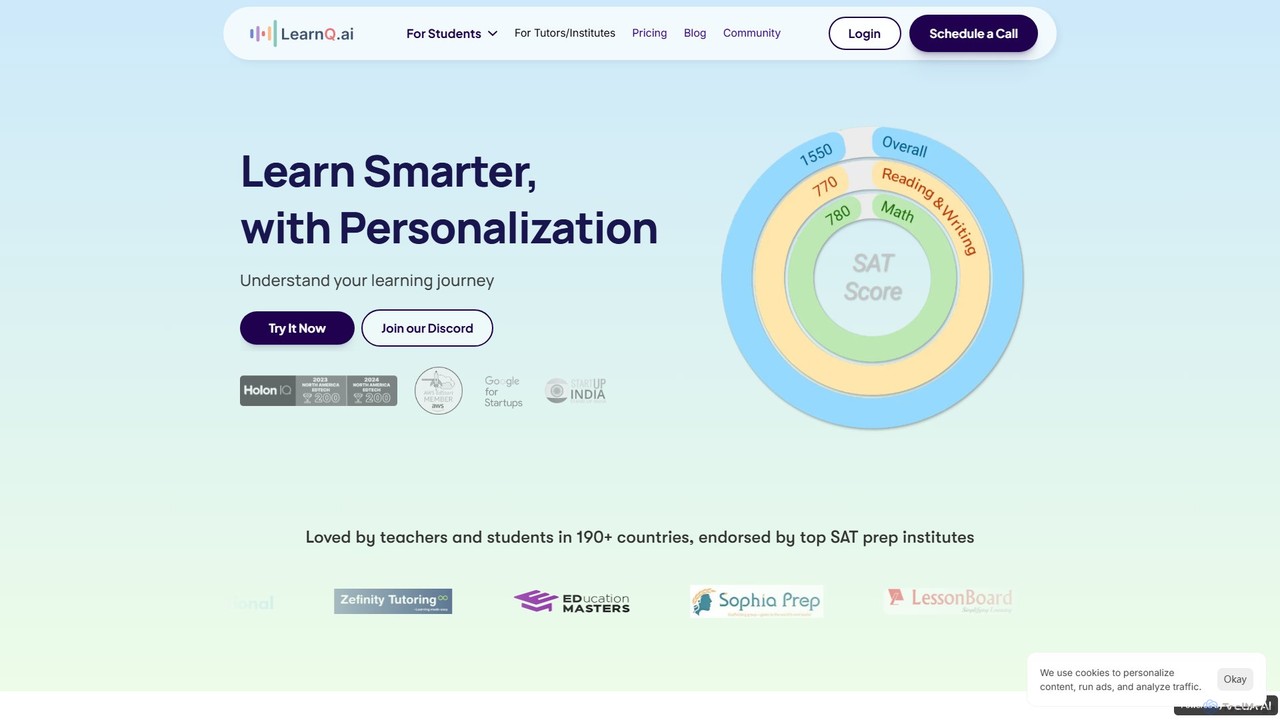
LearnQ.ai is an AI-powered smart learning platform designed to revolutionize test preparation, starting with the Digital SAT. It offers personalized study plans, gamified practice tests, and a 24/7 AI tutor named Mia. By leveraging data-driven analytics, LearnQ.ai helps students identify weaknesses, master concepts efficiently, and achieve higher scores. It also provides powerful tools for tutors and educational institutes to enhance their teaching and track student performance in real-time.

Tutoring
Visits 33.8KFavorites 119Likes 100

About Tutoring

AI Tutoring tools are a specialized category of AI chatbots designed to provide personalized, one-on-one educational support. These tools leverage natural language processing (NLP) and machine learning to simulate the experience of a human tutor, adapting to each user's unique learning pace and style. They offer instant homework help, step-by-step problem-solving, and interactive lessons across various subjects. The primary value of AI tutors lies in their ability to make learning accessible 24/7, identify knowledge gaps, and provide targeted feedback to reinforce concepts.

Core Features

  • Personalized Learning Paths: Adapts curriculum and difficulty based on the user's performance and progress.
  • Interactive Problem-Solving: Guides users through complex problems with hints and step-by-step explanations rather than just giving the answer.
  • Instant Feedback and Assessment: Provides immediate corrections on quizzes and assignments to help users learn from mistakes in real-time.
  • Socratic Questioning: Asks probing questions to stimulate critical thinking and deeper understanding of a topic.
  • Multi-format Content Delivery: Supports various learning styles through text, interactive exercises, and sometimes visual aids.

Use Cases

AI Tutoring tools are widely used by K-12 and university students for homework assistance and exam preparation in subjects like math, science, and language arts. They are also valuable for professionals and lifelong learners seeking to acquire new skills, such as coding or a new language, at their own pace. Educational institutions may integrate them as a supplementary resource to support classroom instruction.

How to Choose

When selecting an AI Tutoring tool, consider the subject matter coverage and its depth. Evaluate the pedagogical approach—does it encourage critical thinking or rote memorization? Assess the quality and immediacy of its feedback. Finally, check for progress tracking features and its ability to integrate with existing learning platforms or curricula.

Tutoring use cases

1

Homework Assistance for Math Problems

A high school student struggling with a complex algebra problem can use an AI Tutor for help. Instead of providing the final answer, the tool guides the student through each step. It might ask questions like, 'What do you think the first step should be?' or 'Can you explain why you applied that formula?' This interactive process helps the student understand the underlying logic, reinforcing their learning and building problem-solving skills for future assignments, all without the pressure of asking a teacher in front of the class.

2

Personalized Language Learning Practice

A user learning Spanish can engage in conversational practice with an AI Tutor. The tool can simulate real-life scenarios, such as ordering food at a restaurant or asking for directions. It provides instant feedback on pronunciation, grammar, and vocabulary choices. The AI can adjust the conversation's complexity based on the user's proficiency, ensuring the practice is challenging but not overwhelming. This allows for consistent, daily practice to build fluency and confidence at a fraction of the cost of a human tutor.

3

Standardized Test Preparation (SAT/GRE)

A student preparing for the SAT or GRE can use an AI Tutor to focus on specific areas of weakness. After taking a diagnostic test, the AI identifies topics that need improvement, such as 'quadratic equations' or 'vocabulary in context'. It then generates a personalized study plan with practice questions, video explanations, and timed drills. The tool tracks progress over time, showing score improvements and dynamically adjusting the study plan to ensure the student is efficiently preparing for exam day.

4

Corporate Training and Employee Upskilling

A company can deploy an AI Tutor to train new hires on company policies or specific software. The AI provides a consistent, self-paced learning experience for all employees. It can answer frequently asked questions, administer quizzes to check for understanding, and certify completion. For existing employees, it can be used for upskilling, offering modules on new industry regulations or advanced features of a tool they use daily. This automates a significant portion of the training process, freeing up human trainers to focus on more complex, hands-on coaching.

5

Reinforcing K-12 Classroom Concepts

A middle school teacher can assign an AI Tutor module as a follow-up to a classroom lesson on photosynthesis. The AI provides an interactive experience where students can label parts of a plant cell, answer questions about the chemical process, and correct misconceptions in real-time. This allows students to reinforce what they learned in class at their own pace. The teacher can then view a dashboard of student progress to identify common areas of difficulty and address them in the next class, making instruction more targeted and effective.

6

Learning to Code with Real-time Assistance

A beginner learning Python encounters a syntax error they can't solve. They can paste their code into a specialized AI coding tutor. The tool doesn't just fix the code; it explains what the error means, why it occurred, and provides examples of the correct syntax. It can also suggest more efficient ways to write the code or explain complex concepts like recursion through interactive examples. This provides an on-demand, patient learning companion that helps aspiring developers overcome common hurdles and build a solid foundational understanding.

Tutoring FAQ

What is an AI Tutoring tool?

An AI Tutoring tool is a specialized type of AI chatbot designed to provide personalized educational assistance. Unlike general chatbots that answer factual questions, AI tutors use pedagogical strategies to guide users through learning processes. They adapt to an individual's learning pace, offer step-by-step problem-solving, provide instant feedback, and use interactive methods to deepen understanding in subjects ranging from mathematics to language learning.

How to choose the right AI Tutor?

Choosing the right AI Tutor depends on your specific learning goals. Consider the following factors:

  • Subject Expertise: Ensure the tool has strong, accurate content for the subject you need to learn.
  • Pedagogical Approach: Look for a tutor that promotes understanding and critical thinking, not just memorization. Does it use Socratic questioning or interactive simulations?
  • Adaptability: A good AI tutor should adjust its difficulty and content based on your performance.
  • Feedback Quality: The feedback should be instant, clear, and constructive, explaining why an answer is incorrect.
What's the difference between an AI Tutor and a general AI Chatbot?

The primary difference lies in their purpose and design. A general AI chatbot (like a customer service bot) is designed for information retrieval—it finds and delivers answers. An AI Tutor, on the other hand, is designed for knowledge construction. It uses learning science principles to guide a user, ask probing questions, and create an interactive environment where the user builds their own understanding. Its goal is not just to provide an answer, but to teach the user how to find the answer themselves.

Are AI Tutors effective for learning?

Yes, AI Tutors can be highly effective as a supplement to traditional learning. Their effectiveness comes from providing immediate, personalized feedback, which is crucial for skill development. They allow for self-paced learning and endless practice without judgment, which can build a student's confidence. While they may not replace the nuanced understanding and motivation provided by a human teacher, they are a powerful tool for reinforcing concepts, practicing skills, and filling knowledge gaps 24/7.

Who can benefit from using an AI Tutor?

A wide range of individuals can benefit from AI Tutors. This includes:

  • K-12 Students: For homework help, concept clarification, and test preparation.
  • University Students: For tackling complex subjects and reviewing foundational knowledge.
  • Lifelong Learners: For acquiring new skills like coding, data science, or a new language at their own pace.
  • Professionals: For corporate training, upskilling, and staying current with industry standards.
  • Educators: For supplementing classroom instruction and providing students with personalized practice resources.