Falou
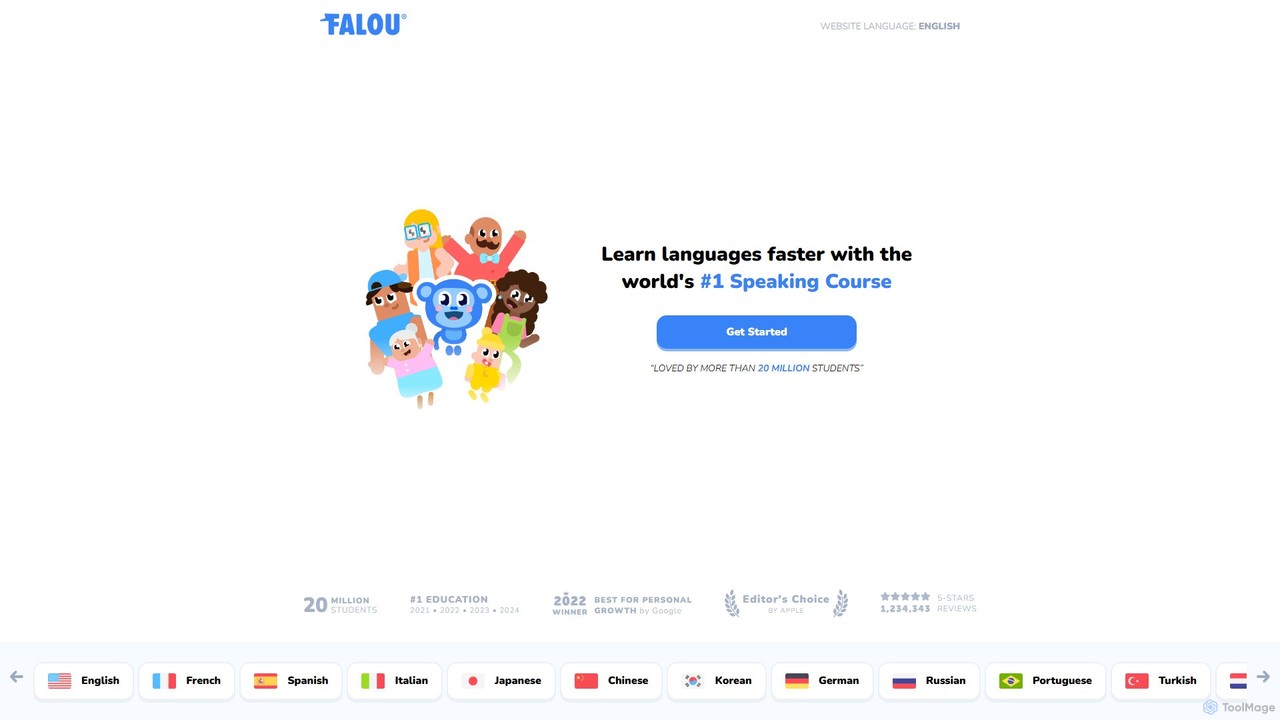
Falou is an AI-powered language learning app designed to improve your conversational skills. Practice speaking in real-world scenarios, …
Falou is an AI-powered language learning app designed to improve your conversational skills. Practice speaking in real-world scenarios, receive instant pronunciation feedback, and build confidence to speak new languages fluently. It's like having a personal language tutor available 24/7.
Avatalks
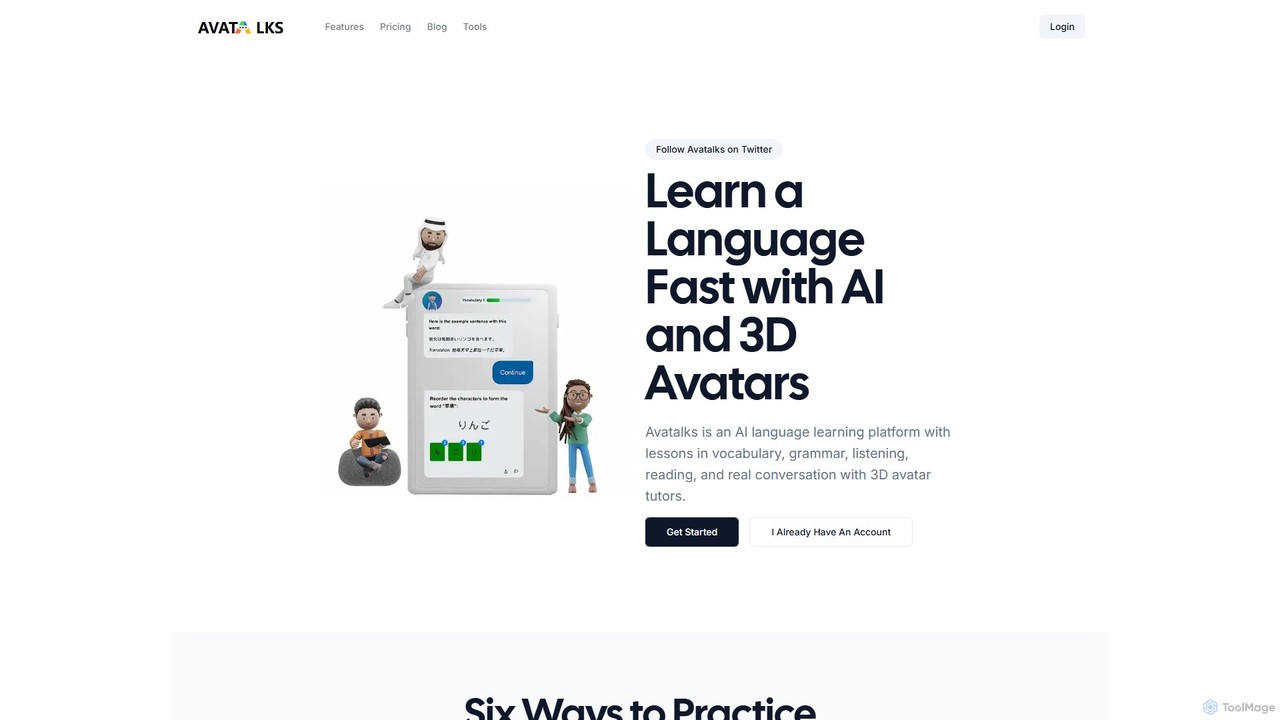
Avatalks is an AI-powered language learning platform that uses interactive 3D avatars as tutors. It offers a comprehensive …
Avatalks is an AI-powered language learning platform that uses interactive 3D avatars as tutors. It offers a comprehensive curriculum covering vocabulary, grammar, listening, reading, and writing, alongside real-time conversational practice. Supporting over 20 languages, Avatalks personalizes the learning journey for each user, adapting to their skill level and providing instant feedback to accelerate fluency.
About Virtual Tutors
Virtual Tutors are AI-powered conversational tools designed to provide personalized and interactive learning experiences. Unlike general-purpose AI chatbots, they are built on pedagogical frameworks and subject-specific knowledge bases to guide users through educational content. They offer scalable, on-demand academic support by adapting to individual learning paces, answering subject-specific questions, and providing practice exercises. Their primary value lies in simulating a one-on-one tutoring session, offering instant feedback and customized learning paths to make education more accessible and effective.
Core Features
- Personalized Learning Paths: Adapts curriculum and difficulty based on the user's performance and learning style.
- Interactive Q&A: Provides detailed, step-by-step explanations for subject-specific questions.
- Practice & Assessment: Generates quizzes, problems, and exercises to test understanding and reinforce concepts.
- Instant Feedback: Offers real-time corrections and guidance on answers to facilitate learning from mistakes.
- Socratic Dialogue: Engages users in a guided questioning process to help them discover solutions independently.
Use Cases
Virtual Tutors are widely used by K-12 and university students for homework help and exam preparation. Professionals use them for corporate training and upskilling in areas like coding or new software. They are also valuable for language learners seeking conversational practice and for educational institutions aiming to provide scalable, supplementary support to traditional teaching methods.
How to Choose
When selecting a Virtual Tutor, first consider its subject coverage to ensure it aligns with your learning needs. Evaluate its pedagogical approach—whether it uses direct instruction, inquiry-based learning, or another method. Assess its level of adaptivity and the quality of its feedback mechanism. Finally, consider its integration capabilities if you plan to use it within a Learning Management System (LMS) or other educational platforms.
Virtual TutorsUse Cases
Mastering High School Calculus Concepts
A high school student struggling with calculus concepts like derivatives and integrals before a major exam can use a Virtual Tutor for targeted support. Instead of waiting for a human tutor's availability, the student can immediately engage with the AI. They can ask specific questions, receive step-by-step solutions for practice problems, and take adaptive quizzes that focus on their weak areas. The tutor provides instant feedback on incorrect answers, explaining the underlying principles. This on-demand, personalized practice helps the student build confidence and achieve a deeper understanding of the material, leading to better exam performance.
Conversational Practice for Language Learning
An adult learning French needs consistent practice to improve fluency but lacks a native-speaking partner. A Virtual Tutor specializing in languages can act as a 24/7 conversation partner. The learner can engage in role-playing scenarios, such as ordering food at a restaurant or asking for directions. The AI tutor can correct their grammar and pronunciation in real-time, suggest more natural phrasing, and introduce new vocabulary relevant to the conversation. This provides a safe, low-pressure environment to make mistakes and learn, significantly accelerating their conversational skills without the scheduling constraints or cost of a human tutor.
Onboarding Employees with Corporate Training
A large company needs to train new hires on complex internal software and company policies. Instead of resource-intensive, in-person sessions, they deploy a Virtual Tutor. The AI guides each new employee through interactive training modules at their own pace. It can simulate software tasks, answer frequently asked questions about HR policies, and administer quizzes to certify comprehension. This ensures all employees receive standardized, high-quality training. It also frees up HR personnel and senior staff to focus on more complex, strategic tasks, while providing a scalable solution for a growing workforce.
Coding Practice and Debugging Assistance
A novice programmer learning Python often gets stuck on coding exercises or bugs. A Virtual Tutor specialized in programming can provide invaluable assistance. The user can present their code and the problem they're facing. Instead of giving the answer directly, the AI tutor uses the Socratic method, asking guiding questions like "What do you think this line of code does?" or "Have you considered what happens if this variable is null?". This approach helps the learner develop critical thinking and debugging skills. It also explains complex concepts like recursion or data structures with interactive examples, accelerating the learning process.
Personalized Standardized Test Preparation (SAT/GRE)
A student preparing for the SAT needs to efficiently improve their score across multiple subjects. A Virtual Tutor for test prep can create a highly personalized study plan. After an initial diagnostic test, the AI identifies the student's specific weaknesses, such as geometry problems or vocabulary questions. It then delivers a targeted curriculum of practice questions and mini-lessons focused on those areas. The tutor simulates test conditions, tracks progress over time, and predicts potential scores, allowing the student to focus their effort where it will have the most impact and optimize their study time for maximum results.
Explaining Complex Scientific Topics to Children
A parent wants to explain a complex topic like black holes to their curious child, but struggles to simplify it. A Virtual Tutor designed for younger audiences can make learning fun and accessible. The parent and child can ask the tutor questions in simple language. The AI responds with age-appropriate analogies, interactive animations, and engaging stories instead of dense, technical text. It can ask follow-up questions like "What do you think happens to the light?" to keep the child engaged and encourage critical thinking. This transforms a potentially difficult learning moment into a fun, collaborative exploration of science.