ToolMage
Sign in

Best 1 Code Analysis AI tools for Ai Developer Tools

Popular Code Analysis AI tools in Ai Developer Tools include Enforster AI, helping you work more efficiently.

Freemium

Enforster AI

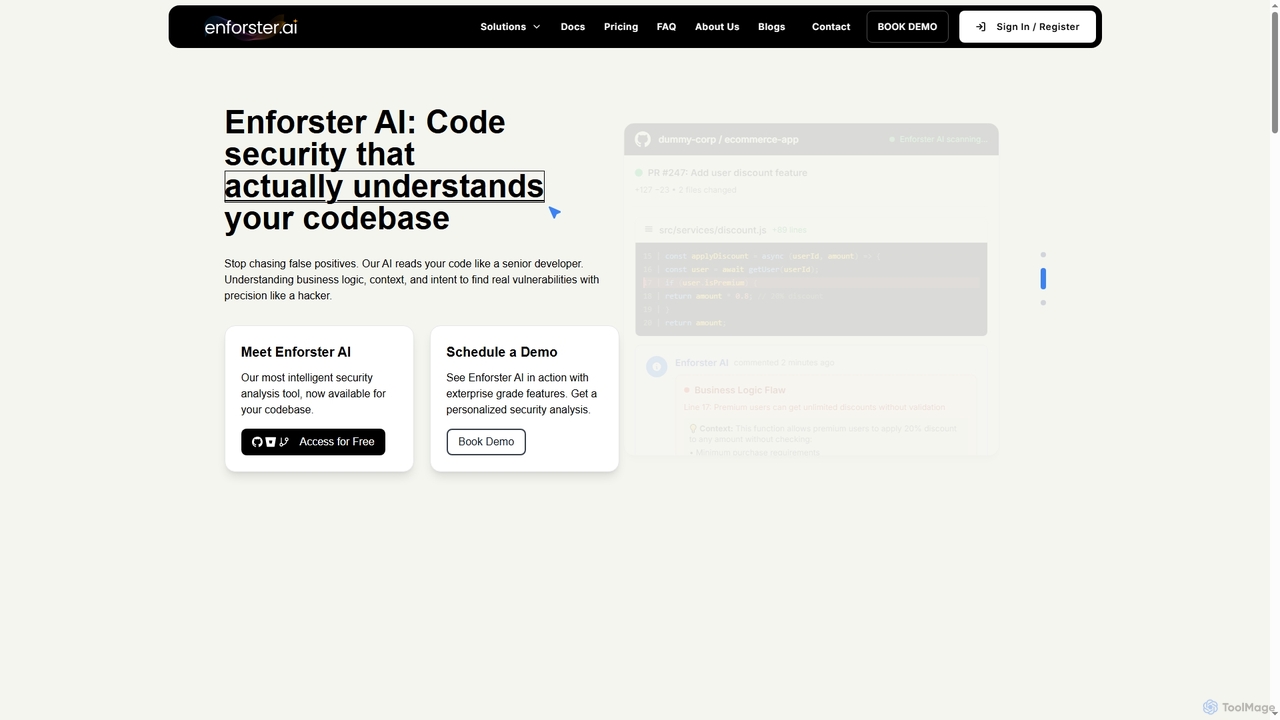
Enforster AI is an AI-native Static Application Security Testing (SAST) tool that analyzes code like a senior developer. It understands business logic and context to identify real vulnerabilities with 90% accuracy, reducing false positives by 60% and providing AI-generated fixes.

Code Analysis
Visits 4.2KFavorites 92Likes 100

About Code Analysis

Code Analysis tools are AI-powered solutions designed to automatically inspect source code for potential issues, vulnerabilities, and quality concerns without executing the program. Leveraging advanced machine learning and static analysis techniques, these tools identify bugs, security flaws, performance bottlenecks, and deviations from coding standards. They empower developers to write cleaner, more secure, and efficient code, significantly improving software reliability and reducing technical debt within the broader context of AI developer tools.

Core Features

  • Automated Bug Detection: Proactively identifies common programming errors, logical flaws, and potential runtime exceptions.
  • Security Vulnerability Scanning: Detects potential security weaknesses like SQL injection, cross-site scripting (XSS), and insecure configurations.
  • Code Quality & Style Checks: Enforces coding standards, identifies complex or redundant code, and suggests refactoring improvements.
  • Performance Optimization Suggestions: Pinpoints inefficient code patterns that could lead to performance issues.
  • Dependency Analysis: Maps out external library usage and flags known vulnerabilities in third-party components.

Use Cases

These tools are crucial for software development teams, security engineers, and quality assurance professionals. They are integrated into CI/CD pipelines to provide immediate feedback on code changes, used for auditing large legacy codebases, and essential for maintaining high standards in critical applications where security and reliability are paramount.

How to Choose

When selecting an AI Code Analysis tool, consider its language support (e.g., Python, Java, C++), the types of issues it detects (security, quality, performance), integration capabilities with your existing CI/CD pipeline and IDEs, the accuracy of its findings (minimizing false positives), and its reporting features. Scalability for large projects and customization options for specific coding standards are also important factors.

Featured tool rankings

Code Analysis use cases

1

Automated Bug Detection in Development

For software developers, integrating AI Code Analysis into their IDE or version control system allows for real-time identification of common programming errors, logical flaws, and potential runtime exceptions. This proactive approach catches bugs early in the development cycle, reducing debugging time and preventing issues from reaching production environments, thereby streamlining the overall development process.

2

Identifying Security Vulnerabilities in CI/CD

Security engineers and DevOps teams utilize AI Code Analysis within their Continuous Integration/Continuous Delivery (CI/CD) pipelines to automatically scan every code commit for security vulnerabilities. This ensures that potential threats like injection flaws, insecure configurations, or exposed sensitive data are flagged and remediated before deployment, significantly enhancing application security posture.

3

Improving Code Quality and Maintainability

Development leads and architects employ these tools to enforce consistent coding standards across teams and projects. AI Code Analysis identifies complex, redundant, or poorly structured code, offering suggestions for refactoring and improving readability. This leads to a more maintainable codebase, easier onboarding for new team members, and reduced long-term technical debt.

4

Optimizing Performance Bottlenecks

Performance engineers leverage AI Code Analysis to pinpoint inefficient algorithms, resource-intensive operations, or suboptimal database queries within the codebase. By analyzing code patterns, the tools suggest specific improvements that can significantly boost application speed and responsiveness, ensuring a smoother user experience and efficient resource utilization.

5

Refactoring Legacy Codebases

Teams working with large, aging codebases often face challenges with understanding and modifying existing code. AI Code Analysis can help by identifying dead code, suggesting modularization, and highlighting areas that are difficult to test or prone to errors. This facilitates a structured approach to refactoring, making legacy systems more manageable and extensible.

6

Ensuring Compliance with Coding Standards

For organizations with strict internal coding guidelines or industry-specific compliance requirements (e.g., MISRA for automotive, OWASP for web security), AI Code Analysis tools can be configured to automatically check for adherence. This ensures that all code produced meets necessary standards, reducing compliance risks and fostering best practices across the development lifecycle.

Code Analysis FAQ

What are AI Code Analysis tools?

AI Code Analysis tools are software solutions that use artificial intelligence, particularly machine learning and advanced static analysis, to automatically examine source code for defects, security vulnerabilities, and quality issues without running the program. They go beyond traditional rule-based analysis by learning from vast code repositories to detect more subtle and complex patterns of errors and inefficiencies.

How do AI Code Analysis tools differ from traditional static analysis?

Traditional static analysis tools primarily rely on predefined rules and patterns to identify issues. AI Code Analysis tools, while often incorporating static analysis, enhance it with machine learning. This allows them to detect more nuanced bugs, predict potential issues based on historical data, reduce false positives, and offer more intelligent suggestions for remediation, adapting to evolving code patterns.

What specific problems do AI Code Analysis tools solve for developers?

AI Code Analysis tools address several critical problems: they proactively catch bugs early, significantly reducing debugging time and costs; they identify security vulnerabilities before deployment, enhancing application security; they enforce coding standards and suggest improvements for code quality, leading to more maintainable software; and they help optimize performance by flagging inefficient code patterns.

How can AI Code Analysis be integrated into a development workflow?

AI Code Analysis tools are typically integrated at various stages of the development workflow. They can be used directly within Integrated Development Environments (IDEs) for real-time feedback, as part of version control systems (e.g., Git hooks) to review pull requests, and most commonly, within Continuous Integration/Continuous Delivery (CI/CD) pipelines to automate code quality and security checks before deployment.

What should I consider when choosing an AI Code Analysis tool?

Key considerations include the programming languages supported by the tool, its ability to integrate seamlessly with your existing development environment and CI/CD pipeline, the accuracy of its findings (minimizing false positives and negatives), the breadth of issues it can detect (bugs, security, quality, performance), its reporting and visualization capabilities, and whether it offers customizable rulesets to match your team's specific needs.