
OpenPrompt
OpenPrompt is a collaborative platform for AI prompt engineering, designed for developers and teams. It functions like a …
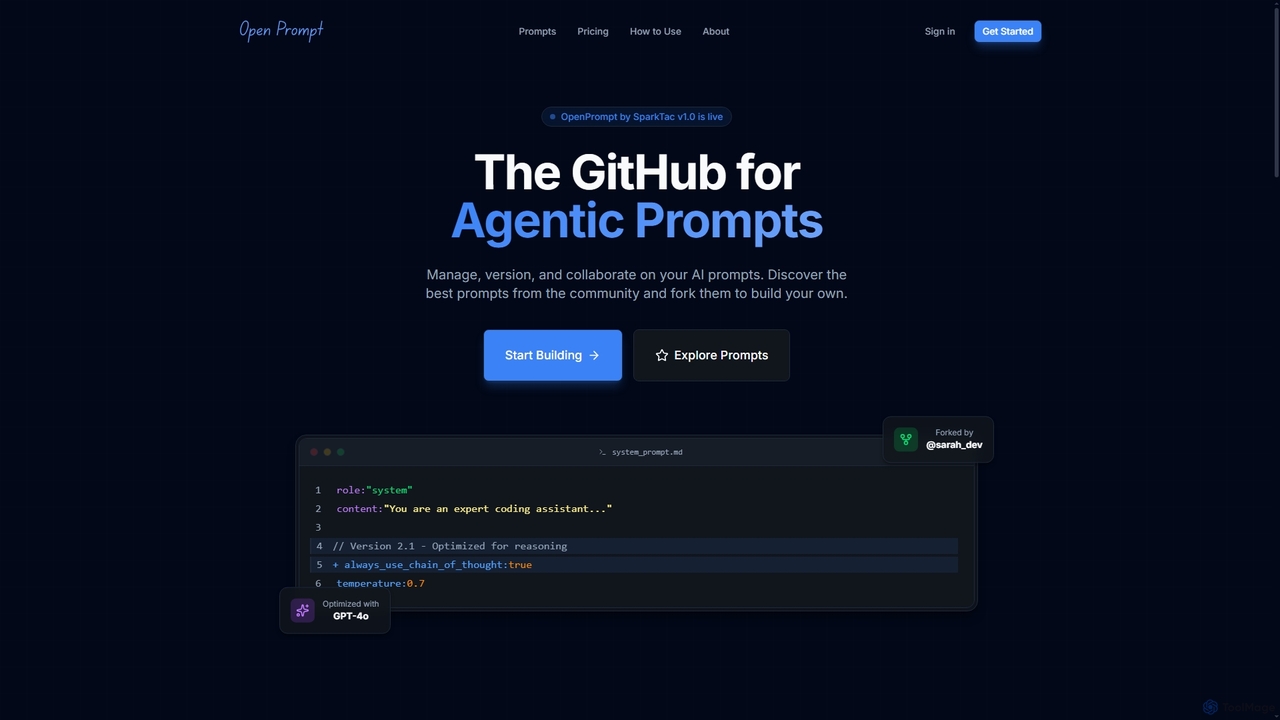
OpenPrompt is a collaborative platform for AI prompt engineering, designed for developers and teams. It functions like a GitHub for prompts, offering version control, real-time collaboration, instant forking, and API integration to manage, test, and deploy prompts efficiently.
About Prompt Management
Prompt Management tools are specialized AI developer tools designed to organize, test, version, and optimize the prompts used with large language models (LLMs). These platforms enable developers and AI practitioners to systematically manage their prompt libraries, ensuring consistent, high-quality, and efficient AI outputs. By centralizing prompt creation and iteration, they streamline the development workflow and enhance the reliability of AI applications.
Core Features
- Prompt Versioning: Track changes to prompts over time, allowing for rollbacks and historical analysis.
- Prompt Testing & Evaluation: Run prompts against test cases and evaluate outputs for quality, relevance, and bias.
- Prompt Templates & Libraries: Create reusable prompt structures and maintain a centralized repository for easy access and collaboration.
- Performance Monitoring: Analyze prompt effectiveness, token usage, and latency to identify optimization opportunities.
- Integration with LLMs: Seamlessly connect with various AI models and APIs for direct testing and deployment.
Use Cases
AI developers and researchers use prompt management tools to maintain consistency across different AI models and projects, ensuring that prompt variations are tracked and their performance is measurable. Content teams leverage them to standardize brand voice and messaging when generating content at scale, while data scientists optimize prompts for specific data extraction or analysis tasks.
How to Choose
When selecting a prompt management tool, consider its integration capabilities with your existing LLMs and development environment. Evaluate features like version control, testing frameworks, and collaboration tools. Look for robust analytics for performance monitoring and a user-friendly interface that supports your team's workflow and technical expertise. Scalability and pricing models are also crucial for long-term adoption.
Prompt ManagementUse Cases
Optimizing Prompts for Specific AI Tasks
AI engineers refine prompts for tasks like summarization or code generation, using A/B testing to find the most effective and token-efficient versions. This ensures that the AI model consistently delivers high-quality and relevant outputs while managing operational costs.
Maintaining Brand Voice in Content Generation
Marketing teams create and manage a library of brand-approved prompt templates, ensuring all AI-generated content adheres to consistent tone and style guidelines across various campaigns. This prevents off-brand messaging and maintains brand integrity at scale.
Collaborative Prompt Development
Development teams work together on complex AI applications, sharing, reviewing, and iterating on prompts within a centralized platform to accelerate project timelines and maintain quality. This fosters teamwork and ensures best practices are shared across the organization.
Ensuring Reproducibility in Research
AI researchers version control their experimental prompts, allowing them to reproduce results accurately and track the evolution of their prompt engineering strategies for academic studies. This is vital for validating findings and building upon previous experiments with confidence.
Automating Prompt Testing and Evaluation
Developers set up automated pipelines to test new prompt iterations against predefined datasets and metrics, quickly identifying regressions or improvements before deployment. This accelerates the iteration cycle and ensures only high-performing prompts are pushed to production.
Managing Prompts for Multi-Model Deployments
Enterprises deploying AI across various LLMs (e.g., OpenAI, Anthropic, custom models) use prompt management to adapt and optimize prompts for each model's nuances from a single interface. This simplifies complex multi-model strategies and ensures optimal performance across diverse AI ecosystems.