ERBuilder Data Modeler
ERBuilder Data Modeler is an AI-powered database design and data modeling tool for data architects and developers. It …
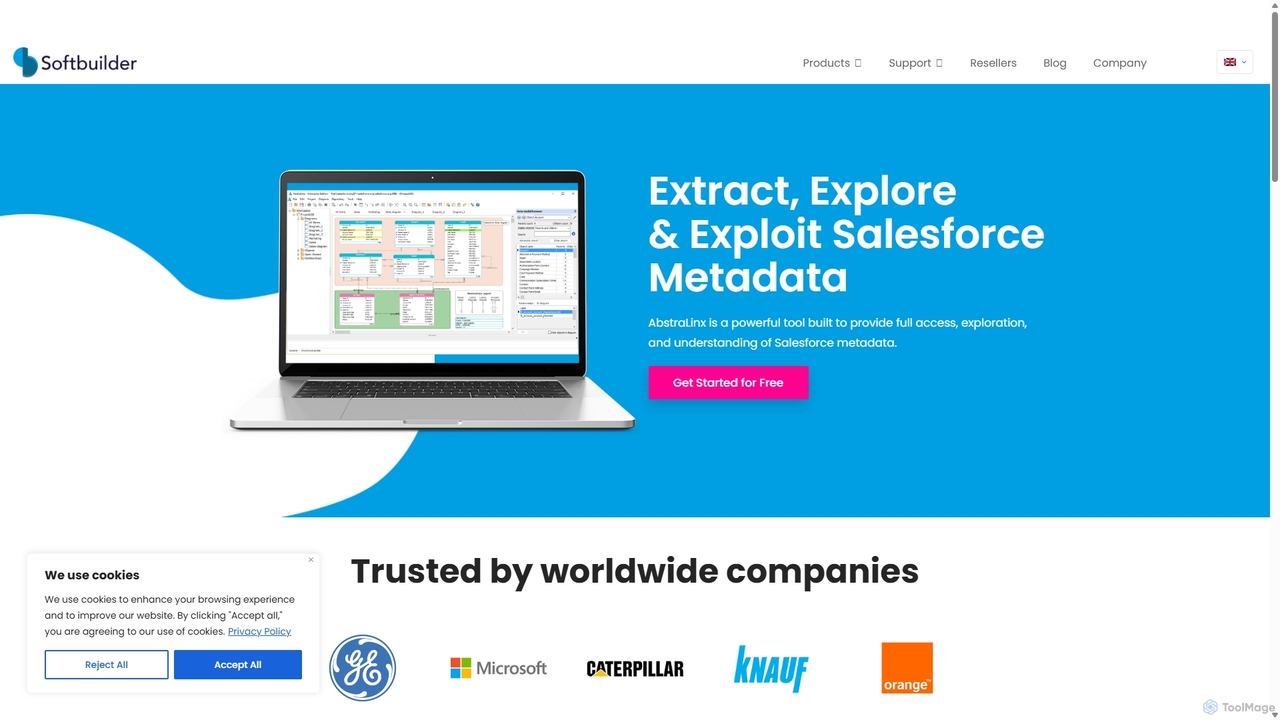
ERBuilder Data Modeler is an AI-powered database design and data modeling tool for data architects and developers. It facilitates the visual creation of Entity-Relationship Diagrams (ERDs), supports forward and reverse engineering for numerous databases, and leverages generative AI to create and update models from natural language. It also offers advanced documentation, version control, and test data generation features.
CodeSandbox
CodeSandbox is an instant cloud development environment that enables developers to build, share, and collaborate on web applications. …
CodeSandbox is an instant cloud development environment that enables developers to build, share, and collaborate on web applications. It provides scalable, secure sandboxes for any project, from quick prototypes to full-stack applications, and now features a powerful SDK for integrating code execution into AI agents.
About Code Generation
AI Code Generation tools are applications that use artificial intelligence to automatically write, complete, and refactor source code. These tools leverage large language models (LLMs) trained on vast datasets of public code to understand programming logic, syntax, and patterns across multiple languages. Their primary value is to accelerate the development lifecycle by automating repetitive coding tasks, generating boilerplate code, and providing intelligent suggestions. This allows developers to focus on high-level architecture and complex problem-solving rather than manual implementation.
Core Features
- Natural Language to Code: Translates plain text descriptions or prompts into functional code snippets, functions, or even entire classes.
- Context-Aware Autocompletion: Provides intelligent, multi-line code suggestions that understand the context of the entire file and project.
- Boilerplate and Scaffolding: Generates foundational code structures, such as project files, API endpoints, or UI components, from simple commands.
- Unit Test Generation: Automatically creates test cases for existing functions and methods to improve code coverage and reliability.
- Code Refactoring and Optimization: Analyzes existing code and suggests improvements for performance, readability, or adherence to best practices.
Use Cases
These tools are widely used by software developers, data scientists, and students. In software development, they are used for rapid prototyping, building features, and debugging. Data scientists use them to quickly generate scripts for data analysis and visualization. For learners, they serve as an interactive assistant for understanding new languages and frameworks.
How to Choose
When selecting an AI Code Generation tool, consider the following: language and framework support, quality of IDE integration (e.g., VS Code, JetBrains), the model's context awareness and suggestion accuracy, and its security policies regarding your codebase. Also, evaluate the balance between free features and the capabilities offered in paid plans.

Code GenerationUse Cases
Accelerate Application Prototyping
A startup developer needs to build a functional proof-of-concept for investors within a tight deadline. Instead of writing everything from scratch, they use an AI code generation tool. They describe the required API endpoints in plain English, and the tool generates the corresponding controller and model files in a Node.js framework. For the frontend, they describe UI components like 'a user login form with email and password fields,' and the tool produces the React component code. This approach reduces initial development time from days to hours, allowing for rapid iteration based on feedback.
Automate Unit Test Creation
A software engineer is tasked with increasing the test coverage of a legacy Java module. Manually writing unit tests for dozens of complex methods is time-consuming. Using an AI code generation tool, the engineer feeds it an existing method. The tool analyzes the code, understands its logic, inputs, and outputs, and then generates a comprehensive suite of JUnit tests. It covers standard cases, edge cases (e.g., null inputs, empty lists), and potential error conditions. This automates a significant portion of the work, ensuring code quality and reliability with minimal manual effort.
Learning a New Programming Language
A developer with a strong background in Python wants to learn Rust for a new project. They use an AI code generation tool as a learning companion. When they're unsure how to implement a concept like 'ownership' or 'borrowing' in Rust, they can ask the tool for an example. They can also provide a Python code snippet and ask the tool to translate it into idiomatic Rust code. The tool not only provides the code but often includes explanations of the syntax and concepts, accelerating the learning process and helping them write better, more efficient Rust code from the start.
Generating Complex SQL Queries
A business analyst needs to pull a specific dataset for a quarterly report, which requires a complex SQL query with multiple joins, filters, and aggregations. While proficient in data analysis, their SQL skills are intermediate. They use an AI code generation tool and type a natural language prompt like: 'Show me the total sales per product category for customers in North America who registered after January 1, 2023, grouped by category and sorted by total sales descending.' The tool translates this request into a well-structured and optimized SQL query, saving the analyst time and preventing potential syntax errors.
Refactoring and Documenting Legacy Code
A maintenance team inherits a large Ccodebase with inconsistent coding styles and minimal documentation. To improve maintainability, they use an AI code generation tool. They select a poorly written function, and the tool suggests refactoring it for clarity and efficiency, for example, by replacing a complex nested loop with a LINQ expression. After applying the changes, they use the same tool to generate comprehensive XML documentation comments (docstrings) for the refactored function. This process systematically improves code quality and makes the codebase easier for new developers to understand.
Creating Scripts for Data Analysis
A data scientist is exploring a new dataset in a Jupyter Notebook. They need to perform several data cleaning and visualization tasks. They use an AI code generation assistant integrated into their environment. They type comments like 'Load the CSV file and drop rows with missing values' or 'Create a scatter plot of column A vs column B with a regression line'. The AI assistant generates the corresponding Python code using libraries like Pandas and Matplotlib. This allows the scientist to maintain a high-level thought process focused on analysis, rather than getting bogged down in the specific syntax of library functions.