Apify
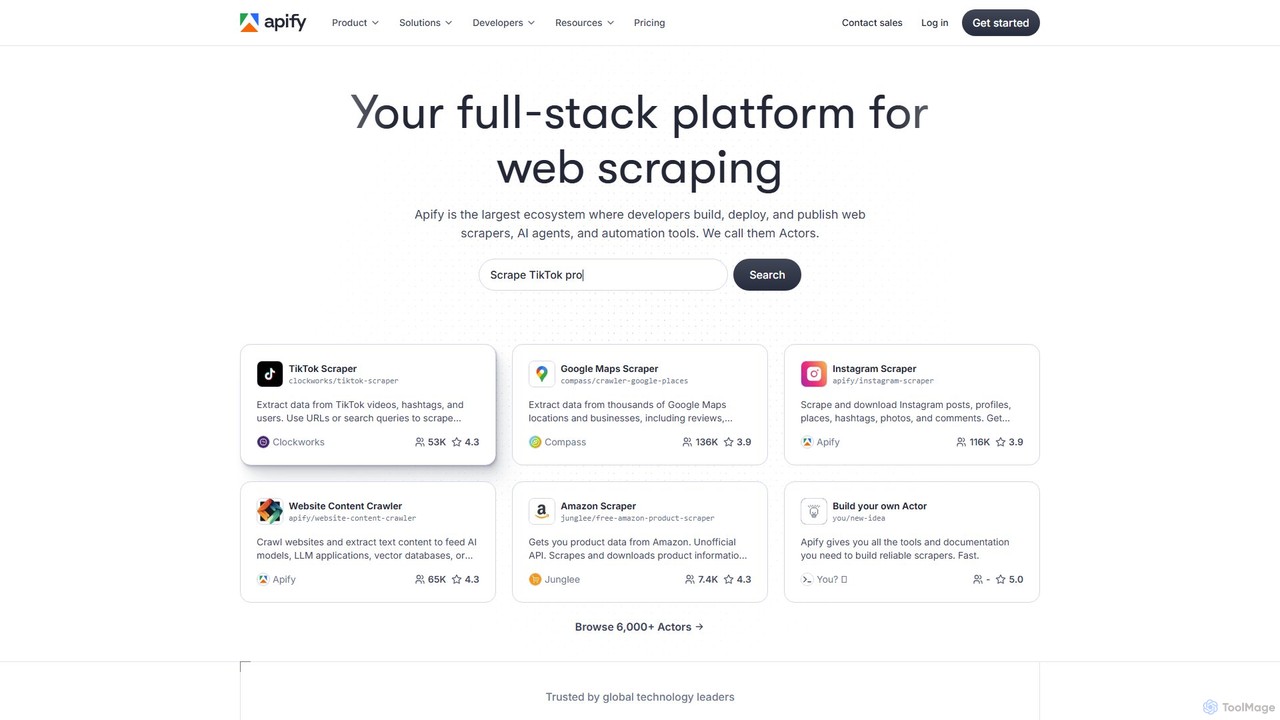
Apify is a full-stack web scraping and automation platform that enables developers to build, deploy, and publish data …
Apify is a full-stack web scraping and automation platform that enables developers to build, deploy, and publish data extraction tools, known as 'Actors'. It offers a vast marketplace of pre-built scrapers for popular websites like Google Maps, Instagram, and TikTok, alongside a robust cloud infrastructure for creating custom solutions. With support for Python and JavaScript, open-source libraries, and seamless integrations, Apify simplifies collecting web data at any scale.
About Data Collection
Data Collection tools are a class of AI-powered software designed to automate the process of gathering, extracting, and structuring information from diverse sources. These tools leverage technologies like Natural Language Processing (NLP) and computer vision to intelligently identify and pull relevant data from unstructured formats such as websites, documents, and images. They are crucial for building high-quality datasets for training machine learning models, conducting market research, and populating business intelligence systems. As a key component of AI Developer Tools, they provide the foundational data necessary for any successful AI project.
Core Features
- Intelligent Web Scraping: Uses AI to navigate dynamic websites, handle anti-bot measures, and extract data even when page layouts change.
- Unstructured Data Extraction: Employs NLP and OCR to pull specific information like names, prices, or dates from plain text, PDFs, and images.
- Automated Data Structuring: Automatically organizes extracted information into clean, structured formats like JSON or CSV, ready for analysis.
- Scheduled & Real-time Collection: Allows users to configure recurring data gathering tasks or capture information as it becomes available in real-time.
Use Cases
These tools are widely used by data scientists, machine learning engineers, and market analysts. Common applications include building custom datasets for model training, monitoring competitor pricing in e-commerce, aggregating financial news for sentiment analysis, and gathering property listings for real estate market analysis.
How to Choose
When selecting a Data Collection tool, consider its compatibility with your target data sources (websites, APIs, documents). Evaluate its scalability for handling the required data volume and its ease of use—whether it's a no-code platform or a developer-focused API. Also, assess the quality of its data cleaning and formatting features to ensure the output meets your needs.

Data CollectionUse Cases
E-commerce Price and Competitor Monitoring
An e-commerce manager needs to track daily pricing, stock levels, and promotions from dozens of competitor websites. Instead of spending hours manually checking each site, they configure an AI data collection tool. The tool is set to run every morning, automatically navigating to product pages, extracting key data points like price and availability, and handling any website structure changes. The result is a structured CSV file delivered to their inbox, providing actionable competitive intelligence and enabling dynamic pricing strategies, all with minimal human effort.
Building a Custom Dataset for Machine Learning
A machine learning engineer is tasked with building a sentiment analysis model for hotel reviews. They need a large, diverse dataset of reviews with corresponding ratings. Using an AI data collection tool, they target several major travel review websites. The tool is configured to crawl thousands of hotel pages, use NLP to identify and extract the full review text and the star rating, and then structure this data into a labeled dataset. This process automates what would be months of manual data gathering, providing a clean, high-quality dataset ready for model training in just a few days.
Automated Lead Generation for Sales Teams
A sales operations team needs to build a targeted list of potential clients from online industry directories and professional networks. They use a data collection tool to automate this research. They define the criteria, such as 'VP of Engineering' at 'SaaS companies in California'. The AI tool then crawls the specified websites, identifies individuals and companies matching the profile, and extracts contact information like names, titles, and company URLs. This transforms a tedious manual process into an automated workflow, consistently feeding the sales pipeline with high-quality, relevant leads.
Real Estate Market Trend Analysis
A real estate investment firm wants to analyze housing market trends in a specific metropolitan area. They need comprehensive data on property listings, including prices, square footage, location, and days on the market. An AI data collection tool is deployed to scrape data from multiple major real estate portals daily. The tool intelligently extracts and standardizes data from different site layouts into a single, unified database. This provides the firm's analysts with a continuous stream of up-to-date market data, enabling them to build predictive models, identify investment opportunities, and advise clients more effectively.
Aggregating News for Financial Sentiment Analysis
A quantitative hedge fund relies on real-time news to inform its trading algorithms. A data collection tool is set up to monitor hundreds of financial news websites, press release wires, and regulatory filing portals. As soon as a new article or document is published, the tool fetches its content and feeds it directly into an NLP pipeline for sentiment analysis. This high-speed, automated data aggregation is critical for strategies that capitalize on market reactions to news, providing a significant advantage over manual monitoring.
Academic Research and Literature Review
A university researcher is conducting a meta-analysis that requires data from thousands of published scientific papers across multiple databases. Manually downloading and extracting metadata (authors, publication dates, abstracts) is unfeasible. They use a data collection tool to systematically query academic portals like PubMed and arXiv. The tool automates the process of finding relevant papers based on keywords, downloading them, and extracting the required metadata into a structured spreadsheet. This drastically accelerates the literature review phase, allowing the researcher to focus on analysis rather than data collection.