
hanabitech
Hanabi Technologies is a global software development agency specializing in building custom, AI-powered solutions. They leverage modern JavaScript/TypeScript …
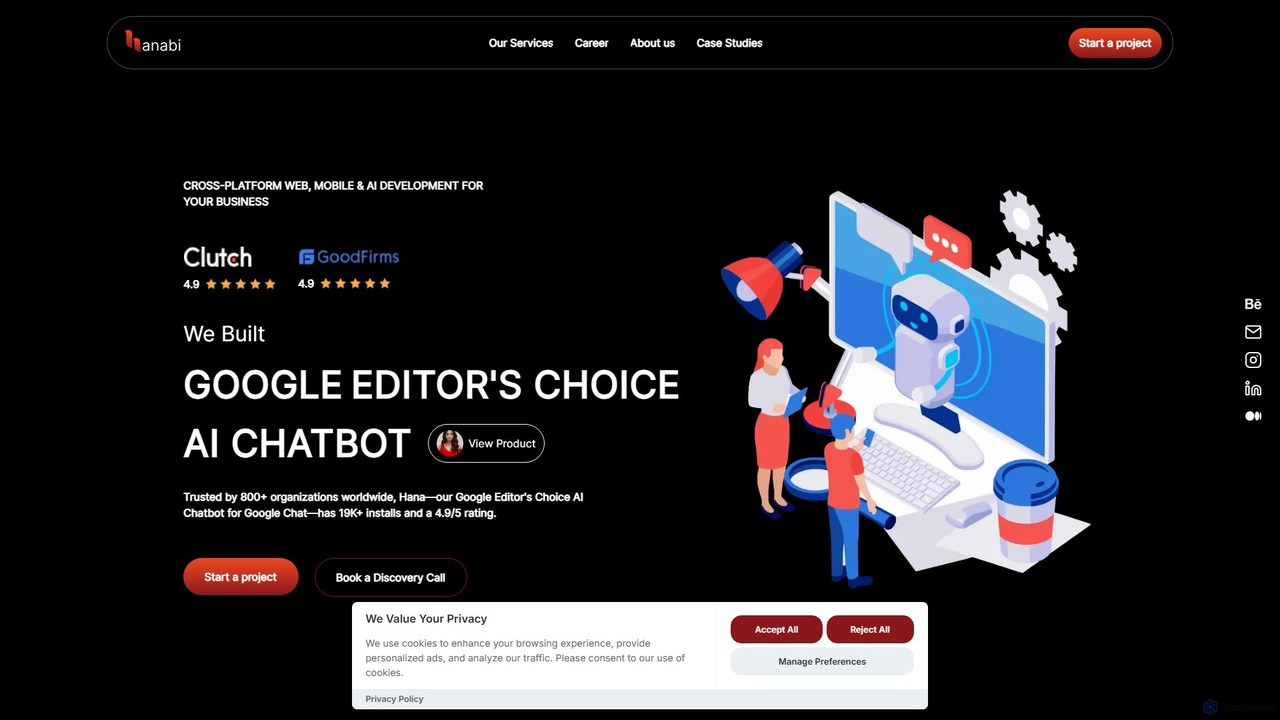
Hanabi Technologies is a global software development agency specializing in building custom, AI-powered solutions. They leverage modern JavaScript/TypeScript stacks (React, Node.js) and advanced AI technologies like GPT-4 and Langchain to create secure, scalable web, mobile, and desktop applications. They offer end-to-end services from design to deployment, ensuring full code ownership and transparent, flexible engagement models for businesses worldwide.
About Custom Models
Custom Models are a specialized category within AI developer tools, enabling the creation of AI models precisely tailored to unique datasets, specific business logic, or niche domain requirements. Unlike general-purpose AI, these models are trained or fine-tuned with proprietary data, allowing for unparalleled accuracy and performance in highly specific tasks. They empower developers to build AI solutions that address challenges where off-the-shelf models fall short, providing a distinct competitive advantage.
Core Features
- Data Ingestion & Preprocessing: Tools for efficiently collecting, cleaning, and transforming proprietary datasets for model training.
- Model Training & Fine-tuning: Capabilities to train AI models from scratch or adapt existing pre-trained models using custom data.
- Performance Monitoring & Evaluation: Systems to track model metrics, identify biases, and ensure optimal performance in specific operational environments.
- Deployment & Integration: Facilitates seamless deployment of custom models into existing applications, cloud platforms, or edge devices via APIs and SDKs.
- Version Control & Experiment Tracking: Manages different model iterations, training configurations, and experimental results for reproducibility and improvement.
Applicable Scenarios
Custom models are essential for industries requiring high precision and domain-specific intelligence. This includes healthcare for specialized diagnostics, finance for unique fraud detection patterns, and manufacturing for bespoke quality control systems. They are also vital for e-commerce platforms seeking highly personalized recommendation engines based on proprietary user behavior data.
How to Choose
When selecting custom model tools, consider their data handling capabilities for diverse formats, the flexibility in training algorithms and architectures, and scalability for growing datasets. Evaluate integration options with your existing MLOps pipelines and deployment environments, along with the cost-effectiveness of training and inference for your specific use case. Technical support and community resources are also important for complex development.
Custom ModelsUse Cases
Personalized E-commerce Product Recommendations
An e-commerce platform uses custom models to analyze proprietary customer browsing history, purchase patterns, and product interactions. By training a model on this unique dataset, they can generate highly personalized product recommendations that significantly outperform generic suggestions, leading to increased conversion rates and customer satisfaction. This allows for a unique shopping experience tailored to each individual user's preferences.
Specialized Medical Image Analysis for Rare Conditions
Hospitals and research institutions develop custom computer vision models to detect rare medical conditions or subtle anomalies in imaging data (e.g., X-rays, MRIs) that general AI models might miss. By training these models on small, highly curated datasets of specific cases, they achieve superior diagnostic accuracy, aiding early detection and improving patient outcomes for niche diseases.
Domain-Specific Chatbots for Enterprise Support
Large enterprises fine-tune foundational language models with their extensive internal knowledge bases, product documentation, and customer interaction logs. This creates a custom chatbot that understands company-specific jargon, policies, and complex product queries, providing more accurate and relevant support than a generic AI, significantly reducing the workload on human support agents and improving resolution times.
Automated Quality Control in Manufacturing
A manufacturing plant trains a custom computer vision model on images of its specific product defects (e.g., scratches, misalignments, color variations unique to their production line). This model can then automatically inspect every item on the assembly line with high accuracy, identifying flaws that might be too subtle for human eyes or too time-consuming to manually check, ensuring consistent product quality and reducing waste.
Financial Fraud Detection for Niche Markets
Financial institutions operating in specialized markets (e.g., microfinance, specific commodity trading) develop custom models to detect fraudulent activities unique to their transaction types and customer demographics. Generic fraud detection systems often fail to adapt to these niche patterns, making custom models crucial for accurately identifying and preventing financial crimes in highly specific contexts, protecting both the institution and its clients.
Custom Content Moderation for Unique Community Guidelines
Social media platforms or online communities with highly specific and nuanced content policies train custom AI models to moderate user-generated content. These models learn to identify violations that are unique to their community standards (e.g., specific types of hate speech, misinformation, or brand-specific inappropriate content) with greater accuracy and consistency than general-purpose moderation tools, ensuring a safer and more compliant online environment.